


Some error occured while loading the Quick View. Please close the Quick View and try reloading the page.
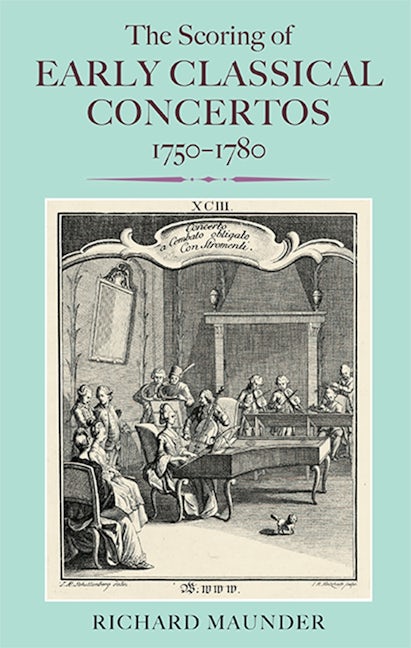
The sequel to Richard Maunder's The Scoring of Baroque Concertos
In the baroque era most concertos were - in the modern sense of the term - chamber music, to be played by a small group of musicians each reading from an individual printed or manuscript part. Indeed, composers often expected thesoloist to be accompanied by just a string quartet with a harpsichord or organ continuo. But over the thirty years from 1750, as the classical style was being developed, numbers began to rise slowly. This did not happen at a uniform rate throughout Europe, however, for many concertos continued to be played one-to-a-part, and even by 1780 an ensemble with more than eight or nine strings would have been unusual. The nineteenth-century notion that a concertopitted a lone soloist against a full symphony orchestra still lay some years in the future.
At the same time ideas about form were changing, as the Vivaldian ritornello pattern metamorphosed into the concerto-sonata form usedby Mozart and his contemporaries; some unconventional variants appeared as composers strove to keep abreast of latest developments. It was a fascinating period of innovation, in which many hundreds of concertos were written. To be sure, not all of them can be described as "forgotten masterpieces", but among them there are some very fine works that certainly ought to be revived. It is hoped that readers of this book may be encouraged to explore this comparatively neglected repertoire.
The late RICHARD MAUNDER was a Fellow of Christ's College, Cambridge. His previous book, The Scoring of Baroque Concertos, was published by The Boydell Press in 2004. He has also published books on Mozart's Requiem, Keyboard Instruments in Eighteenth-Century Vienna and numerous editions of seventeenth- and eighteenth-century music.
In the baroque era most concertos were - in the modern sense of the term - chamber music, to be played by a small group of musicians each reading from an individual printed or manuscript part. Indeed, composers often expected thesoloist to be accompanied by just a string quartet with a harpsichord or organ continuo. But over the thirty years from 1750, as the classical style was being developed, numbers began to rise slowly. This did not happen at a uniform rate throughout Europe, however, for many concertos continued to be played one-to-a-part, and even by 1780 an ensemble with more than eight or nine strings would have been unusual. The nineteenth-century notion that a concertopitted a lone soloist against a full symphony orchestra still lay some years in the future.
At the same time ideas about form were changing, as the Vivaldian ritornello pattern metamorphosed into the concerto-sonata form usedby Mozart and his contemporaries; some unconventional variants appeared as composers strove to keep abreast of latest developments. It was a fascinating period of innovation, in which many hundreds of concertos were written. To be sure, not all of them can be described as "forgotten masterpieces", but among them there are some very fine works that certainly ought to be revived. It is hoped that readers of this book may be encouraged to explore this comparatively neglected repertoire.
The late RICHARD MAUNDER was a Fellow of Christ's College, Cambridge. His previous book, The Scoring of Baroque Concertos, was published by The Boydell Press in 2004. He has also published books on Mozart's Requiem, Keyboard Instruments in Eighteenth-Century Vienna and numerous editions of seventeenth- and eighteenth-century music.

Price: $85.00
Pages: 304
Publisher: Boydell & Brewer Inc.
Imprint: Boydell Press
Publication Date:
20 March 2014
Trim Size: 9.21 X 6.14 in
ISBN: 9781843838937
Format: Hardcover
BISACs:
MUSIC / Genres & Styles / Classical, Art music, orchestral and formal music

A useful volume for those researching . . . late eighteenth-century instrumental repertoires.
Introduction
Northern and Central Germany
Italy
Vienna
Salzburg
The South German Courts
Paris
England
Bibliography
Northern and Central Germany
Italy
Vienna
Salzburg
The South German Courts
Paris
England
Bibliography