


Some error occured while loading the Quick View. Please close the Quick View and try reloading the page.
Finalist, 2025 Frances Fuller Victor Award in General Nonfiction, Oregon Book Awards
Honorable Mention, 2024 William Sanders Scarborough Prize, Modern Language Association
One Sunday afternoon in February 1977, Toni Morrison, Alice Walker, Ntozake Shange, and several other Black women writers met at June Jordan’s Brooklyn apartment to eat gumbo, drink champagne, and talk about their work. Calling themselves “The Sisterhood,” the group—which also came to include Audre Lorde, Paule Marshall, Margo Jefferson, and others—would get together once a month over the next two years, creating a vital space for Black women to discuss literature and liberation.
The Sisterhood tells the story of how this remarkable community transformed American writing and cultural institutions. Drawing on original interviews with Sisterhood members as well as correspondence, meeting minutes, and readings of their works, Courtney Thorsson explores the group’s everyday collaboration and profound legacy. The Sisterhood advocated for Black women writers at trade publishers and magazines such as Random House, Ms., and Essence, and eventually in academic departments as well—often in the face of sexist, racist, and homophobic backlash. Thorsson traces the personal, professional, and political ties that brought the group together as well as the reasons for its dissolution. She considers the popular and critical success of Sisterhood members in the 1980s, the uneasy absorption of Black feminism into the academy, and how younger writers built on the foundations the group laid. Highlighting the organizing, networking, and community building that nurtured Black women’s writing, this book demonstrates that The Sisterhood offers an enduring model for Black feminist collaboration.


One of "30 books we can’t wait to read this fall"
A "Must-Read Book" of Fall 2023
An LJ Review Editors' Fall Pick
One of the "Best Black History Books of 2023"
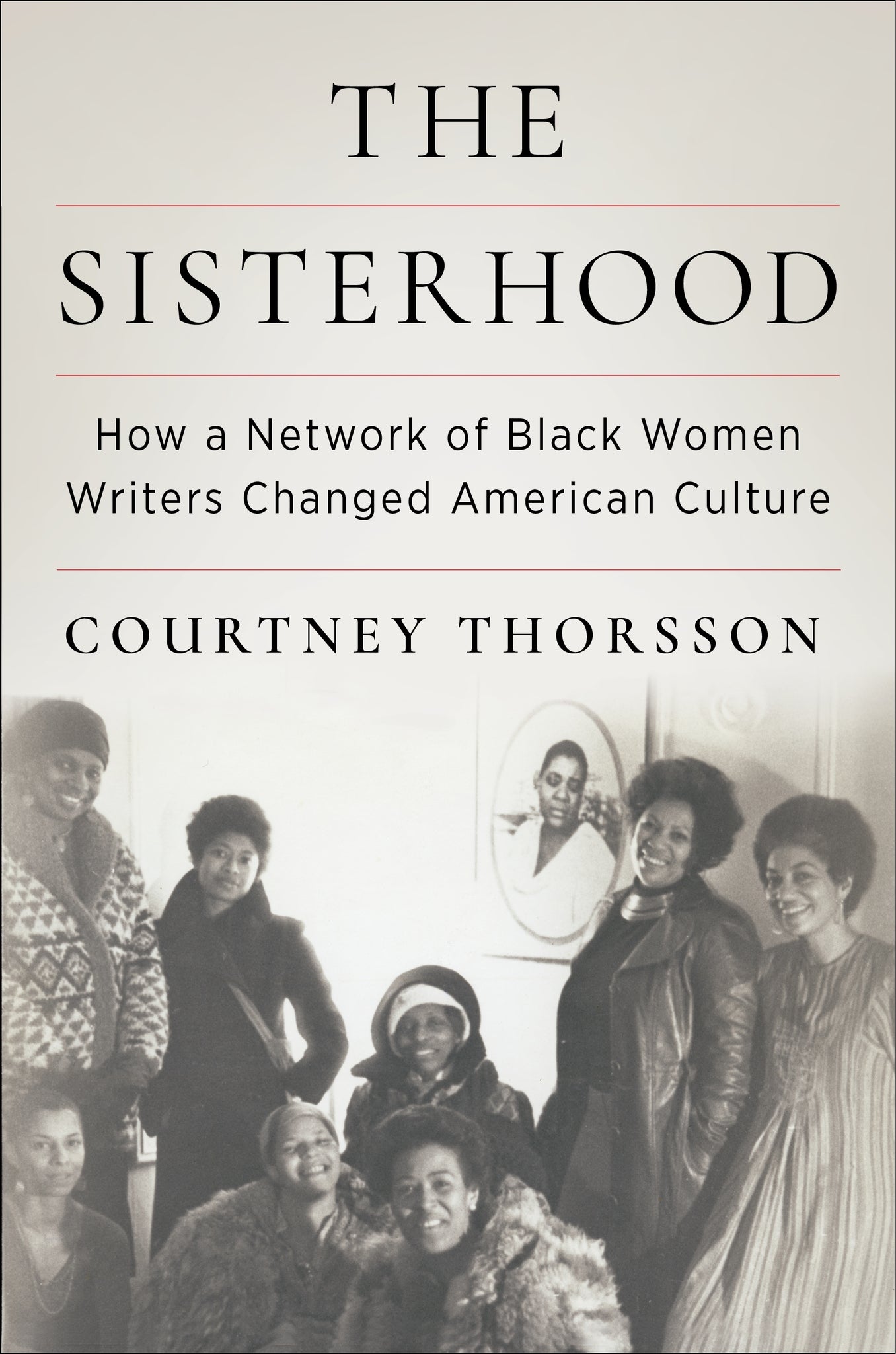
Starting with a photograph, Courtney Thorsson brings her all to this luminous work about The Sisterhood, a group of Black women writers who met informally in the 1970s. Together they transformed American literature and helped to shape generations of writers, visual artists, filmmakers, and scholars. This is a profoundly important story, and it has found an astute and sensitive author in Thorsson.
— Farah Jasmine Griffin, author of In Search of a Beautiful Freedom: New and Selected Essays
If a picture is worth a thousand words, then the photograph that inspired Courtney Thorsson’s immensely perceptive The Sisterhood should be valued in the millions. The Black women who made up The Sisterhood represented the greatest creative minds of the last half century. Today we see them as literary ‘Super Friends,’ but back in 1977 many were struggling artists whose friendship, generosity, and support for one another enabled them all to fly. And the literary, cultural, political, and academic worlds we now inhabit are better for it.
— Robin D. G. Kelley, author of Thelonious Monk: The Life and Times of an American Original
Proceeding from an archive of one iconic photograph of The Sisterhood, 1977, Courtney Thorsson has pieced together the story of how Black women writers, in intimate and collaborative gatherings throughout New York in the 1970s, created literary history. It is an indispensable, fascinating, and original history and one that might have been lost without Thorsson’s loving and meticulous archival work.
— Mary Helen Washington, author of The Other Blacklist: The African American Literary and Cultural Left of the 1950s
The Sisterhood offers an indispensable history of Black women’s writing and organizing. Thorsson’s painstakingly researched story of The Sisterhood reaches far beyond the now-famous 1977 photo on the book's cover. In these tenderly written pages, Thorsson reveals an entire history of contemporary Black feminism and the writers, editors, organizers, and dreamers who shepherded it. This is an essential contribution to Black feminist thought and American literary history.
— Erica R. Edwards, author of The Other Side of Terror: Black Women and the Culture of US Empire
Richly detailed . . . A well-documented contribution to Black literary history.
A scintillating snapshot of a significant moment in American literature.
A fascinating, empowering look at how Black women writers collaborated to move their own needle in the publishing industry and academia.
The Sisterhood is an important record of what the Sisterhood was — and the work it did . . . Highly recommended, for everyone.
— Jacqueline Nyathi
Thorsson makes a strong case for the afterlife of [the Sisterhood’s] work and advocacy . . . The strength of [this book] is [its] ability to take us back in time and to share with us those quieter moments . . . that nurtured a close-knit community and transformed society.
— Harvey Young
Highly recommended.
Provides a fascinating glimpse into a social and intellectual network that we are still discovering but may never fully know.
Through its exploration of solidarity, activism, and intellectual collaboration, the book enriches our understanding of Black feminist thought, the history of Black women’s literary contributions, and the intersections of race and gender.
In these rich archival studies, Thorsson remind[s] us of the powerful work of public intellectuals in two historical moments.
The Sisterhood’s story has long needed a sustained telling, and Thorsson provides just that, in literary history done right.
An exemplar of archival research in African American literature. It is a noteworthy contribution to the herstory of June Jordan, Alice Walker, Toni Morrison, Ntozake Shange, and Toni Cade Bambara.
Beautifully written in lucid and accessible prose, it recovers the untold story of this illustrious collective and demonstrates how their collaborative and often invisible work transformed publishing and higher education.
Brilliant.
Outstanding.
Thorsson demonstrates why Black women’s e orts to exert agency over their literary production, in the face of internal and external pressures, mattered then and matters now.
A timely, noteworthy, and engrossing addition to the corpus of work in Black feminist politics, African American literature, and US history.
Introduction
1. “Revolution Is Not a One-Time Event”
2. “An Association of Black Women Who Are Writers/poets/artists”
3. “To Move the Needle in Black Women’s Lives”
4. “A Community of Writers Even if They Only Slap Five Once a Month”
5. “A Regular Profusion of Certain / Unidentified Roses”
6. “The Function of Freedom Is to Free Somebody Else”
7. “Making Use of Being Used”
Conclusion
Acknowledgments
Permissions
Appendix 1. Members of The Sisterhood
Appendix 2. Meetings of The Sisterhood
Notes
Index