


Some error occured while loading the Quick View. Please close the Quick View and try reloading the page.
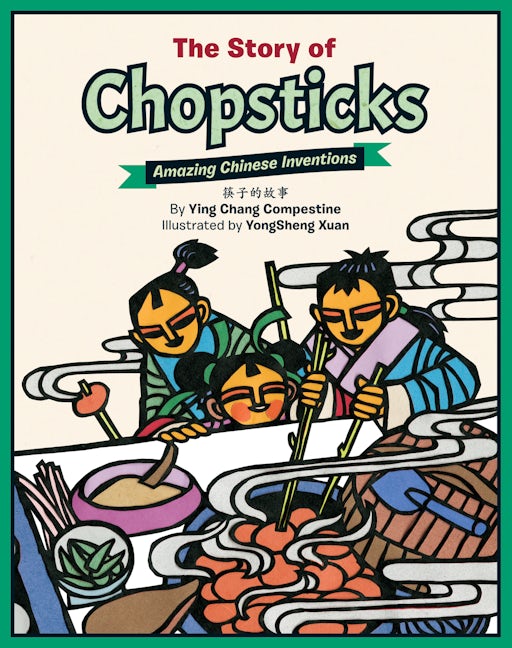
Learn how the three fun-loving Kang brothers created chopsticks, one of China’s most famous inventions! This colorfully redesigned edition features a new bilingual Chinese translation.
The three playful and creative Kang brothers (Ting, Pan, and Kùai) discovered four of China's most famous discoveries in the series Amazing Chinese Inventions. In this adventure, the youngest boy Kùai never gets enough to eat. One day Kùai comes up with a plan: he is inspired to use sticks to grab food quickly while it's too hot for Ting and Pan. What will his family think?
When the Kang family attends a wedding banquet, Kai brings his chopsticks... to everyone's great surprise! When the whole village finds out, then what will the Emperor think? The story features an author’s note on the history of chopsticks and a delicious dessert recipe, ideal for eating with chopsticks.
This fanciful blend of fact and imagination brings Asian culture alive for young readers. Children will enjoy the bright and bold artwork, created in the traditional Chinese style of hand cut, colored paper. Parents will enjoy the ingenuity of the main characters who teach adults a thing or two about inventiveness.
Teachers and librarians like the storybook’s historical references and how it features a bilingual translation in simplified Chinese - ideal for language classes, programs, and schools.
“Like the hues in a stained glass window, [the illustrations] look brilliant...this well-designed book will please children in the primary grades."
- ALA Booklist


- Resource Links
"[The series Amazing Chinese Inventions provides] an important intervention into the existing literature by foregrounding Chinese characters as the main protagonists rather than as supporting or marginal characters in their narratives. Although these books take place in historical China, they do resist stereotypical representations by, for example, depicting Kùai and his brothers as ordinary kids who can misbehave like anyone else. Similarly, the books’ representations of Chinese cultural practices, such as their food and customs, would not be particularly foreign to readers. Even for readers who may have limited knowledge of China, these books demystify these cultural references and make them more accessible to readers in various ways."
- CM magazine
""Bold and beautiful cut-paper design in bright colors resembling stained glass, instantly draws our attention." - In Culture Parent
YongSheng Xuan illustrated the four volume "Story of" series. Educated at the renowned Central Arts and Crafts University in Beijing, China, he lives in Vancouver, Canada. His art has exhibited worldwide and appeared in Cricket magazine. His website is www.ysxuan.com.