


Some error occured while loading the Quick View. Please close the Quick View and try reloading the page.
—Dr. Madeleine K. Albright, former U.S. Secretary of State
Are there limits to American power? The neoconservative brain trust behind the Bush administration's foreign policy doesn't seem to recognize any. For the first time, we have people in power who believe that as the world's reigning superpower, America can do what it wants, when it wants, without regard to allies, costs, or results. But as events in Iraq are proving, America may be powerful, but it is not all-powerful.
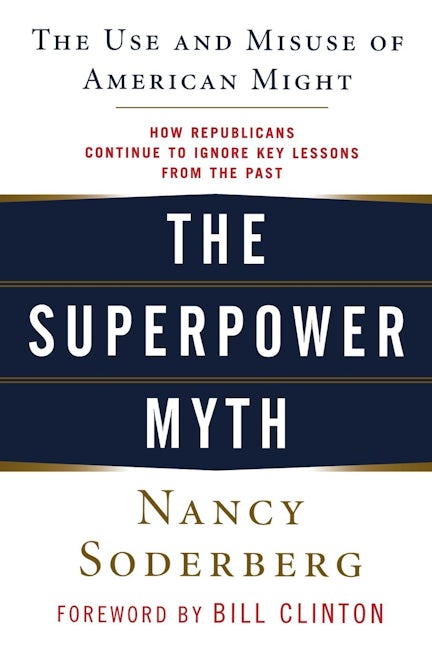
In practice, no country could ever be strong enough to solve problems like Somalia, Kosovo, Afghanistan, and Iraq through purely military means. In the future, America's power will constantly be called up to help failed and failing states, and it is becoming clear that the complex mess of Somalia has replaced the proxy war of Vietnam as the model for what future military conflicts will look like: a failed state, a power vacuum, armed factions, and enough chaos to panic an entire region. Using vivid examples from her years in the White House and at the United Nations, Nancy Soderberg demonstrates why military force is not always effective, why allies and consensus-building are crucial, and how the current administration's faulty world view has adversely affected policies toward Israel, Iraq, North Korea, Haiti, Africa, and Al-Qaeda. Powerful, provocative, and persuasive, this timely book demonstrates that the future of America's security depends on overcoming the superpower myth.


One of the greatest strengths of Soderberg's book is her insider's account of many of the seminal events of the 1990s. From 1993-96, Soderberg was a high-ranking official on President Clinton's National Security Council (where I also worked from 1993 to early 1994). She then served as a U.S. ambassador to the United Nations until 2001. These perches gave Soderberg a bird's-eye view of such critical issues as intervention in the Balkans and Haiti and U.S. efforts to combat al Qaeda and hunt down Osama bin Laden. Although she is sometimes a bit too easy on her former bosses, her narrative provides valuable material on the considerations and personalities that shaped policy. While her accounts do not offer stunning revelations, they do provide important new detail, illuminating, for example, the tortured debates over intervention in Bosnia and Clinton's effort to overcome the post-Vietnam aversion to limited war. (The Washington Post, April 3, 2005)
Unilateral big-stick carrying may seem well and good to the "hegemons" in the Bush administration, writes erstwhile Clinton advisor Soderberg, but it hasn't made the world safer or better.
In the tradition of Clinton and other Democratic leaders (John Kerry comes to mind), the author argues that the way for the White House to win friends and influence people abroad is to build strong international alliances and share the burden of promoting peace and order with our partners. The Bush administration had the chance to extend the Clinton approach in addressing recent events, she continues, and did so to some extent in Afghanistan. But it chose to do otherwise after the fall of the Taliban. The present administration's insistence on going to war in Iraq "will prove to be a test of the myth of the hegemon's view of America's role as a superpower," writes Soderberg, who contends that going it alone in the modern world leads to isolation and the accumulation of enemies. The Superpower Myth has some interesting moments, as when the author recounts the 1993 attack on American soldiers in Somalia so ably depicted in Mark Bowden's Black Hawk Down (1999). Soderberg describes a livid Bill Clinton demanding to know what had gone wrong, letting a few heads roll as a result, then taking charge of his own foreign policy. Lessons learned: Don't allow Pentagon types to go unquestioned, and don't allow the United Nations to lead American troops into battle. The second lesson has become an article of rhetorical faith among politicos, but the first has been lost on the onetime cold warriors of Ford and Reagan vintage who now serve Bush II. The point is well taken, but Soderberg's arguments swim in a sea of dreary detail; her narrative is less a book than an extended white paper, with all the requisite problem-describing, pundit-quoting, and policy-recommending.
May set a think-tank denizen's pulse racing, but won't do much for general readers with a concern for America's role in the world. (Kirkus Reviews, December 1, 2004)