


Some error occured while loading the Quick View. Please close the Quick View and try reloading the page.
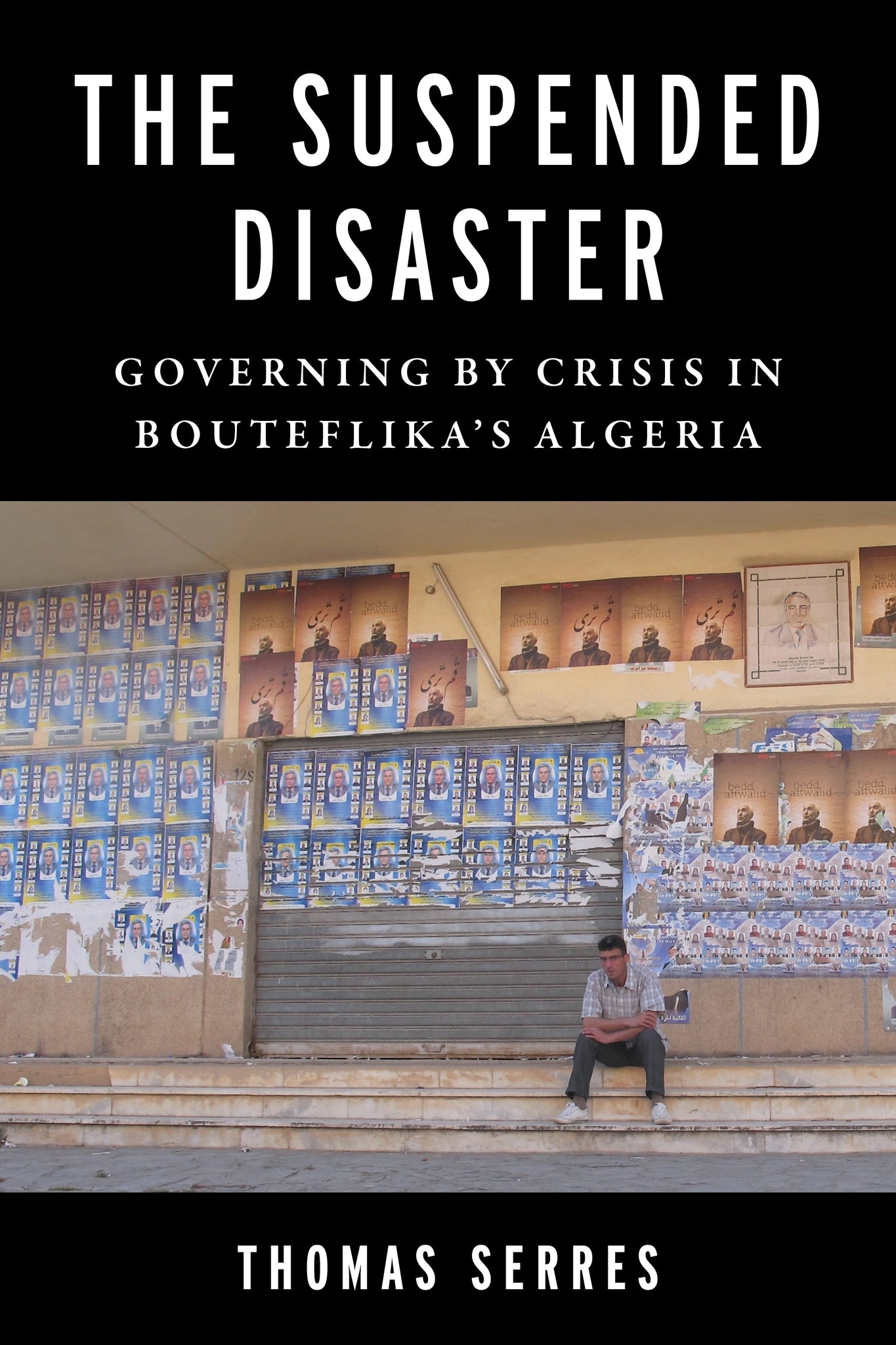
After Algeria’s president Abdelaziz Bouteflika announced his intention to run for a fifth term in early 2019, a popular peaceful uprising erupted calling for change. Bouteflika, who had been in office since 1999, was eventually forced to resign, but the Hirak (“movement”) continued to protest the country’s inequalities and entrenched ruling elite.
The Suspended Disaster examines the dynamics of the Algerian political system, offering new insights into the last years of Bouteflika’s rule and the factors that shaped the emergence of an unexpected social movement. Thomas Serres argues that the Algerian ruling coalition developed a mode of government based on the management of a seemingly never-ending crisis, marked by an obsession with security and the ever-present possibility of unrest, violence, and economic collapse. Identifying this form of rule as “governance by catastrophization,” he shows how attempts to preserve the status quo through emergency policies and constant reforms can also lay the groundwork for a revolutionary situation. Serres contrasts the government’s portrayal of perpetually imminent disaster with the uncertainty, precarity, and indignity experienced by much of the population, which fueled the rejection of ruling elites, a profound mistrust toward institutions, and new spaces for grassroots opposition.
Based on extensive fieldwork and theoretically novel, The Suspended Disaster sheds new light on the political, economic, and social processes underlying an uprising that changed the face of Algerian politics.


— Bassam Haddad, coeditor of A Critical Political Economy of the Middle East
The reconsolidation of the Algerian state after the crisis of the 1990s and its subordination to the increasingly centralized, corrupt leadership of the Bouteflika regime (1999-2019) has finally been accounted for in this erudite study by Thomas Serres, who brings to bear an impressive empirical apparatus, including extended periods of in-country field work.
— Jacob Mundy, author of Imaginative Geographies of Algerian Violence
A comprehensive analysis of Algerian politics under Abdelaziz Bouteflika, with a detailed and insightful history of the political structures, actors, and struggles.
— Lydie Caban, Leiden University
Preface
1. A Never-Ending Crisis?
2. Struggles at the Heart of the State
3. Cronies and Labyrinths
4. Fragments of Order
5. The Regulation of Freedoms
6. The Crisis as a Lived Experience
7. In Search of Lost Meaning
Coda
Acknowledgments
Appendix A: Methods of Inquiry
Appendix B: A Time Line for Bouteflika’s Algeria
Glossary of Terms and Abbreviations
Notes
Bibliography
Index