


Some error occured while loading the Quick View. Please close the Quick View and try reloading the page.
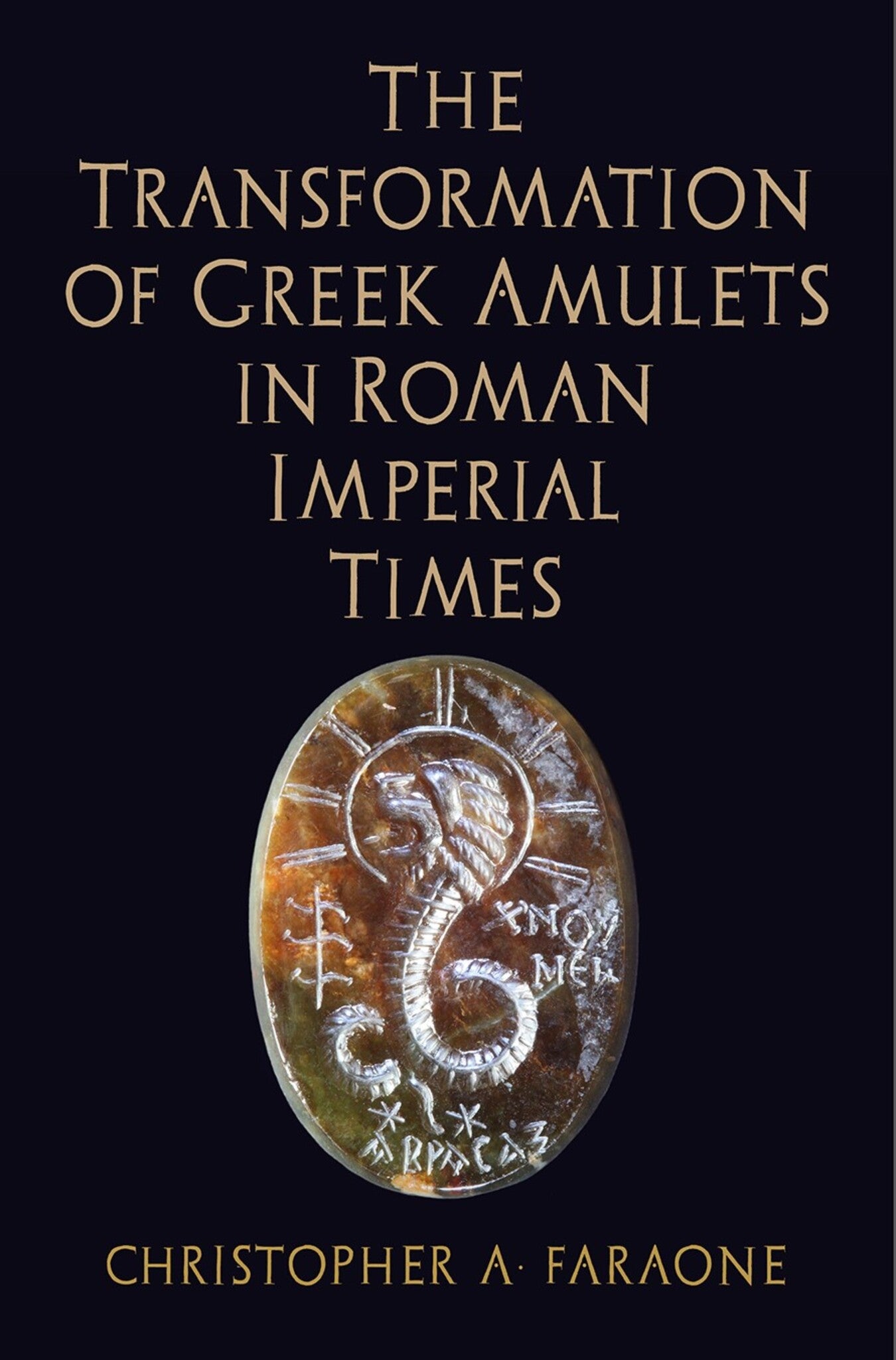
The era of the Roman Empire was distinguished by an explosion of images and texts in a variety of media—metal, papyrus, mosaic, gemstone—all designed to protect, heal, or grant some abstract benefit to the persons who wore them on their bodies or placed them in their homes. In the past scholars have explained this proliferation of readily identifiable amulets by a sudden need for magic or by a precipitous rise in superstition or anxiety in this period, connected, perhaps, with the internal breakdown of Greek rationalism or the migration of superstitious peoples from the East.
Christopher A. Faraone argues, instead, that these amulets were not invented in this period as a result of an alteration in the Roman worldview or a tidal wave of "oriental" influence, but rather that they only become visible to us in the archaeological record as a result of a number of technical innovations and transformations: the increased epigraphic habit of the Imperial period, the miniaturization of traditional domestic amulets, like the triple-faced Hecate, on durable gems, or the utilization of newly crafted Egyptianizing iconography. In short, it is only when explicitly protective or curative texts, or strange new images, are added to traditional Greek amulets, that modern observers realize that these objects were thought to have the power to protect or heal all along. The real question addressed by the book, then, is not why we can identify so many amulets in the Roman Imperial period but, rather, why we have failed to identify them in artifacts of the preceding centuries.
Featuring more than 120 illustrations, The Transformation of Greek Amulets in Roman Imperial Times is not only a tremendous resource for those working in the fields of ancient magic and religion but also an essential reference for those interested in the religion, culture, and history of the ancient Mediterranean.


Preface
Abbreviations for Corpora of Magical Texts
Introduction 1
PART I. ARCHAEOLOGY
Chapter 1. Distribution
Chapter 2. Shapes
Chapter 3. Media
PART II. IMAGES
Chapter 4. Action Figures
Chapter 5. Domestic Guardians
Chapter 6. Pharaonic and Ptolemaic Images
PART III. TEXTS
Chapter 7. Prayers
Chapter 8. Incantations
Chapter 9. Framing Speech Acts
Chapter 10. Conclusions and Further Trajectories
APPENDICES
A. Summaries of Recipes for Protective Amulets Worn During Dangerous Rituals (from the longer PGM Handbooks)
B. Summaries of Recipes from a Curative Handbook Embedded in a Magical Handbook (PGM VII 193-214)
C. Summaries of Recipes from Smaller Fragments of Curative or Protective Handbooks
D. Summaries of Recipes from a Fragment of a Curative Handbook (Testament of Solomon 18.15-40)
E. Summary of Recipes from a Fragment of an Amulet Handbook (S&D 26-39)
F. Summary of Recipes Preserved by Marcellus of Bordeaux
G. Summary of Recipes Preserved by Alexander of Tralles
H. Summary of Recipes Preserved by Aelius Promotus
I. Summary of Recipes Preserved by Dioscorides
Notes
Glossary of Authors and Texts
Glossary of Terms
Bibliography
INDICES
General Index
Index Locorum
Ancient Words