


Some error occured while loading the Quick View. Please close the Quick View and try reloading the page.
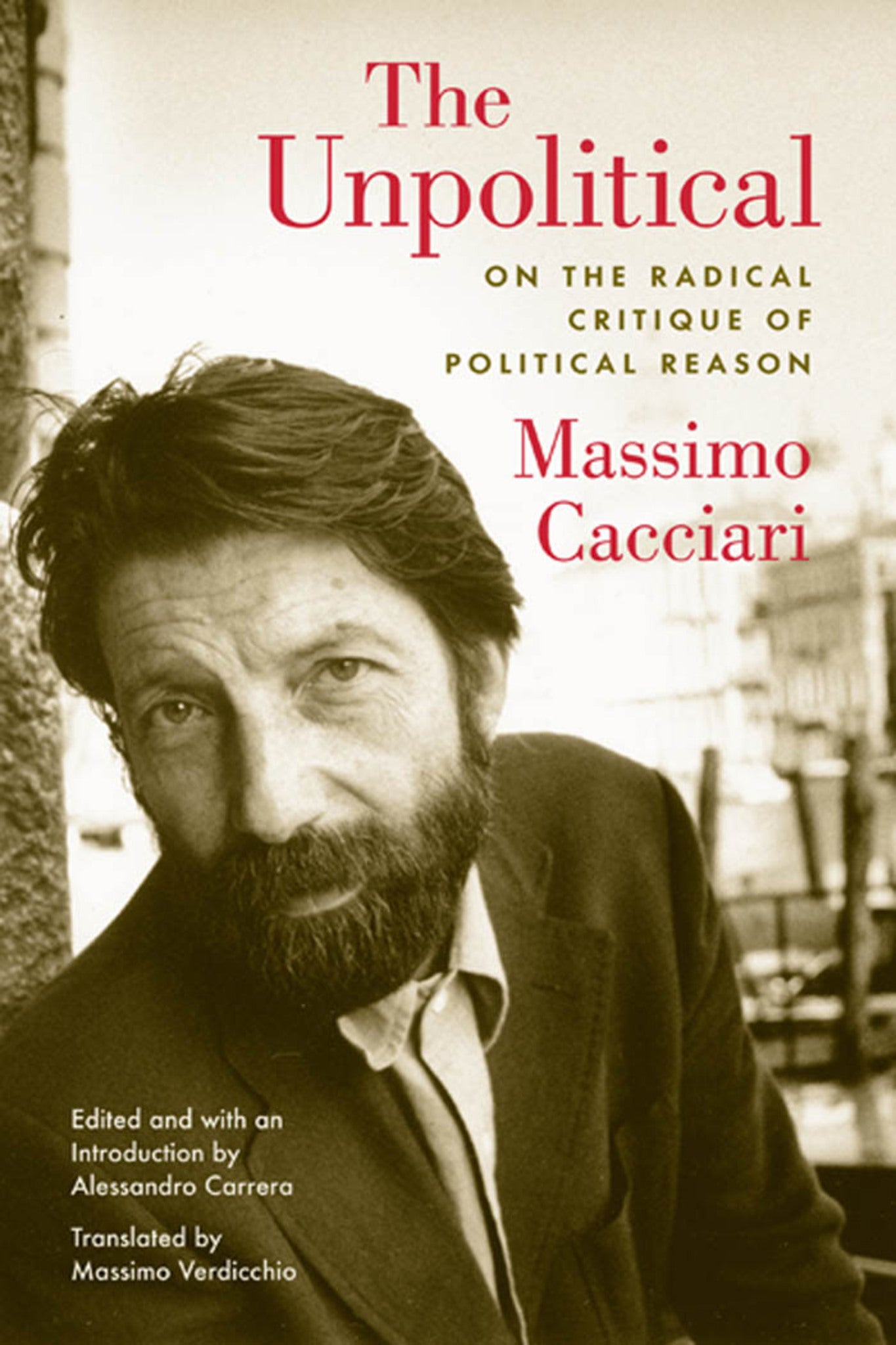
Massimo Cacciari is one of the leading public intellectuals in today's Italy, both as an outstanding philosopher and political thinker and as now three times (and currently) the mayor of Venice. This collection of essays on political topics provides the best introduction in English to his thought to date. The political focus does not, however, prevent these essays from being an introduction to the full range of Cacciari's thought.
The present collection includes chapters on Hofmannstahl, Lukács, Benjamin, Nietzsche, Weber, Derrida, Schmitt, Canetti, and Aeschylus. Written between 1978 and 2006, these essays engagingly address the most hidden tradition in European political thought: the Unpolitical. Far from being a refusal of politics, the Unpolitical represents a merciless critique of political reason and a way out of the now impracticable consolations of utopia and harmonious community. Drawing freely from philosophy and literature, The Unpolitical represents a powerful contribution to contemporary political theory.
A lucid and engaging Introduction by Alessandro Carrera sets these essays in the context of Cacciari's work generally and in the broadest context of its historical and geographical backdrop.


In a time like ours, when disaffection with politics is widespread among the younger generation, the idea of the 'unpolitical' pursued by Cacciari–as a way not to neglect the value of political discourse but to set and control its limits–may become an important tool to counteract the growing indifference to politics and detachment from the public sphere.---—Massimo Lollini, University of Oregon
With this publication of Massimo Cacciari's The Unpolitical: On the Radical
Critique of Politcal Reason, the non-Italian speaking reader is introduced
to an integral part of Massimo Cacciari's socio-political thought process
and, especially, how it developed over the years. We see how Cacciari, in
his readings and analysis of the various philosophers and political thinkers
he tackles over the years, is able to anticipate to a certain degree the
current state of political affairs in Italy and, perhaps, as well as
elsewhere. Alessandro Carrera provides an exhaustively substantial
introduction, and Massimo Verdicchio offers the English reader a lucid and
smooth translation.
Massimo Cacciari offers a paradoxical new alternative to our view of governamentality: neither the classical politics of Grand Narratives, Great Reforms and Ultimate Utopias, nor the post-modern anti-politics of cynical self-interest and petty calculations, __The unpolitical__ is a critical look at the very limits of politics. The unpolitical is not, like the anti-political, opposed to politics: it re-thinks, in fact, its myths and utopias, but now from the perspective of daily praxis and techniques of governance.
In this elegant and precise translation, supplemented by an original and informative introduction, Alessandro Carrera puts forward a coherent genealogy of the "unpolitical" in the writings of one of today's most important philosophers. This is a book to be treasured by all those who care about the future of politics.
An excellent English-language intoduction to Cacciari's thought.---—Luca Somigli, University of Toronto