


Some error occured while loading the Quick View. Please close the Quick View and try reloading the page.
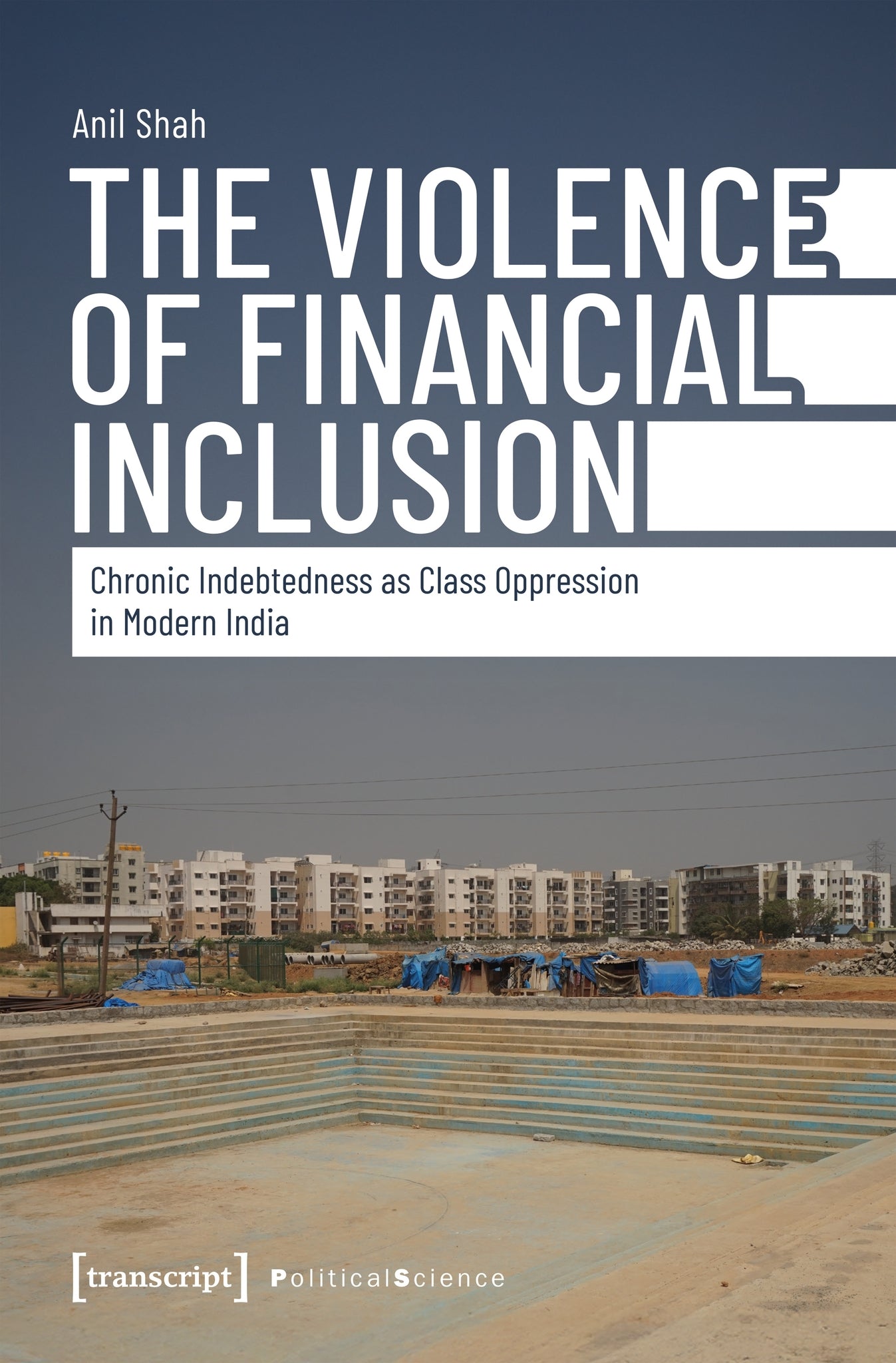
Financial inclusion appears as a timely development policy. Ostensibly, providing poor households with access to credit and other financial services contributes to sustainable development and poverty alleviation. Anil Shah reveals the colonial roots of microfinance and how these paved the way for its rise in the present. Drawing on empirical field research, he demonstrates how financial inclusion is the latest incarnation of a class-based mode of dominating and exploiting subaltern classes on the Indian subcontinent through gendered and racialised indebtedness. As such, he offers a vital resource for researchers, students, and policymakers working in the field of development finance.

Price: $67.00
Pages: 354
Publisher: transcript publishing
Imprint: transcript publishing
Publication Date:
05 August 2025
Trim Size: 8.86 X 5.83 in
ISBN: 9783837680645
Format: Paperback
BISACs:
SOCIAL SCIENCE / Developing & Emerging Countries, SOCIAL SCIENCE / Poverty & Homelessness, BUSINESS & ECONOMICS / Finance / General

»This pathbreaking analysis unpacks development in India through the lens of household financing of subaltern classes. It intertwines concepts from Marxism, feminist social reproduction theory and racial capitalism to show the ordinary, everyday violence of access to credit. Moreover, it demonstrates how debt struggles are a form of class struggle which can challenge oppressive regimes of chronic indebtedness.«
»This is the kind of important work that takes the suggestiveness of the framework of racial capitalism and stretches it to meet the urgent questions of the present. Admirably interdisciplinary, this is a book that will help us comprehend the lived impacts of financial instruments for decades to come.«
»This is the kind of important work that takes the suggestiveness of the framework of racial capitalism and stretches it to meet the urgent questions of the present. Admirably interdisciplinary, this is a book that will help us comprehend the lived impacts of financial instruments for decades to come.«
Anil Shah, born in 1989, is a lecturer in global political economy at Universität Kassel and a research associate at the chair for development and postcolonial studies. His PhD project emerged from a collaboration between Universität Kassel and the Institute for Social and Economic Change in Bengaluru, India. His research draws inspiration from various theoretical, disciplinary and methodological traditions, and focuses primarily on the history and perseverance of violence and inequalities in global capitalism.