


Some error occured while loading the Quick View. Please close the Quick View and try reloading the page.
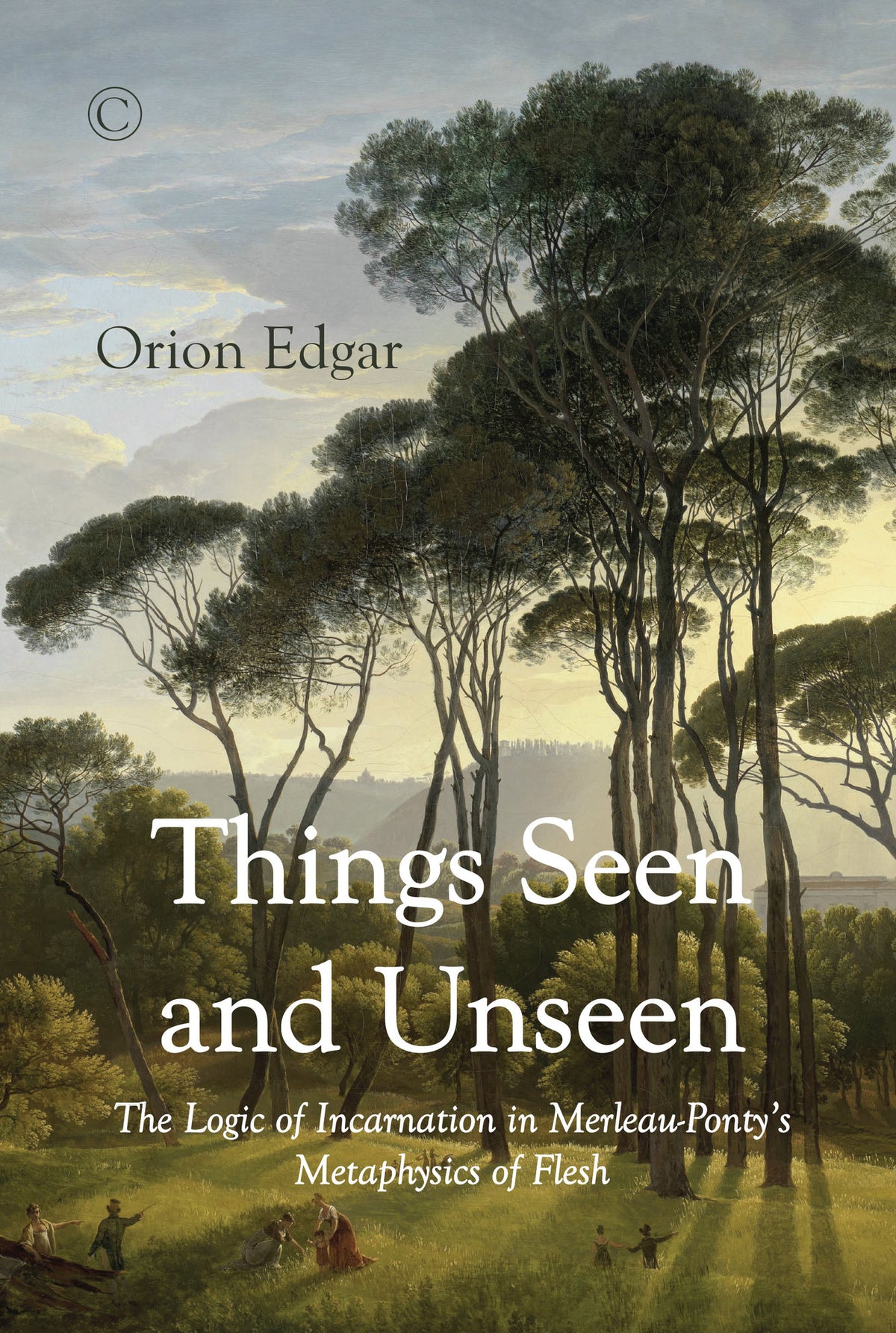
A study of the theological roots of the French philosopher Maurice Merleau-Ponty's writings, and their fruitful implications for Christian thought.
The philosophy of Maurice Merleau-Ponty was developing into a radical ontology when he died prematurely in 1961. Merleau-Ponty identified this nascent ontology as a philosophy of incarnation that carries us beyond entrenched dualisms in philosophical thinking about perception, the body, animality, nature, and God. What does this ontology have to do with the Catholic language of incarnation, sacrament, and logos on which it draws? In Things Seen and Unseen, Orion Edgar argues that Merleau-Ponty's philosophy is dependent upon a logic of incarnation that finds its roots and fulfillment in theology, and that Merleau-Ponty drew from the Catholic faith of his youth. Merleau-Ponty's final abandonment of Christianity was based on an understanding of God that was ultimately Kantian rather than orthodox. As such, Merleau-Ponty's philosophy suggests a new kind of natural theology, one that grounds an account of God as ipsum esse subsistens in the questions produced by a phenomenological account of the world. This philosophical ontology also offers Christian theology a route away from dualistic compromises and back to its own deepest insight.
The philosophy of Maurice Merleau-Ponty was developing into a radical ontology when he died prematurely in 1961. Merleau-Ponty identified this nascent ontology as a philosophy of incarnation that carries us beyond entrenched dualisms in philosophical thinking about perception, the body, animality, nature, and God. What does this ontology have to do with the Catholic language of incarnation, sacrament, and logos on which it draws? In Things Seen and Unseen, Orion Edgar argues that Merleau-Ponty's philosophy is dependent upon a logic of incarnation that finds its roots and fulfillment in theology, and that Merleau-Ponty drew from the Catholic faith of his youth. Merleau-Ponty's final abandonment of Christianity was based on an understanding of God that was ultimately Kantian rather than orthodox. As such, Merleau-Ponty's philosophy suggests a new kind of natural theology, one that grounds an account of God as ipsum esse subsistens in the questions produced by a phenomenological account of the world. This philosophical ontology also offers Christian theology a route away from dualistic compromises and back to its own deepest insight.

Price: $36.95
Pages: 274
Publisher: Boydell & Brewer Inc.
Imprint: James Clarke
Publication Date:
29 September 2016
Trim Size: 9.02 X 5.98 in
ISBN: 9780227175941
Format: Paperback
BISACs:
RELIGION / Christian Theology / General, Christianity, Theology

Merleau-Ponty's philosophy is at last beginning to receive the attention it so richly deserves. It remains one of the most fertile sources in recent thought for reshaping the way we think about knowledge, time, and embodiment - a reshaping made all the more urgent by the political and ecological disasters of our times. It is also a style of thought with obvious theological resonance, a question that has long been in need of the kind of careful, insightful, and creative attention that Orion Edgar provides in this really admirable study, which brings Merleau-Ponty's analyses of bodily existence together with central themes of the Christian imagination - incarnation and sacrament - in a deeply original and fruitful way.
— Rowan Williams, former Archbishop of Canterbury, Master of Magdalene College, Cambridge
This is, quite simply, the most magnificent account of Merleau-Ponty's phenomenology ever written. Edgar brings to life, in the fullest possible terms, the genius of Merleau-Ponty - the church should be truly grateful.
— Conor Cunningham, Associate Professor in Theology and Philosophy, Department of Theology; Co-Director, Centre of Theology and Philosophy, University of Nottingham
In this sophisticated first monograph, Orion Edgar reexamines the philosophy of Merleau-Ponty from the perspective of the Catholic faith that always lapped at the edges of his thought. Once Merleau-Ponty's notions of 'flesh' and 'depth' (in particular) are thus freshly illuminated, his striking relevance for a contemporary theology of the incarnation becomes apparent. Edgar's analysis is both philosophically insightful and theologically rich, and this study makes a significant contribution to Merleau-Ponty scholarship.
— Sarah Coakley, Norris-Hulse Professor of Divinity, University of Cambridge
Things Seen and Unseen is a welcome and elegant contribution to the recovery of Merleau-Ponty's 'incarnational' phenomenology for theology. It will be read with value by those interested in theological aesthetics and philosophy of religion as well.
— Janet Soskice, Professor of Philosophical Theology, Faculty of Divinity, University of Cambridge
— Rowan Williams, former Archbishop of Canterbury, Master of Magdalene College, Cambridge
This is, quite simply, the most magnificent account of Merleau-Ponty's phenomenology ever written. Edgar brings to life, in the fullest possible terms, the genius of Merleau-Ponty - the church should be truly grateful.
— Conor Cunningham, Associate Professor in Theology and Philosophy, Department of Theology; Co-Director, Centre of Theology and Philosophy, University of Nottingham
In this sophisticated first monograph, Orion Edgar reexamines the philosophy of Merleau-Ponty from the perspective of the Catholic faith that always lapped at the edges of his thought. Once Merleau-Ponty's notions of 'flesh' and 'depth' (in particular) are thus freshly illuminated, his striking relevance for a contemporary theology of the incarnation becomes apparent. Edgar's analysis is both philosophically insightful and theologically rich, and this study makes a significant contribution to Merleau-Ponty scholarship.
— Sarah Coakley, Norris-Hulse Professor of Divinity, University of Cambridge
Things Seen and Unseen is a welcome and elegant contribution to the recovery of Merleau-Ponty's 'incarnational' phenomenology for theology. It will be read with value by those interested in theological aesthetics and philosophy of religion as well.
— Janet Soskice, Professor of Philosophical Theology, Faculty of Divinity, University of Cambridge
Acknowledgments
Introduction
PART ONE: Perception
1: Merleau-Ponty's Embodied Philosophy
Merleau-Ponty's Gestalt Phenomenology
The Unity of Sens
Depth and the Bodily Subject
2: "Taste and See . . . ": Eating as Perception
Hunger, Appetite, and Imagination
Taste, Vision, and Perception
Eating and Ontology
Eating and Human Nature
MIDDLE PART: The Crossing
3: The Old Ontology
The Dominance of Linear Perspective
Science and the Observer
The Exclusion of Mind from Nature
Gestalt Ontology and Human Exceptionalism
PART TWO: Ontology
4: "Restoring Sight to the Blind"
Towards a Renewed Understanding of Visual Perception
Sight as Representation
Glancing at the World
Contents
5: Institution and Incarnation in Merleau-Ponty's Ontology
Merleau-Ponty and Christianity
The Logic of Institution
The Anonymous Body and Incarnation
6: Incarnation, Existence, and Musterion
God and Nature
Existential Metaphysics
Merleau-Ponty's Doubt
Creation and Participation
The Logic of Incarnation
Transcendence and Transformation
Conclusion
Bibliography
Index
Introduction
PART ONE: Perception
1: Merleau-Ponty's Embodied Philosophy
Merleau-Ponty's Gestalt Phenomenology
The Unity of Sens
Depth and the Bodily Subject
2: "Taste and See . . . ": Eating as Perception
Hunger, Appetite, and Imagination
Taste, Vision, and Perception
Eating and Ontology
Eating and Human Nature
MIDDLE PART: The Crossing
3: The Old Ontology
The Dominance of Linear Perspective
Science and the Observer
The Exclusion of Mind from Nature
Gestalt Ontology and Human Exceptionalism
PART TWO: Ontology
4: "Restoring Sight to the Blind"
Towards a Renewed Understanding of Visual Perception
Sight as Representation
Glancing at the World
Contents
5: Institution and Incarnation in Merleau-Ponty's Ontology
Merleau-Ponty and Christianity
The Logic of Institution
The Anonymous Body and Incarnation
6: Incarnation, Existence, and Musterion
God and Nature
Existential Metaphysics
Merleau-Ponty's Doubt
Creation and Participation
The Logic of Incarnation
Transcendence and Transformation
Conclusion
Bibliography
Index