


Some error occured while loading the Quick View. Please close the Quick View and try reloading the page.
Winner of the 2026 Borghese Prize
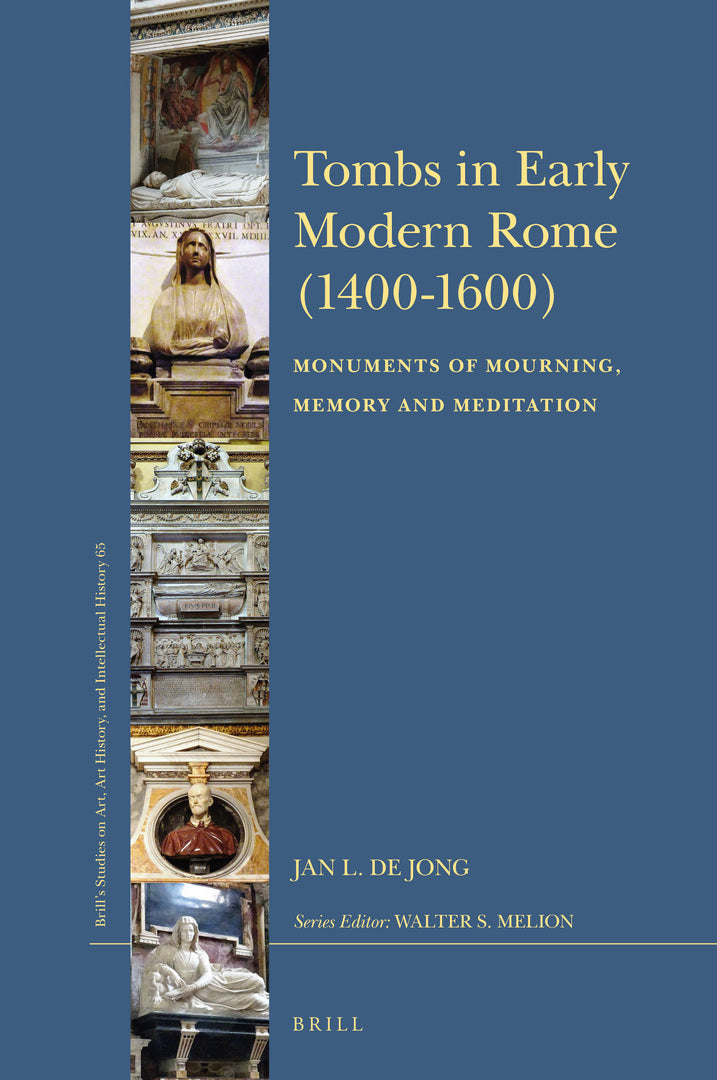
In Tombs in Early Modern Rome (1400–1600), Jan L. de Jong reveals how funerary monuments, far from simply marking a grave, offered an image of the deceased that was carefully crafted to generate a laudable memory and prompt meditative reflections on life, death, and the hereafter. This leads to such questions as: which image of themselves did cardinals create when they commissioned their own tomb monuments? Why were most popes buried in grandiose tomb monuments that they claimed they did not want? Which memory of their mothers did children create, and what do tombs for children tell about mothers? Were certain couples buried together so as to demonstrate their eternal love, expecting an afterlife in each other’s company?
In Tombs in Early Modern Rome (1400–1600), Jan L. de Jong reveals how funerary monuments, far from simply marking a grave, offered an image of the deceased that was carefully crafted to generate a laudable memory and prompt meditative reflections on life, death, and the hereafter. This leads to such questions as: which image of themselves did cardinals create when they commissioned their own tomb monuments? Why were most popes buried in grandiose tomb monuments that they claimed they did not want? Which memory of their mothers did children create, and what do tombs for children tell about mothers? Were certain couples buried together so as to demonstrate their eternal love, expecting an afterlife in each other’s company?

Price: $197.00
Pages: 404
Publisher: Brill
Imprint: Brill
Publication Date:
10 November 2022
ISBN: 9789004179363
Format: Hardcover

Winner of the 2026 Daria Borghese Prize. Established in 1965 in memory of Princess Daria Borghese Olsoufieff (1909–1963), the prize is awarded annually for the best book on Rome by a non-Italian author.
“Not only a great addition to the study of tomb monuments in Rome but also a significant methodological work for the study of church monuments more generally.”
Elise Philippe, Catholic University of Louvain. In: Church Monuments, Vol. 38 (2024), pp. 149–151.
“This book stands out for its innovative and inclusive approach to tomb monuments [...] The reader is treated to a rich and insightful journey through the cultural, spiritual, and emotional dimensions of early-modern tomb monuments in Rome.”
Laura Overpelt, Royal Netherlands Institute in Rome / Utrecht University. In: Incontri, Vol. 38, No. 1 (2023).
“Not only a great addition to the study of tomb monuments in Rome but also a significant methodological work for the study of church monuments more generally.”
Elise Philippe, Catholic University of Louvain. In: Church Monuments, Vol. 38 (2024), pp. 149–151.
“This book stands out for its innovative and inclusive approach to tomb monuments [...] The reader is treated to a rich and insightful journey through the cultural, spiritual, and emotional dimensions of early-modern tomb monuments in Rome.”
Laura Overpelt, Royal Netherlands Institute in Rome / Utrecht University. In: Incontri, Vol. 38, No. 1 (2023).
Jan L. de Jong (PhD Leiden University, 1987) is Senior Lecturer of Art History of the Early Modern Period at the Rijksuniversiteit Groningen, The Netherlands. He has published extensively on early modern Italian art, especially in Rome. His books include The Power and the Glorification: Papal Pretensions and the Art of Propaganda in the Fifteenth and Sixteenth Centuries (Penn State University Press, 2013).