


Some error occured while loading the Quick View. Please close the Quick View and try reloading the page.
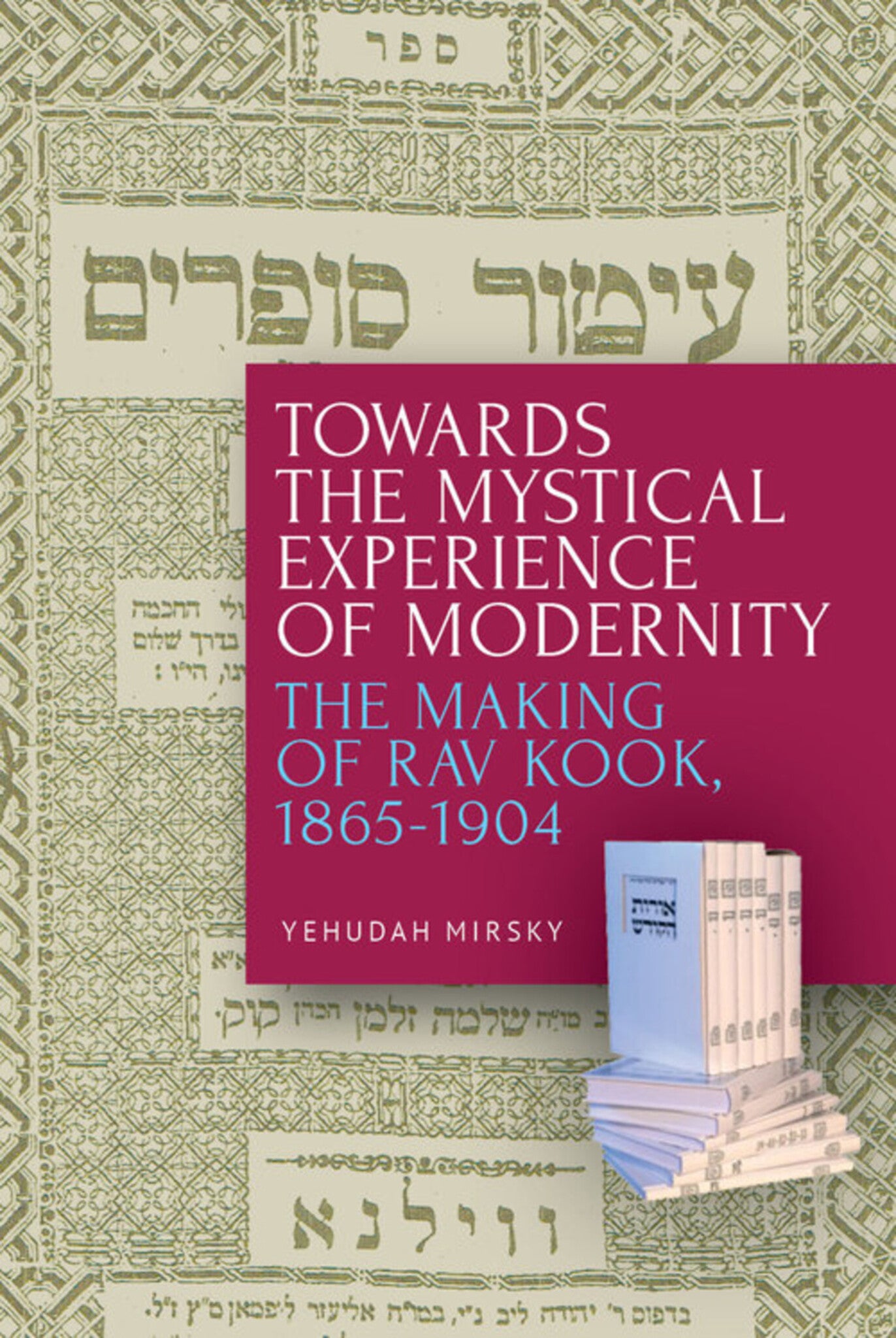
Avraham Yitzhaq Ha-Cohen Kook (1865-1935) stands as a colossal figure of modern Jewish history and thought. Jurist, mystic, poet, theologian, communal leader, founder of the modern Chief Rabbinate and still the defining thinker of Religious Zionism, he is indispensable for understanding modern Jewish thought, the contemporary State of Israel, and the most fundamental interactions of religion, nationalism, ethics and spirituality. Despite countless studies of him, almost no full-fledged intellectual biography of him exists in any language. This study of the years before his momentous move to Jaffa in 1904, drawing on little-known works, including recently published manuscripts, begins to fill that gap. It traces his life and times in the remarkably intense Rabbinic intellectual milieu of late nineteenth-century Eastern Europe, and his path from a profound, regularly rationalist traditionalism, towards a dynamic theology and spiritual practice weaving together Kabbalah, philosophy, universal ethics, and romantic mysticism.


“Mirsky teaches us how to read afresh a much-discussed writer and how to navigate a vast and at times bewildering corpus. This sterling intellectual biography will become the definitive work on the making of one of the greatest modern mystics, introducing and translating a wealth of lesser known or newly printed sources. Mirsky’s exquisitely rich reading exposes the full range and complexity of the manifold contexts (medieval, Lithuanian, Zionist, theosophical, legal, and ethical) from which his hero emerged, without in any way obscuring his brilliant originality, as he invites us to viewings of Kook as an aspiring prophet, yet also as a master of exegesis and mourning poet. To not only hold all of these tensions, but also render them lucid to readers of all backgrounds, is nothing less than a feat of dedicated reflection and high-powered analysis. This is historical writing in its most eloquent, passionate and engaged form.”
—Jonathan Garb, author of A History of Kabbalah from the Early Modern Period to the Present Day“Rabbi Abraham Isaac Kook plays a central role in twentieth-century Jewish life and thought, and his influence in so many areas is profound. More works of scholarship have been devoted to him than any other modern rabbi, and these studies have concentrated on R. Kook’s mature works, written when he was in the Land of Israel. Yehudah Mirsky’s most recent book stands out as he focuses on the early writings of R. Kook, the ones completed before he left Europe. Anyone who wishes to understand how R. Kook became who he was, and the trajectory of his religious thought, must grapple with these early works, including the tensions that arise between his early thought and what he later expressed. There is no better guide in this matter than Mirsky, whose ear is attuned not only to what R. Kook says, but to how he says it and sometimes even more importantly, what he does not say. Mirsky also shows himself to be an expert translator of R. Kook, able to preserve the nuances of very difficult, and often poetic, formulations. The present work is a worthy successor to Mirsky’s earlier book, the critically acclaimed Rav Kook: Mystic in a Time of Revolution.”
— Marc B. Shapiro, Weinberg Chair of Judaic Studies, University of Scranton
“Yehudah Mirsky’s command of every relevant strand in contemporary Jewish thought is astonishing. A beautifully wrought, intellectually sophisticated, and moving portrait of the wrestlings of one of Judaism’s most indispensable thinkers.”
— Steven J. Zipperstein, Daniel E. Koshland Professor in Jewish Culture and History, Stanford University
“Despite the astounding proliferation of studies relating to the life and works of R. A. I. Kook, the present volume is one which no student of his thought can afford to ignore. In this tour de force, Mirsky provides a detailed intellectual biography of the hitherto relatively ignored years preceding R. Kook’s move to Palestine, an updated bibliography of unpublished writings now being released alongside original versions of previously censored works, and the wealth of secondary literature that these have evoked. Such factors are game-changers, inducing the replacing of misguided attempts to provide a coherent and systematic view of R. Kook’s thought with appreciation of the role of chronological development in the evolution of his inner life and spiritual horizons. Mirsky’s masterly style, the wealth and sophistication of his intriguing commentaries, and his policy of relegating specialized or tangential information to copious footnotes make this book a joy for professional scholars and interested laymen alike.”
— Tamar Ross, Professor Emerita, Department of Jewish Thought, Bar Ilan University
“The significance of Avraham Yitzhak Ha-Cohen Kook in modern Jewish thought is generally recognized. However, he has been more lauded than understood or read. His writing is enigmatic and the limited knowledge about his early years has been a stumbling block for readers and students alike. The apparent impossibility of tracking down necessary sources and the difficulties of penetrating Rav Kook’s prose dismayed even the most dedicated of them. A magic wand was needed. This book is that wand and Yehuda Mirsky is the magician who uncovered remarkable sources on Rav Kook’s life and was able to transform opaqueness into clarity and the obscure into comprehensible. His book will be a standard starting point for anyone setting out to understand Rav Kook and his world. Readers of Towards the Mystical Experience of Modernity will find it hard to remember how they even tried to understand Rav Kook’s writing before they read this book.”
— Shaul Stampfer, Professor Emeritus, Hebrew University
"An illuminating blend of intellectual biography and textual analysis, Toward the Mystical Experience of Modernity charts the course of Rav Kook’s intellectual development throughout his first twenty years of public life. Avoiding the twin pitfalls of historical determinism and ideological essentialism, Mirsky shows how the contingencies of Rav Kook’s life… shaped Rav Kook’s writing and teaching in this period… Toward the Mystical Experience of Modernity paints a picture of Rav Kook’s early life that flows from one point to the next, showing shifts and developments, without flattening individual links in the chain into a homogenous whole. Each step has its own significance, while also taking part of a coherent narrative… Toward the Mystical Experience of Modernity thus invites the reader to reconsider not just how they imagine Rav Kook, but how they imagine their individual selves and the Jewish people.”
– Levi Morrow, The Lehrhaus
“In his outstanding new book, Towards the Mystical Experience of Modernity: The Making of Rav Kook, 1865-1904, Yehudah Mirsky achieves the rare feat of presenting Rav Kook’s teachings in all their fullness. By focusing on Rav Kook’s writings from the first half of his life, before his emigration to Palestine, Mirsky offers a fascinating picture of Rav Kook’s thought that is far richer and more complex than the version taught today by many who claim to be his disciples… [R]ather than read ‘Rav Kook’s works as a unified canon whose inconsistencies must be resolved in order for him to be authoritative,’ Mirsky chooses to ‘read them, and try to understand him, in terms of his time and place.’ In embracing the contradictions and evolutions of his thought, Mirsky reveals intriguing nuances others miss and captures Rav Kook’s unending pursuit of contradiction and its attempted resolution…[I]t behooves us to take a close look—as Mirsky so marvelously does—at Rav Kook in his fullness, and to encounter a thinker who refuses to grant contradiction the final say, while still recognizing that its final resolution may be beyond our grasp.”
– Zachary Truboff, Sources: A Journal of Jewish Ideas
“How did Rav Kook arrive at such a unique approach to modernity? What were the building blocks that he used to erect his intellectual edifice? Where did Rav Kook find the wherewithal to blaze his own individual trail that deviated so distinctively from the well-worn paths of all those around him?
These are the questions that Mirsky seeks to answer, and there is perhaps no one as well equipped to answer them. He brings together a mastery of the sociology of modernity, the history of ideas, the development of the Kabbalah, 19th-century intellectual trends, medieval Jewish philosophy, the Lithuanian yeshiva culture and, of course, Rav Kook’s extensive published and unpublished writings. Mirsky summons all these intellectual resources to get to the bottom of the mystery that is the emergence of Rav Kook.”
– Ross Singer, The Jerusalem Post
“Yehuda Mirsky’s Towards the Mystical Experience of Modernity: The Making of Rav Kook is a masterful work; one might almost say a masterpiece. … Mirsky’s work is a fundamental Handbuch, a guide to Rav Kook’s thinking whose usefulness will surely endure over several decades. Any student of the works featured here… will find in Mirsky’s work the definitive historical, literary, and bibliographical framing for approaching these works. This is an enormous contribution not only to scholarship but to Torah learning. … This book is, then, essential background material for the future student, and will be appreciated for decades to come as a standard reference work. More broadly, this is probably the best introduction in the English language—and probably any language—to the biography, context, formation, and social and intellectual context within which Rav Kook operated. If nothing else, this superb bio-bibliographical introduction to Rav Kook is enough to make this book a classic. … Mirsky has laid solid foundations that will allow others to gain a deeper appreciation of Rav Kook. For the everyman, he has provided a roadmap for studying his early life. For the scholar, he has constructed an edifice that justifies a re-reading of the key texts in light of some of the questions posed above. For both audiences, this first-rate work constitutes an invitation to further study and to deepen our understanding of Rav Kook.”
Yehudah Mirsky is Full Professor of Near Eastern and Judaic Studies at Brandeis University. A former US State Department official, he has written widely on religion, politics, and culture for the New York Times, the Economist, the Washington Post, and many other publications. He won the Jewish Book Council's Sami Rohr Choice Award for his earlier work, Rav Kook: Mystic in a Time of Revolution.
Introduction
The Work in Brief
Precis
Mapping Rav Kook
Many Editorial Hands
Academic Approaches
The Missing Early Decades in Rav Kook's
Corpus
Towards Expressivism and the Subject
Rav Kook and the Medieval Philosophical
Tradition
The Early Writings
Self-Cultivation, Philosophical Ethics,
Mussar
Chapter One: Childhood and Early Years: Between
Mitnagdism, Hasidism and Haskalah 42 Rabbinic Humanism and Haskalah
Geographic and Cultural Background
Family Backgound
Social Changes: Haskalah's Shift from
Enlightenment to Radicalism
Rabbinic Maskilim
Childhood and Early Education
Studies in Lyutsin and Smorgon and
Engagement with Haskalah
Betrothal and Aderet
Avraham Kook Goes to Volozhin
Marriage, Poverty and First Rabbinic
Post
Literary Debut
'Ittur Sofrim
Loss
Chapter 2: All in the Mind: The Writings of
the Zeimel Period
The Small-Town Rabbinate
Talmudic Commentary and a Sage's
Discontents
Halakhic Writings and a Touch of
Philosophy
Hevesh Pe'er
The Primacy of the Mind in Hevesh Pe'er
Midbar Shur
Moshe Hayim Luzzatto
Midbar Shur and the Pursuit of
Perfection, Jewish and Universal
An Elegy for His First Wife
Conclusion
Chapter 3: Boisk at the Crossroads of Mussar and Tiqqun
Unease in Zeimel and the Influence of
Eliasberg
Boisk
Developments in Yeshiva Culture and the
Mussar Movement
The Turn to Interiority as a Defining Theme
of this Period
: The Self and Tiqqun
Lithuanian Kabbalah
Pinkasim 15 & 16
"The Rustlings of My Heart": Rav
Kook and B.M. Levin
Conclusion
Chapter 4: 'Eyn Ayah: Intellect, Imagination, Self-Expression, Prophecy
'Eyn Ayah and Modernity's Expressivist
Turn
The Work: Genre, Method and the Study of
Aggadah in Rabbinic Circles
Two Introductions to the Work
Self-Perfection
Intellect, Imagination, Feeling
Perfection of the Individual and the Whole
and the Internalization of Kabbalah Strategies of Containment
The Renewal of Prophecy and the Mission of
the Artist
The Emergence of Dialectic
The Problem of Self-Love
The Study of Aggadah and Spiritual
Individualism
Concluding Remarks on Expressivism and
Subjectivity
Chapter 5: The Turn Towards Nationalism: Between Ideology and Utopia, or, Ethics and Eschatology
Jewish Nationalism in Eastern Europe
Early Mentions of Nationalism and Hints of
Apocalypse
First Responses to the Zionist Movement
First Response to Orthodox Anti-Zionism
Ha-Peles
The First Essay: Israel's Universal
Mission
Interlude: Creation of the Mizrahi
The Second Essay: Mobilizing Literature
The Third Essay: Ethics, History and
Eschatology
Alexandrov's Response: Rav Kook and Ahad
Ha-Am
'Eyn Ayah Passages on History and
Eschatology
Assessing the Essays: Ideology and
Utopia
Chapter 6:’The New Guide of the Perplexed’ 'The Last in Boisk': Making Sense of Heresy en Route to Zion
To Jaffa and Palestine
The Second Aliyah
‘The New Guide of the Perplexed’
'The Last in Boisk': Heresy, Nietzsche,
Apocalypse
The Journal
Messiah ben Joseph
Expressivism and the Song of Songs
Heresy and Eschatology
Ethics, Jesus, Nietzsche, Qelippah
Working with Heresy, Reworking Torah Study
and Theology
Leaving Boisk
Conclusion
Transformations in the Land of Israel
Seven Shifts: From To-Down to Bottom-Up
Philosophy, Mysticism, Experience
Implications for the Study of Religion:
Theology as Autobiography
Implications for Rav Kook Studies
Berdyczewsky and Rav Kook: Between Rupture
and Dialectic