


Some error occured while loading the Quick View. Please close the Quick View and try reloading the page.
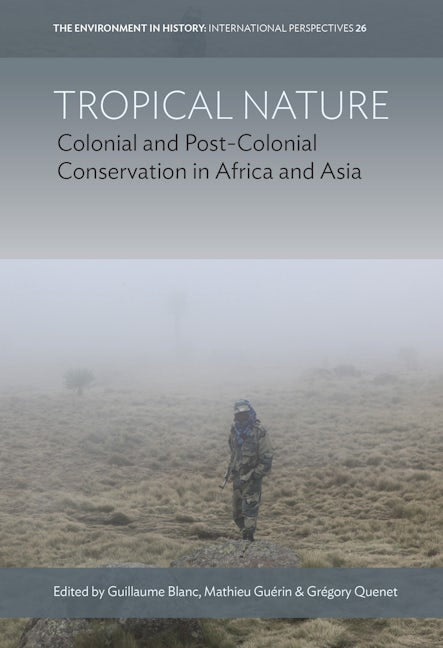
Across Africa and South-East Asia, the impulse to protect nature often dovetails with the domination of local people. From mass displacement to severe restrictions on land use and daily acts of violence, conservation work risks reproducing Eurocentric modes of colonialism and worsening the effects of the climate crisis. In this insightful and wide-ranging study of the colonial history of conservation, Tropical Nature seeks to provide a much-needed history of the Global South from its own perspective. Comparing case studies ranging from Ali Bongo’s Gabon, to the postcolonial African itinerary of the agronomist Arthur Bunting, this volume advances a “small-scale global history” that deciphers the relations binding human societies to the non-human world.


“The book raises a major issue: social and environmental justice. Those who advocate protection are not those who suffer its constraints.” • Steve Hagimont, 20&21. Revue d'histoire, n° 159, 2023
“The book as a whole insists on a contradiction that seems inherent to conservation: "this policy does not exist alongside destruction but with it". Highlighted by the title of the book, this contradictory association is found in two logics: protecting in order to exploit and exploiting in order to protect.” • Colin Vanlaer, Moussons, n°41, 2023
Guillaume Blanc is Associate Professor of Contemporary History at the University of Rennes 2 and a member of the Institut Universitaire de France (2021-2026). His work focuses on the global governance of nature, with a particular concentration on Ethiopia and East Africa. He has recently published La nature des hommes (La Découverte, 2024) and The Invention of Green Colonialism (Polity, 2022).
List of Illustrations
Acknowledgments
Abbreviations
Introduction: Protecting Nature in Africa and Asia. Towards a Small-Scale Global History
Guillaume Blanc
Chapter 1. Laissez-Faire Conservation. Nature Protection in Colonial Vietnam
Pamela McElwee
Chapter 2. Setting up a Wildlife Department. Kenyan Expertise in Malaya
Mathieu Guérin
Chapter 3. Imperial Forests and Nature Reserves in Singapore, 1883-1959
Timothy P. Barnard
Chapter 4. Rambouillet, Agricultural Stations, and French Colonial Africa. Conserving and Improving Nature (1900-1930)
Raphaël Devred
Chapter 5. Missing Conservation? On the Puzzling Dearth of Nature Conservation in Mandate Syria and Lebanon
Diana K. Davis
Chapter 6. Between Empire and Development. The Ubiquitous Life and Career of Arthur Hugh Bunting
Joseph M. Hodge
Chapter 7. The Adamsons, Born Free, and the Late Colonial Era. Images That Helped to Change the Animal World
William Beinart
Chapter 8.Conservation in the Days of Independence. the Case of the Seychelles, 1968-1974
Grégory Quenet
Chapter 9. Tracking Wildebeests. the Technological Mediation of Spaces for Humans and Wildlife in the Serengeti since 1950
Simone Schleper
Chapter 10. Conserving Nature in Mozambique. Relaying Conservation Practices and Imaginaries since Colonial Days
Rozenn Nakanabo Diallo
Chapter 11. Catfights and Crocodile Tears. Conflict, Charismatic Species, and Nature Professionals in India’s Conservation History
Meera Anna Oommen
Chapter 12. Representing Space to Structure Time. Tropical Deforestation Fronts in the Light of Human-Territory Relations
Johan Oszwald
Conclusion: Studying Nature, Networks, and Power. What Next?
Guillaume Blanc
Index