


Some error occured while loading the Quick View. Please close the Quick View and try reloading the page.
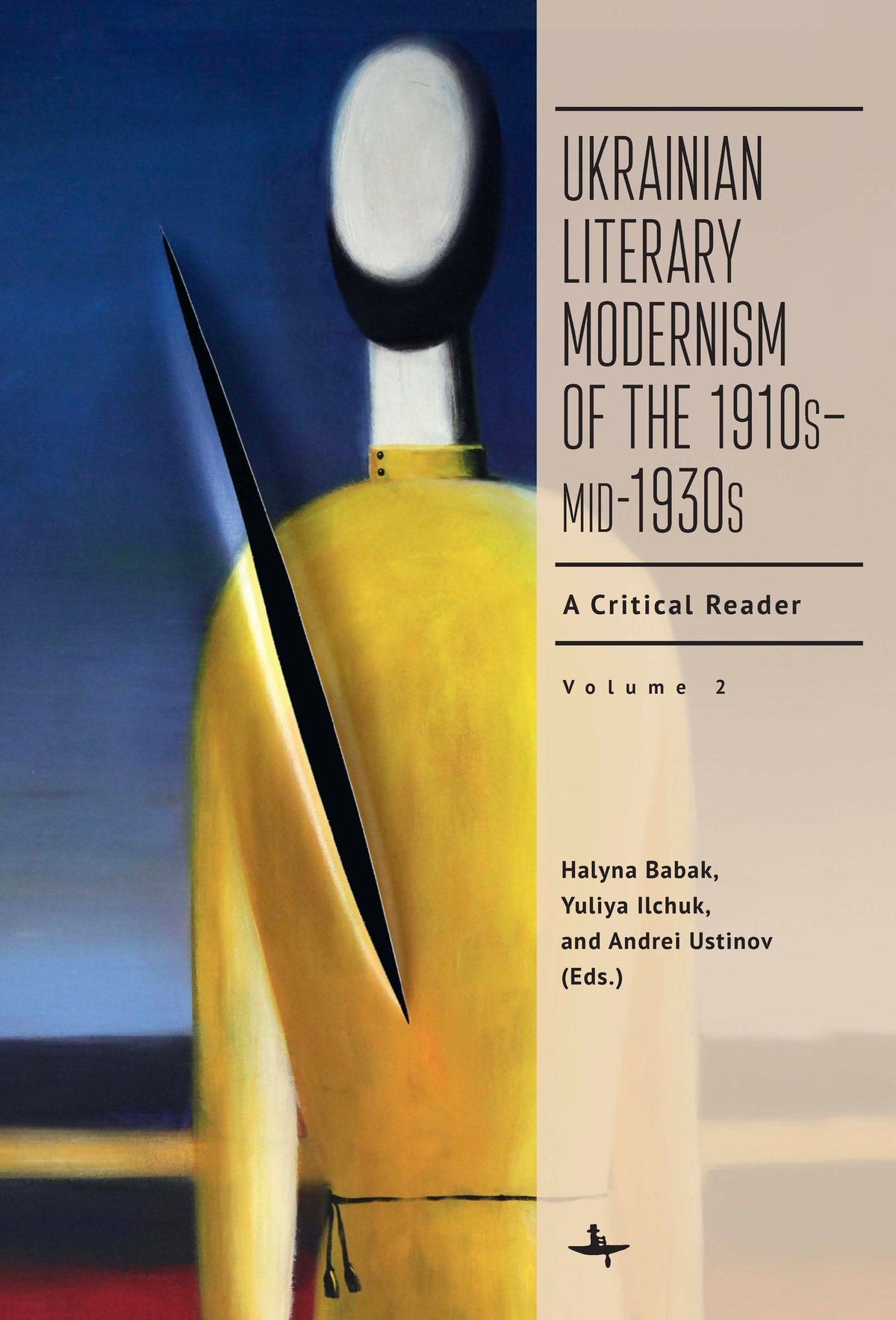


“This is a ground breaking collection of articles, manifestos and poems that will be instrumental to bring about the long needed reconfiguration of Slavic Studies. Ukrainian modernism was more modern than other modernisms because it originated at the crossroads of many cultures (Ukrainian, Russian, Polish, Jewish), it combined a national agenda with a socialist one, and it foreshadowed intellectual debates about hermeneutics and reception theory that would surface in Western Europe only in the 1960s. This reader presents important literary theorists, influential futurists, and innovative poets many of whom perished under Stalinist rule. A substantial introduction provides the necessary context for the presented texts. This collection is an indispensable handbook for all those interested in the Ukrainian dimension of modernist thinking and writing.”
— Ulrich Schmid, Professor of Eastern European Studies at the University of St.Gallen (Switzerland)
"This book brings into sharp focus a brilliant generation of critics and theorists who transformed literary studies while negotiating the pressures of empire, revolution, and cultural Russification <...> Set firmly within the vibrant literary and cultural life of the period, the anthology reveals that figures writing in Ukrainian journals and institutions did more than simply “receive” Shklovsky, Eikhenbaum, or Trotsky; they also tested these thinkers’ ideas against their own experience of a multilingual, socially stratified, and politically volatile literary field <...> This reveals a shared Eastern European horizon in which theory was inseparable from cultural policy, avant-garde experimentation, and mass literacy campaigns. By analyzing the materiality of form together with the sociology of literature and the psychology of artistic creation and reception, Ukrainian critics reframed questions of form and content through class ideology <...> By making this dense, multilingual debate accessible in English and annotating it with great philological care, the editors restore Ukrainian theoretical writing to its rightful place as a central laboratory of European modernism. This reader demonstrates that the “periphery” was in fact one of the most fertile sites for rethinking what literature is, what it does, and how it should be studied, and it will be indispensable for anyone interested in modernism, Slavic and East European studies, or the global history of literary theory."
— Michał Mrugalski, Institute of Slavic and Hungarian Studies, Humboldt University of Berlin
“This wide-ranging anthology makes a major contribution to our knowledge and understanding of Ukrainian literary modernism. The translations, along with the contextualising introductions, present an invaluable and much-needed resource for Slavists and comparatists alike.”
— Galin Tihanov, George Steiner Professor of Comparative Literature, Queen Mary University of London
“Halyna Babak, Yuliya Ilchuk and Andrei Ustinov have enriched Ukrainian and Slavic literary studies with an indispensable instrument for the study of the intellectual and poetic detonation that illumined Ukrainian culture from the early twentieth century to the mid-1930s. Lucid introductory essays precede, and show the relationships between, the period’s theoretical and critical texts, its literary manifestos, and its multifarious poetry. This Reader reveals the vigour and variety of Ukrainian modernism before repressions and executions extinguished its promise; it reflects on Ukrainian modernism’s commonalities with, and distinctiveness from, its European counterparts; it shows Ukrainian modernism participating in the construction of a modern, confident, multi-ethnic Ukrainian nation. Ukrainian Literary Modernism is a book singularly apposite at a time when that nation’s survival is threatened by a resurgent imperialism.”
— Marko Pavlyshyn, Emeritus Professor of Ukrainian Studies, Monash University
Halyna Babak is a Ukrainian scholar whose research explores the intellectual history, literary theory, and literary production of 20th-century Ukraine within the broader context of Soviet and East European political and cultural history. Her first monograph The Atlantis of Soviet National Modernism [Natsmodernism]: The Formal Method in Ukraine (1920s–Early 1930s) (2021, co-authored with A. Dmitriev), offers the first comprehensive interpretation of the role of Ukrainian Formalism in nation-building during the 1920s as part of the broader project of Soviet modernization.
Yuliya Ilchuk is a Ukrainian scholar and translator whose research focuses on cultural exchange, interaction, and “borrowing” between Russia and Ukraine. Her award-winning book, Nikolai Gogol: Performing Hybrid Identity (2021), reinterprets the writer’s identity and his literary works as ambivalent and hybrid. Her recent projects engage with memory studies in post-1991 Ukraine, shifting scholarly attention from collective remembrance to the cultural dimensions of forgetting. Also, she actively translates both modernist and contemporary Ukrainian poetry in tandem with Amelia Glaser.
Andrei Ustinov received his PhD from Stanford University and is currently a Fellow at the Center for Open Studies. His scholarship examines European cultural history, highlighting the interplay between literary theory and artistic practice in modernist and avant-garde movements. He has authored and edited several books, including the comprehensive study Russian Literary Avant-Garde in Paris (with Leonid Livak), and has published widely on poetic experimentation. His current work centers on the rediscovery of texts and contexts of Ukrainian modernism.
Note on Translation and Transliteration
Glossary
Acknowledgments
Foreword: How This Book Was Made
Introduction
1. Halyna Babak, “Ukrainian Formalism and Beyond: Literary Theory and Criticism in Soviet Ukraine from the Revolution to Stalinism”
2. Yuliya Ilchuk and Andrei Ustinov, “Ukrainian Formalism and Its Poetic Ambience”
Articles
3. Valer'ian Polishchuk, “How to Write Poems: Practical Advice for Beginners”
4. Borys Iakubs'kyĭ, “Toward the Essence of Ukrainian Poetry”
5. Volodymyr Koriak, “Form and Content”
6. Ieremiia Aĭzenshtok, “The Study of the New Ukrainian Literature (Notes)”
7. Iuriĭ Mezhenko, “On the Way to a New Theory”
8. Borys Iakubs'kyĭ, “On the ‘Formal Method’ and the Problem of Content and Form”
9. Borys Iakubs'kyĭ, “Forward to Dmytro Zahul’s Poetyka”
10. Mykola Zerov, “The New Ukrainian Literature”
11. Mykhaĭlo Mohylians'kyĭ, “Towards the Problem of Understanding a Work of Art”
12. Borys Navrots'kyĭ, “Formalism or Subjective Aestheticism”
13. Аhapiĭ Shamraĭ, “The ‘Formal Method’ in Literature”
14. Mykhaĭlo Dolengo, “The Poet and Everyday Life (Some Considerations on the Origin of Poetic Styles)”
15. Borys Navrots'kyĭ, “In Search of an Objective Theory of Art (The Contemporary Development of Experimental Aesthetics in the West and the Destruction of Objective Aesthetics)”
16. Mykola Khvyl'ovyĭ, “Formalism?”
17. Ieremiia Aĭzenshtok, “Ten Years of ‘OPOIAZ’”
18. Hryhoriĭ Maĭfet, “A Propos the Composition of the Novella”
19. Oleksandr Bilets'kyĭ, “Reader, Writer, Literature”
20. Oleksa Poltorats'kyĭ, “Through the Formal Method”
21. Vladimir Derzhavin, “The Fantastic in Gogol’s ‘A Terrible Vengeance’”
22. Pavlo Fylypovych, “The Social Profile of the Ukrainian Reader in the 1830s and 1840s. Study I”
23. Maĭk Ĭohansen, “How a Short Story Is Made”
24. Les' Kurbas, “A Study on the Works of Prominent Scholars and Artists, on Art as Scholarship, on Universal Aesthetics. The Estrangement of Things”
Literary Manifestos and Programs
25. Mykola Voronyĭ, “An Appeal”
26. Mykhaĭl' Semenko, “I Alone.”
27. Viktor Khlebnikov, Mariia Siniakova, Bozhidar, Grigorii Petnikov, Nikolai Aseev, “The Trumpet of the Martians”
28. “Muzahet”
29. Mykola Khvyl'ovyĭ, Volodymyr Sosiura, Mykhaĭlo Ĭohansen, “Our Universal Proclamation: To the Workers and Proletarian Artists of Ukraine”
30. Valer'ian Polishchuk, “Credo”
31. Mykhaĭl' Semenko, “Telegram Lit. A. Moscow, Vladimir Maiakovsky, a Futurist”
32. Geo Shkurupiĭ, “Unprecedented Duel!”
33. Mykhaĭl' Semenko, “Pan-Futurism (The Art of the Transitional Period)”
34. Mykhaĭl' Semenko, “What Panfuturism Wants”
35. Mykhaĭl' Semenko, “The Future of the Pan-Futurists”
36. Geo Shkurupiĭ, “Montage of the Word”
37. “The Ideological and Artistic Platform of the Union of Peasant Writers, ‘The Plow’ / ‘Pluh’”
38. Vasyl' Blakytnyĭ, “Without a Manifesto”
39. “Foundational Principles of the Free Academy of Proletarian Literature VAPLITE”
40. Valer'ian Polishchuk, “An Appeal by the Avantgarde Group of Artists”
41. Mykola Bazhan, “Put on Your Glasses”
42. “What Is Techno-Artistic Group A?”
43. Valer'ian Polishchuk, “What? And How? And Why?”
44. Mykhaĭl' Semenko, “A Letter to Our Young Poets. A Pamphlet”
Poetry
45. Mykola Bazhan
46. Osval'd Burghardt (Yuriĭ Klen)
47. Mykhaĭlo Draĭ-Khmara
48. Pavlo Fylypovych
49. Maĭk Ĭohansen
50. Vladimir Makkaveisky
51. Grigorii Petnikov
52. Ievhen Pluzhnyk
53. Maksym Ryl's'kyĭ
54. Iakiv Savchenko
55. Mykhaĭl' Semenko
56. Geo Shkurupiĭ
57. Volodymyr Sosiura
58. Volodymyr Svidzyns'kyĭ
59. Raїsa Troianker
60. Pavlo Tychyna
61. Mykola Voronyĭ
62. Natalia Zabila
63. Dmytro Zahul
64. Mykola Zerov