


Some error occured while loading the Quick View. Please close the Quick View and try reloading the page.
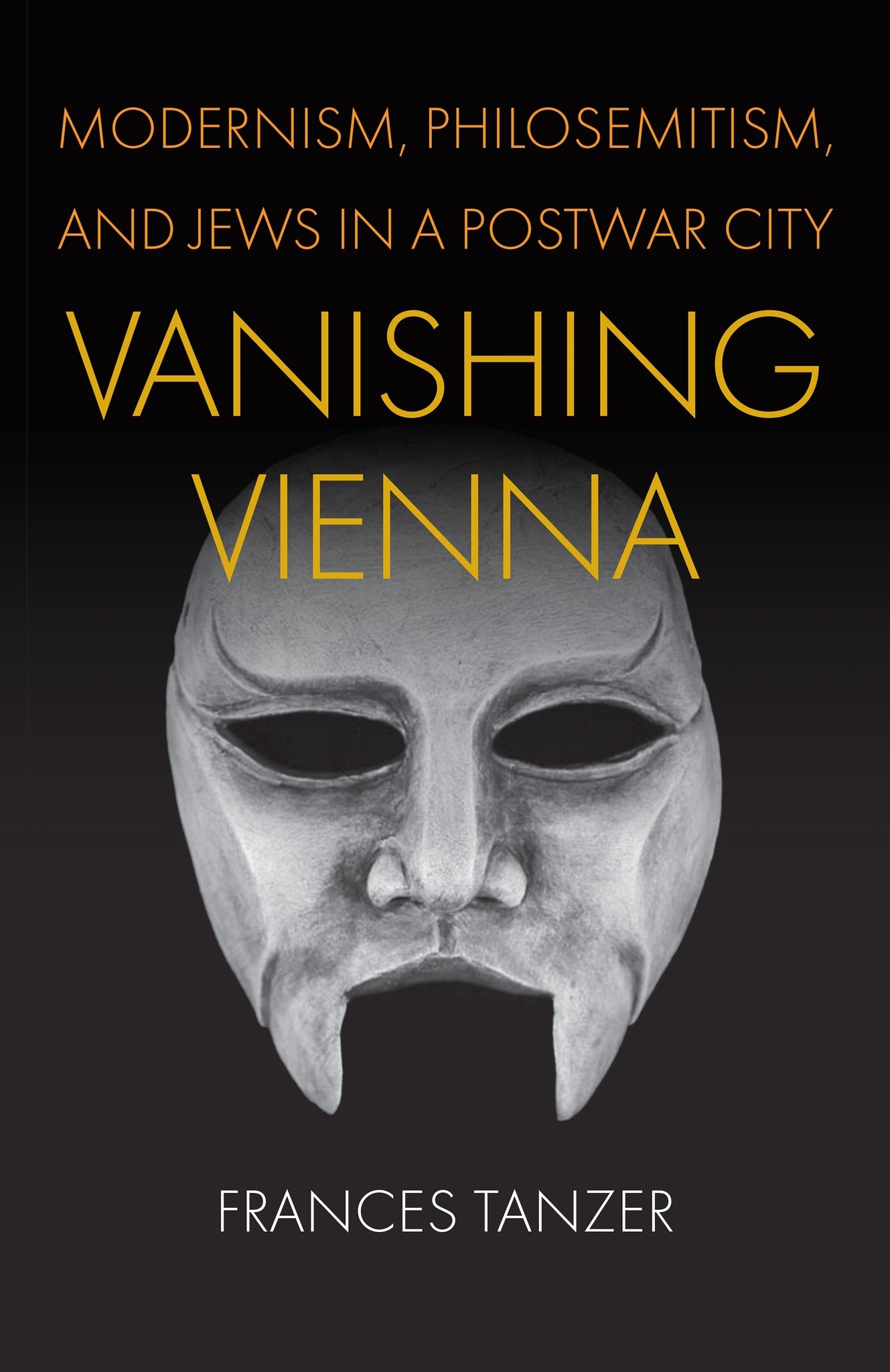
In Vanishing Vienna historian Frances Tanzer traces the reconstruction of Viennese culture from the 1938 German annexation through the early 1960s. The book reveals continuity in Vienna’s cultural history across this period and a framework for interpreting Viennese culture that relies on antisemitism, philosemitism, and a related discourse of Jewish presence and absence. This observation demands a new chronology of cultural reconstruction that links the Nazi and postwar years, and a new geography that includes the history of refugees from Nazi Vienna.
Rather than presenting the Nazi, exile, and postwar periods as discrete chapters of Vienna’s history, Tanzer argues that they are part of a continuous spectrum of cultural evolution—the result of which was the creation of a coherent Austrian identity and culture that emerged by the 1950s. As she shows, antisemitism and philosemitism were not contradictory forces in post-Nazi Austrian culture. They were deeply interconnected aspirations in a city where nostalgia for the past dominated cultural reconstruction efforts and supported seemingly contradictory impulses. Viennese nostalgia at times concealed the perpetuation of antisemitic fantasies of the city without Jews. At the same time, the postwar desire to return to a pre-Nazi past relied upon notions of Austrian culture that Austrian Jews perfected in exile, as well as on the symbolic remigration of a mostly imagined “Jewish” culture now taxed with redeeming Austria in the aftermath of the Holocaust. From this perspective, philosemitism is much more than a simple inversion of antisemitism—instead, Tanzer argues, philosemitism, problematic as it may be, defines Vienna in the era of postwar reconstruction.
In this way, Vanishing Vienna uncovers a rarely discussed phenomenon of the aftermath of the Holocaust—a society that consumes, redefines, and bestows symbolic meaning on the victims in their absence.


— Anson Rabinbach
"This is an important, eye-opening, and potentially controversial study, based on extensive archival research, which offers a subtle, often intricate reading of twentieth-century Austrian culture."
"Vanishing Vienna is a deft cultural history. Studying the ever-shifting position of Jews in Vienna’s cultural imagination, especially as it relates to Jewish migration and remigration, Tanzer elucidates the ways in which the city grappled with its annexation, its role in the Holocaust, and its place in postwar Europe."
"Wonderful, insightful, and deeply intuitive. . . . Tanzer’s argument is complex, subtle, and ultimately convincing."
— Samuel J. Kessler
"Frances Tanzer’s beautifully written and thoroughly researched analysis is an original, sophisticated take—essential reading for understanding the power and persistence of modern antisemitism."
"Well researched, readable, and highly perspicacious, Tanzer’s book shows how a combined investigation of elite and popular culture facilitates an understanding of the continuities, motivations, hidden desires, and paradoxes involved in the construction of a reimagined Viennese culture in mid-twentieth-century Austria."
— Alexander Vari
"Based on extensive archival research and engaged in conversations with earlier scholarship, Tanzer draws her readers in with her focus on modernist art, the coffeehouse, and cabaret. In lucid prose, she highlights how these traditions had grown out of non-Jewish and Jewish cooperation, revealing both antisemitic and philosemitic aspects of these efforts."
— Jacqueline Vansant