


Some error occured while loading the Quick View. Please close the Quick View and try reloading the page.
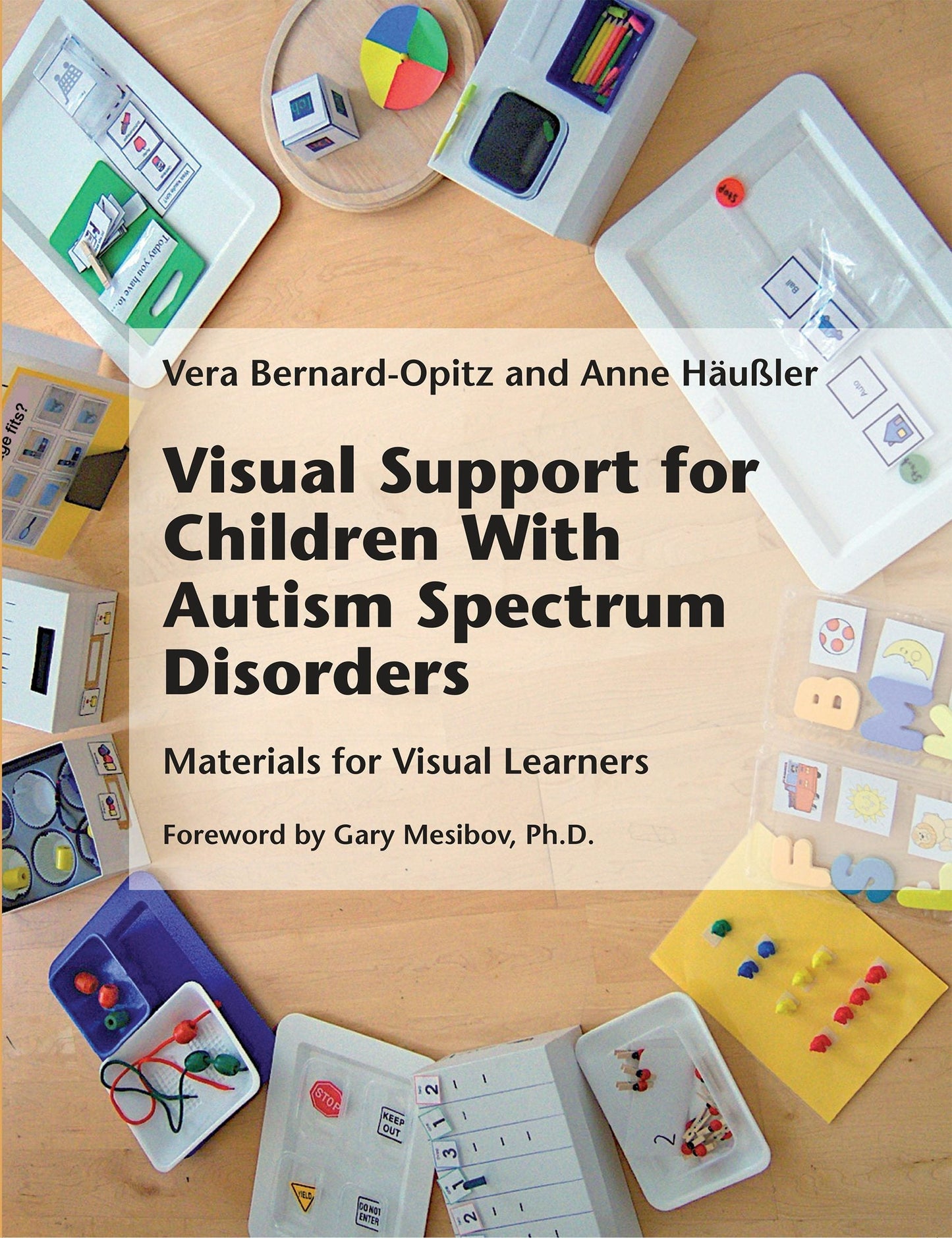
Combining their years of experience working with individuals on the autism spectrum, both here and around the world, authors Vera Bernard-Opitz and Anne Häußler bring teachers and other professionals practical ideas and teaching methods for offering visual supports to students with autism spectrum disorders and other visual learners.
With hundreds of colorful illustrations and step-by-step directions, this book lays the foundation for how to structure teaching environments, as well as offers countless examples of activities for students, ranging from basic skills, to reading and math, to social behavior.


"Most children with autism are visual learners. That’s why Visual Support for Children with Autism Spectrum Disorders is the perfect resource. This book provides an abundance of visual teaching activities and materials that will be an inspiration for educators as they develop successful learning opportunities for their students with ASD."
-Linda Hodgdon, M.Ed., CCC-SLP; author, Visual Strategies for Improving Communication
"This must-have book is beyond ‘comprehensive’; it’s a veritable soup-to-nuts approach to intervention! It also combines the best of both worlds – the structured teaching approach of the TEACCH model and an analytical approach to skill development. The illustrations and step-by-step instructions make setting up the environment and replicating intervention techniques an absolute cinch!"
-Diane Twachtman-Cullen, Ph.D., CCC-SLP; editor-in-chief, Autism Spectrum Quarterly
"Structure, visual support, empathy, and teamwork – the cornerstones of teaching in the field of ASD! Vera Bernard-Opitz and Anne Häußler have pooled their vast experience and practical know-how to present a well-organized, easy-to-use book. Clear instructions and explanations throughout, with examples as well as tips and ideas for how to design and structure tasks and activities, make this an indispensable resource for parents or professionals involved in the support of persons of all ages with ASD or other disabilities."
–Petra Dillmann, parent of an adult with autism; founder of Autism & Asperger's, Namibia
Preface and Acknowledgments 1
Introduction 3
Chapter 1: Levels of Structure 5
Physical Structure 5
Time Structure 6
Structure for Independent Work/Study Sessions 7
Structured Tasks and Activities 8
Chapter 2: Establishing the Basic Structure of Teaching Settings 11
Structuring Space 11
Structuring Time 16
Structuring Situations to Foster Independent Activity 23
Chapter 3: Prototypes of Tasks 29
Task Formats and Task Types 29
Prototypes for Developing Basic Skills 30
Put-In Tasks 30
Put-On Tasks 32
Pegboards 33
Stringing Tasks 34
Matching Tasks 35
Sorting Container 35
Tasks With Table Format 36
Form Boards and Puzzles 37
Sorting Tray 38
Lotto 39
Dominoes 39
Threading Tasks 40
Stamp and Clip Tasks 41
Envelope and Packaging Tasks 41
Individual Activities 43
Basic Skills 45
Put-In Tasks 46
Disassembling 50
Assembling 54
Fine-Motor Skills and Visual-Motor Coordination 58
Matching and Sorting 75
Matching and Sorting of Objects 76
Matching Objects and Pictures 82
Matching and Sorting of Pictures 84
Matching and Sorting of Colors 88
Matching and Sorting of Shapes 96
Matching and Sorting by Size and Length 104
Matching and Sorting of Categories 108
Reading, Writing, and Numerical Skills 113
Number, Amount, and Simple Calculation 114
Letters and Reading 136
Self-Help Skills 149
Shopping and Hygiene 150
Household Tasks and Chores 154
Packaging and Assembly Tasks 162
Play 169
Communication 181
Social Behavior 201
Enhancing Motivation and Managing Behavior 212
Enhancing Motivation 212
Managing Behavior 215
Group Rules 220
Chapter 5: Resources 223
References 225
Practical Resources 227