


Some error occured while loading the Quick View. Please close the Quick View and try reloading the page.
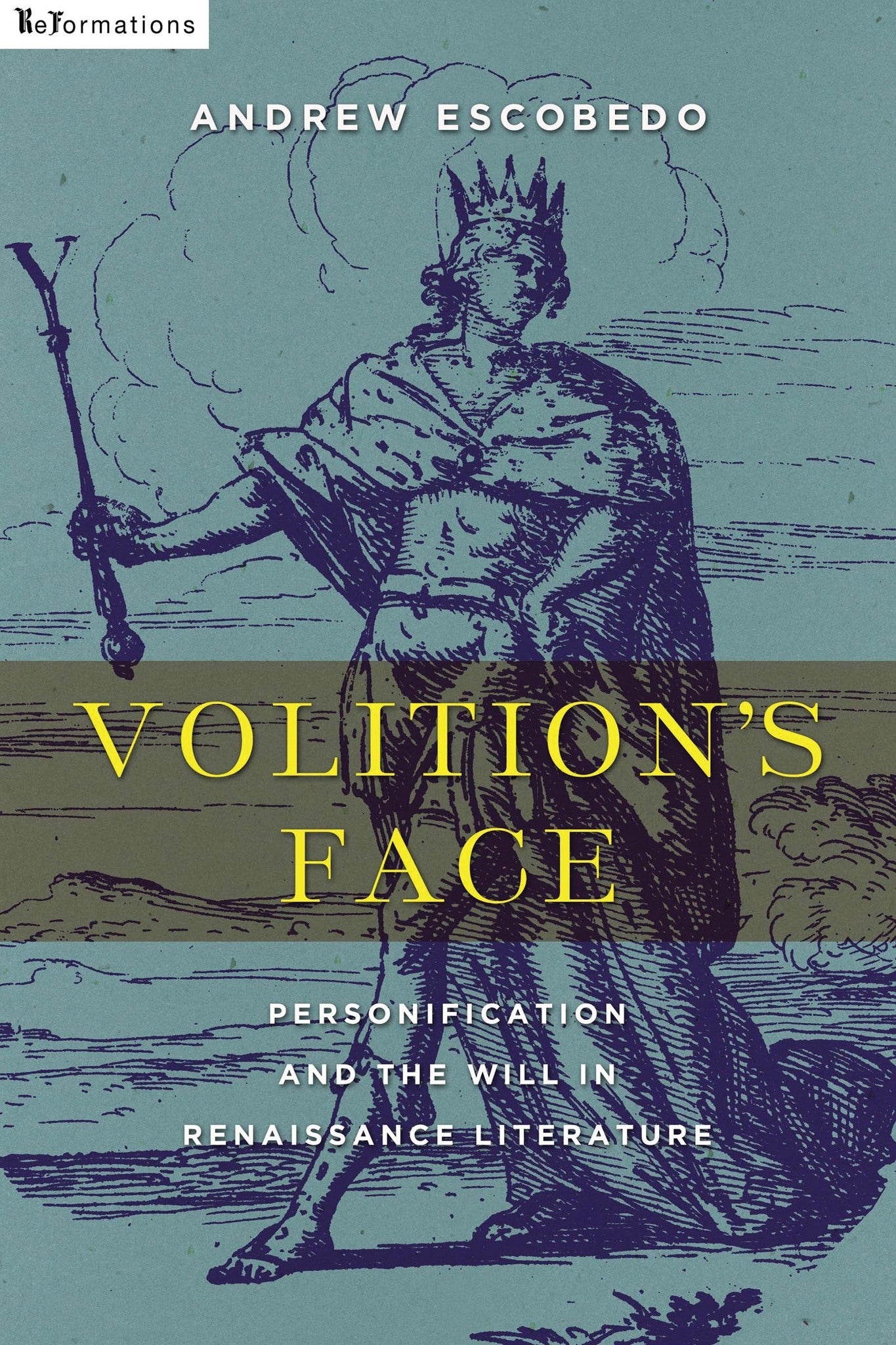
Modern readers and writers find it natural to contrast the agency of realistic fictional characters to the constrained range of action typical of literary personifications. Yet no commentator before the eighteenth century suggests that prosopopoeia signals a form of reduced agency. Andrew Escobedo argues that premodern writers, including Spenser, Marlowe, and Milton, understood personification as a literary expression of will, an essentially energetic figure that depicted passion or concept transforming into action. As the will emerged as an isolatable faculty in the Christian Middle Ages, it was seen not only as the instrument of human agency but also as perversely independent of other human capacities, for example, intellect and moral character. Renaissance accounts of the will conceived of volition both as the means to self-creation and the faculty by which we lose control of ourselves. After offering a brief history of the will that isolates the distinctive features of the faculty in medieval and Renaissance thought, Escobedo makes his case through an examination of several personified figures in Renaissance literature: Conscience in the Tudor interludes, Despair in Doctor Faustus and book I of The Faerie Queen, Love in books III and IV of The Faerie Queen, and Sin in Paradise Lost. These examples demonstrate that literary personification did not amount to a dim reflection of “realistic” fictional character, but rather that it provided a literary means to explore the numerous conundrums posed by the premodern notion of the human will. This book will be of great interest to faculty and graduate students interested in medieval studies and Renaissance literature.


“An excellent study, Volition’s Face is the most sophisticated account to date of the trope known as prosopopoeia, personification, as it developed from Classical times through the Christian Middle Ages to the Renaissance.” —Religion and Literature
“Volition’s Face is a highly exhilarating, informative, and entertaining study. Escobedo often reminds the academic reader that the most obvious explanations belie a complex theoretical framework.” —Parergon
“In chapter after chapter, Escobedo sees and delineates the connections between ancient and early modern ideas of personification and will, and it is difficult to do justice to the nuances of Escobedo’s argument in a brief review. Regardless, it is clear that specialists in medieval and Renaissance studies will find rewarding insights and significant contributions to the field in these pages.” —Sixteenth Century Journal
"Volition’s Face is remarkably subtle, nuanced, and comprehensive. Engaging works by Christopher Marlowe, Edmund Spenser, and John Milton, the book aims to capture premodern intuitions about the human will. Escobedo’s deft treatment of the tensions inherent in such a will—both cause and effect, both active and passive, both within and without—shows an intellectual control of a very high order. The historical sweep of Volition’s Face and its compelling arguments will make it an influential contribution to early modern literary studies." —David J. Baker, Peter G. Phialas Distinguished Professor of English and Comparative Literature, University of North Carolina at Chapel Hill
"In Volition's Face, Andrew Escobedo tracks the uses of allegorical personification from its prehistory in the Greek daemonic to its high points in Spenser and Milton. The originality of the argument is sure to draw attention, for Escobedo engages with the landmark studies of Fletcher, Teskey, and others, respectfully but convincingly redrawing the boundaries of the topic. He does so on the basis of a sustained and rigorous engagement with modern philosophical approaches to agency and volition, which lets him return to early modern literary texts in order to show how distinct conceptions of these categories are encoded within the literary practice of personification. It's a very strong book." —David Miller, Carolina Distinguished Professor, University of South Carolina
“This exhilarating and brilliant book will be a most welcome and timely addition to the ReFormations series, to which it will add distinction. . . . It is also a book that can be relished sentence by sentence, as Escobedo is a writer of intellectual verve and boldness, making hard-won claims look obvious once made.” —Sarah Beckwith, Katherine Everett Gilbert Professor of English, Duke University
“A valuable contribution to the scholarship tackling some of the most important and difficult problems in European literary history.” —Modern Philology
Andrew Escobedo is professor of English at Ohio State University and co-editor of Spenser Studies.
List of Illustrations
Preface
Introduction
1. Personification, Energy, and Allegory
2. The Prosopopoetic Will: Ours, though Not We
3. Conscience in the Tudor Interludes
4. Despair in Marlowe and Spenser
5. Love and Spenser’s Cupid
6. Sin and Milton’s Angel
Epilogue: Premodern Personification and Posthumanism?
Notes
Bibliography
Index