


Some error occured while loading the Quick View. Please close the Quick View and try reloading the page.
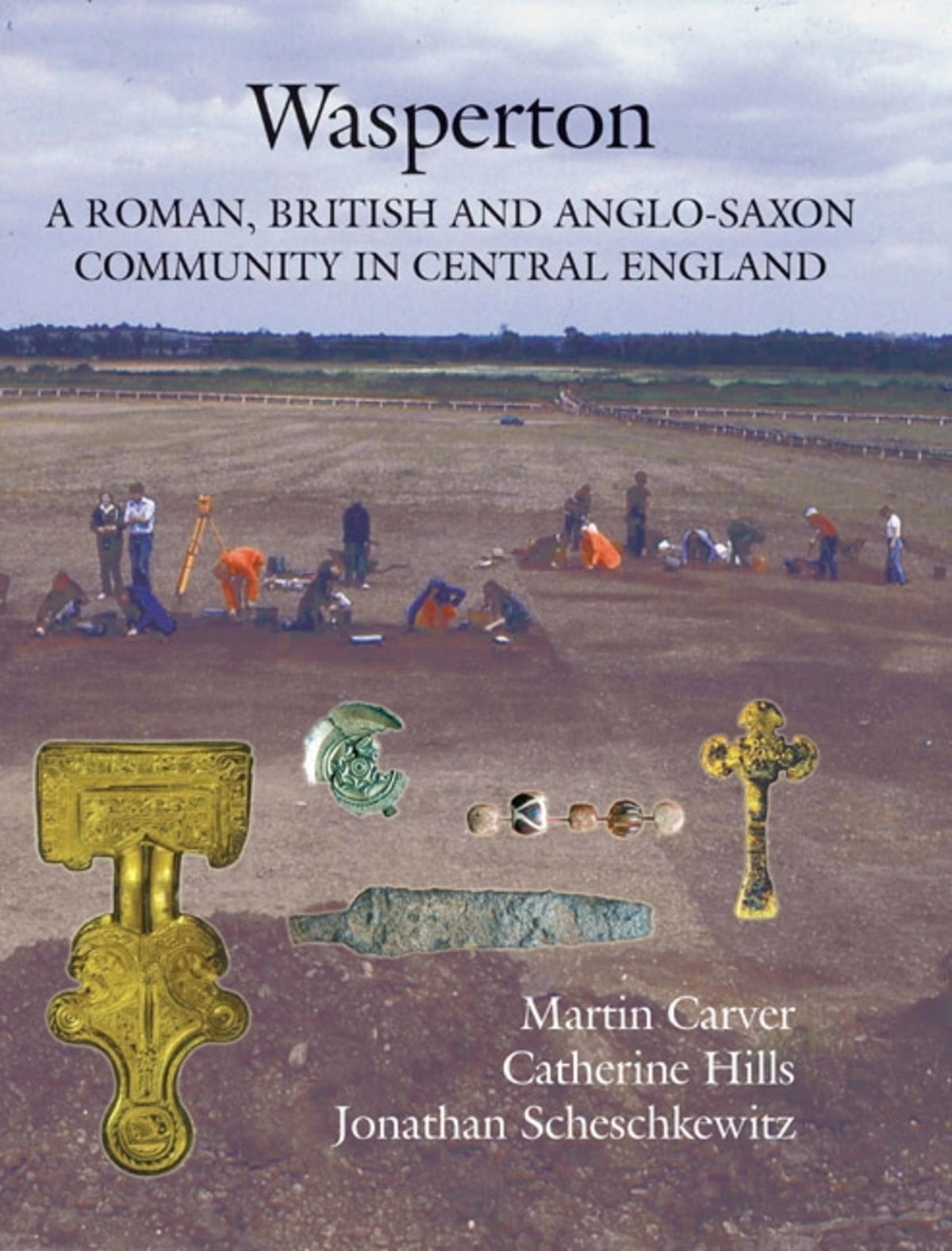
The newest research on a major Anglo-Saxon site paints a vivid picture of the beginnings of England.
[Edited by Martin Carver] For decades scholars have puzzled over the true story of settlement in Britain between the fifth and eight centuries. Did the Romans leave? Did the Anglo-Saxons invade? What happened to the British? Newlight on these questions comes unexpectedly from Wasperton, a small village on the Warwickshire Avon, where archaeologists had the good fortune to excavate a complete cemetery and its prehistoric setting. The community reused an old Romano-British agricultural enclosure, and built burial mounds beside it. There was a score of cremations in Anglo-Saxon pots; but there were also unfurnished graves lined with stones and planks in the manner of western Britain.
In a pioneering analysis, including radiocarbon and stable isotopes, the authors of this book have put this variety of burial practice into a credible sequence, and built up a picture of life at the time. Here there were people who were culturally Roman, British and Anglo-Saxon, pagan and Christian in continuous use of the same graveyard and drawing on a common inheritance. Here we can see the beginnings of England and the people who made it happen- not the kings, warriors and preachers, but the ordinary folk obliged to make their own choices: choices about what nation to build and which religion to follow.
MARTIN CARVER is Professor Emeritus of Archaeology at the University of York; Dr CATHERINE HILLS is Senior Lecturer in Anglo-Saxon Archaeology at the University of Cambridge; Dr JONATHAN SCHESCHKEWITZ is Officer with the Ancient Monuments authority of Stuttgart.
[Edited by Martin Carver] For decades scholars have puzzled over the true story of settlement in Britain between the fifth and eight centuries. Did the Romans leave? Did the Anglo-Saxons invade? What happened to the British? Newlight on these questions comes unexpectedly from Wasperton, a small village on the Warwickshire Avon, where archaeologists had the good fortune to excavate a complete cemetery and its prehistoric setting. The community reused an old Romano-British agricultural enclosure, and built burial mounds beside it. There was a score of cremations in Anglo-Saxon pots; but there were also unfurnished graves lined with stones and planks in the manner of western Britain.
In a pioneering analysis, including radiocarbon and stable isotopes, the authors of this book have put this variety of burial practice into a credible sequence, and built up a picture of life at the time. Here there were people who were culturally Roman, British and Anglo-Saxon, pagan and Christian in continuous use of the same graveyard and drawing on a common inheritance. Here we can see the beginnings of England and the people who made it happen- not the kings, warriors and preachers, but the ordinary folk obliged to make their own choices: choices about what nation to build and which religion to follow.
MARTIN CARVER is Professor Emeritus of Archaeology at the University of York; Dr CATHERINE HILLS is Senior Lecturer in Anglo-Saxon Archaeology at the University of Cambridge; Dr JONATHAN SCHESCHKEWITZ is Officer with the Ancient Monuments authority of Stuttgart.

Price: $190.00
Pages: 384
Publisher: Boydell & Brewer Inc.
Imprint: Boydell Press
Publication Date:
February 19, 2009
Trim Size: 11.02 X 8.54 in
ISBN: 9781843834274
Format: Hardcover
BISACs:
SOCIAL SCIENCE / Archaeology, Archaeology, HISTORY / Ancient / General

Essential reading for every archaeologist and historian of late Roman and early medieval Europe.
Has much to offer students of late-Roman and post-Roman Britain. [...] As a reference for historians of early medieval Britain, this volume has much to recommend it.
Including newly-commissioned scientific and specialist analyses, it provides a comprehensive and welcome statement in English which offers new readings of the cemetery's sequence and significance. [...] This study offers a strong, acute and stimulating narrative that recognises the local and immediate in the long and broad perspectives.
Features an up-to-date account of scholarly views on ethnicity and migration theory in Anglo-Saxon studies.
The authors weave a convincing story of migration and acculturation, asking how indigenous Britons become Romanised and Saxonised and what degree of choice versus compulsion they experienced. [...] Martin Carver's final chapter discussing these issues ('Wasperton in Context') is a masterpiece that every archaeology student needs to read, no matter what their period of study, as an example of archaeological analysis and argument at its very best.
This is not just an Anglo-Saxon cemetery report; it could be one of the most interesting and important yet published. [...] Careful arguments result in the beautifully written story of a community going through massive cultural changes. This is groundbreaking stuff: a new way to study the physical remains of these small communities should change the way we look at the end of Roman Britain and the start of the medieval world.
Has much to offer students of late-Roman and post-Roman Britain. [...] As a reference for historians of early medieval Britain, this volume has much to recommend it.
Including newly-commissioned scientific and specialist analyses, it provides a comprehensive and welcome statement in English which offers new readings of the cemetery's sequence and significance. [...] This study offers a strong, acute and stimulating narrative that recognises the local and immediate in the long and broad perspectives.
Features an up-to-date account of scholarly views on ethnicity and migration theory in Anglo-Saxon studies.
The authors weave a convincing story of migration and acculturation, asking how indigenous Britons become Romanised and Saxonised and what degree of choice versus compulsion they experienced. [...] Martin Carver's final chapter discussing these issues ('Wasperton in Context') is a masterpiece that every archaeology student needs to read, no matter what their period of study, as an example of archaeological analysis and argument at its very best.
This is not just an Anglo-Saxon cemetery report; it could be one of the most interesting and important yet published. [...] Careful arguments result in the beautifully written story of a community going through massive cultural changes. This is groundbreaking stuff: a new way to study the physical remains of these small communities should change the way we look at the end of Roman Britain and the start of the medieval world.
Summary
The Wasperton Sequence
Description of the investigation
Setting and character of the cemetery
Assemblages: provenance and date
Arguments for the sequence
Wasperton in context
Catalogue
Bibliography
The Wasperton Sequence
Description of the investigation
Setting and character of the cemetery
Assemblages: provenance and date
Arguments for the sequence
Wasperton in context
Catalogue
Bibliography