


Some error occured while loading the Quick View. Please close the Quick View and try reloading the page.
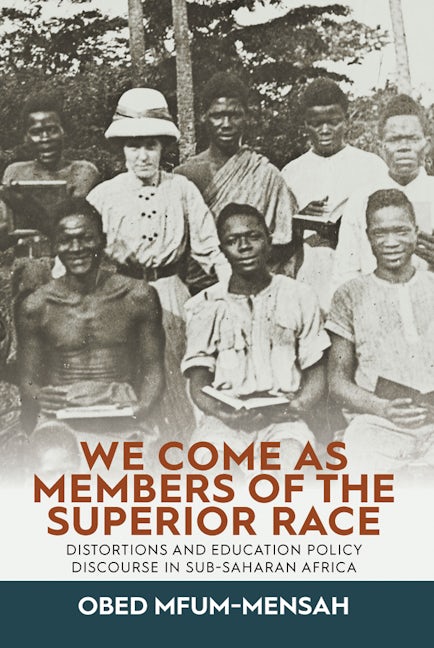
Westerners have long represented Africans as “backwards,” “primitive,” and “unintelligent,” distortions which have opened the door for American philanthropies to push their own education agendas in Africa. We Come as Members of the Superior Race discusses the origin and history of these dangerous stereotypes and western “infantilization” of African societies, exploring how their legacy continues to inform contemporary educational and development discourses. By viewing African societies as subordinated in a global geopolitical order, these problematic stereotypes continue to influence education policy and research in Sub-Sahara Africa today.


“This book is a very good introduction to the connections between education and colonialism, thanks particularly to the author’s mastery of a wide body of scholarly literature.” • Choice
“We Come as Members of the Superior Race interrogates European colonialism and neocolonial policies, searching deep into the history of Africans’ encounters with Europeans and the dark ideas that the latter held of Africans as a backdrop for exploring detrimental education policies”. • Martha Donkor, West Chester University
Obed Mfum-Mensah is Professor of Sociology of Education at Messiah University at Mechanicsburg, Pennsylvania. His research includes postcolonial analysis of education policy and knowledge transfer in Sub-Saharan Africa, education of marginalized groups, curriculum theorizing, and alternative forms of schooling in the developing world.
Acknowledgments
Part I: Western Distortions and Stereotypes about Sub-Saharan Africa
Chapter 1. Theorization and “Africa” in European-American Imaginations
Chapter 2. “Dirty Gossips” and a Different “Africa” in the Global Geopolitical Order
Chapter 3. Architects of European “Dirty Gossips” about Africa
Part II: Effects of Distortions on Education and Development Discourses in Sub-Saharan Africa
Chapter 4. Education and Social Stratification in Sub-Saharan Africa
Chapter 5. American Philanthropy and Industrial Education for Black Africans
Chapter 6. Philanthropy, Education, and Race Relations in Sub-Saharan Africa
Chapter 7. A Generation of Slackers and Lazy-People Demanding Handouts?
Chapter 8. The Political Economy of Affirmative Initiatives in Sub-Saharan Africa
Chapter 9. “Dirty Gossip” and Education Policy Discourse in Sub-Saharan Africa
Conclusion
Bibliography