


Some error occured while loading the Quick View. Please close the Quick View and try reloading the page.
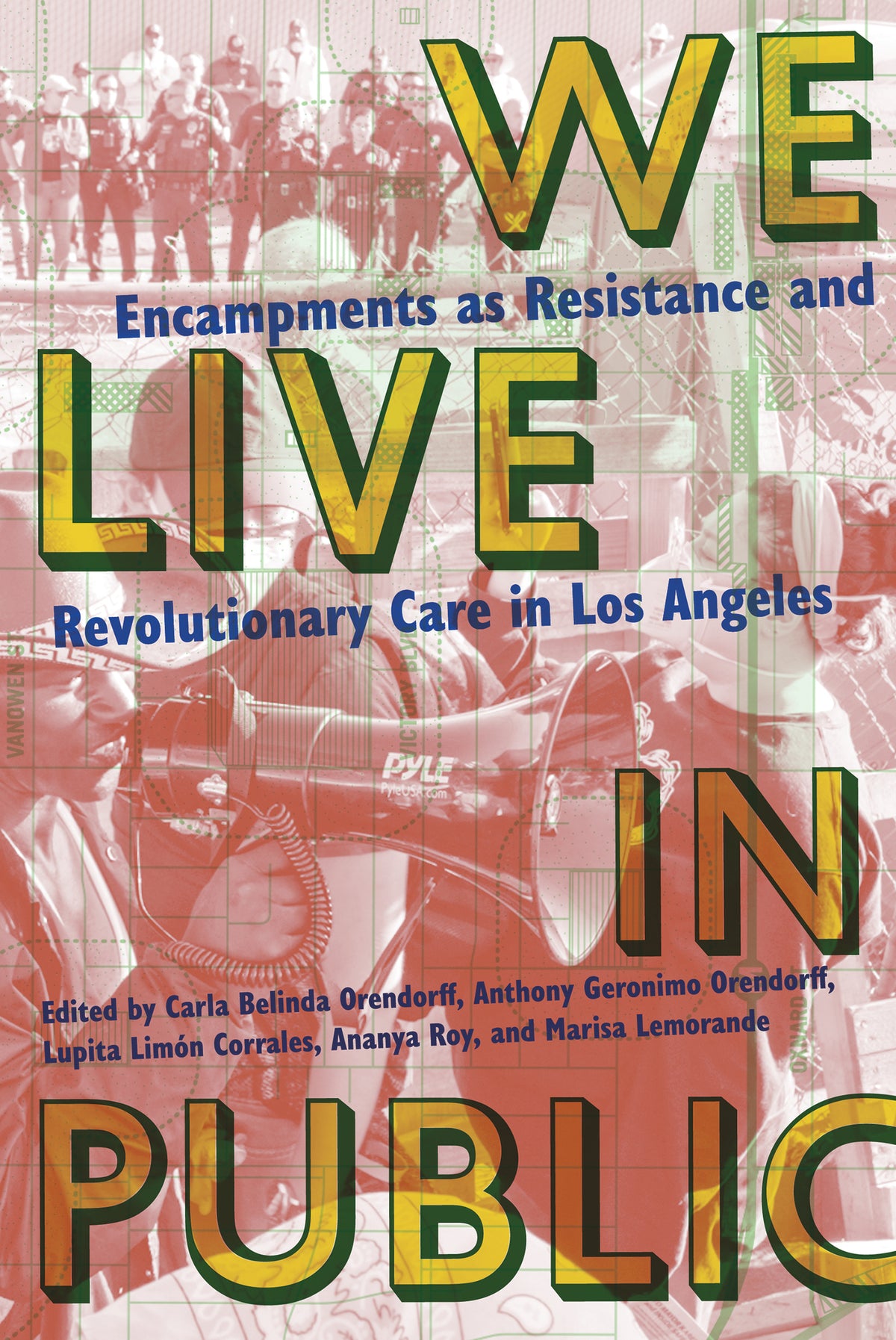
Written by unhoused people and their allies, We Live in Public is an invitation to revolutionary care in a time of class war.
Los Angeles is one of the richest and most unequal cities in the world, where nine unhoused people die every day. As rent rises, evictions increase, and houselessness grows, the homeless encampment becomes both a symptom of organized abandonment and a site of insurgent knowledge and practice. We Live in Public was conceptualized and written by residents and organizers of one such encampment, Aetna Street, whose experiences offer strategies for solidarity and survival in the face of escalating state violence.
Many people’s worst fear is to be homeless, equating it with social death. But within the encampment, we see people living with wisdom and maps to offer. Throughout this book, Aetna residents and organizers generously share such insights and analysis. We Live in Public insists that these histories provide crucial lessons in modes of collective living and must be at the center of public history and knowledge.
Centering those who care for others on the street, it is an invitation to revolutionary care in the time of war. That war is the more immediate criminalization of homelessness and the longer arc of the unrelenting settlement of the US. We Live in Public is a refusal of such settler-colonial logics in the making of home and place.


“We Live in Public shows through text and pictures what it means to say 'where life is precious life is precious.' Aetna Street was abolition-as-practice, a model -- not blueprint -- for solidarity-as-care. The flourishing consciousness depicted in these remarkable pages insists that 'life does not end when fear of becoming homeless comes true.' Rather, like comrades worldwide, the encampment’s residents are militant subjects who refuse passivity in the face of organized abandonment and organized violence. Through analysis and example, this composition is an urgent book.”—Ruth Wilson Gilmore, Professor of Earth & Environmental Sciences, Africana Studies, and American Studies at the Graduate Center of the City University of New York and author of Abolition Geography
“I fell in love with the title and content of this collection, augmented by the principles and commitments that ground it, and the amazing writers who contributed. A justice-seeking collaboration between organizer-researchers, many of them unhoused, and university-based scholars, the book encapsulates all the hope and contradictions of this political moment as they play out on LA’s harsh urban landscape. Stewarded by the brilliant Ananya Roy, this project is an exemplary model of insurgent intellectual work at its best, insisting we move from despair to determined resistance, and from words to action, and that we respectfully put voices too long marginalized at the very center of all we do.”—Barbara Ransby, John D. MacArthur University Chair, Professor of Black Studies, Gender and Women’s Studies and History at University of Illinois at Chicago and author of Making All Black Lives Matter
"Grounded in love and liberation, this is what justice looks like."—Nicholas Blomley, Professor of Geography at Simon Fraser University
Carla Belinda Orendorff is a community organizer living in the suburban hell of Los Angeles.
Anthony Geronimo Orendorff is a street journalist and multidisciplinary artist born and raised in the San Fernando Valley, Los Angeles.
Lupita Limón Corrales is a poet, artist, organizer, and language interpreter born in Sinaloa, Mexico, and raised in the San Gabriel Valley.
Ananya Roy is Professor of Urban Planning, Social Welfare, and Geography and the Meyer and Renee Luskin Chair in Inequality and Democracy at the University of California, Los Angeles. She is the founding director of the UCLA Luskin Institute on Inequality and Democracy, which advances research and scholarship on displacement and dispossession in Los Angeles and elsewhere.
Marisa Lemorande joined the UCLA Luskin Institute on Inequality and Democracy in 2018 as deputy director and has supported the Institute’s continued growth in public programming, open-access scholarship, community-centered collaborations, and philanthropic relationships.
Robin D. G. Kelley is Professor of History at the University of California, Los Angeles. His books include Freedom Dreams: The Black Radical Imagination; Africa Speaks, America Answers: Modern Jazz in Revolutionary Times; Thelonious Monk: The Life and Times of an American Original; and Black, Brown and Beige: Surrealist Writings from Africa and the African Diaspora (coedited with Franklin Rosemont). His essays have appeared in a wide variety of publications, including Nation, New York Times, frieze, New York Review of Books, Hammer and Hope, and Boston Review, where he is contributing editor.
Preface - Robin D.G. Kelley
Introduction: Revolutionary Care in the Time of War - The Editors
A brief introduction to the book by the editors.
1. Living Beyond Eviction - Rebecca Chavez with Lupita Limón Corrales
In this chapter, Aetna resident Rebecca Chavez, analyzes how she has created modes of living amidst death-dealing evictions and carceral shelter programs.
2. Open Letter from Aetna Street on the Eve of Our 41.18 Eviction - Aetna Residents
One of several open letters by Aetna residents to elected officials and powerholders in the City of Los Angeles.
3. The Vanishing Point of Research Justice - Ananya Roy
The Institute’s work is underpinned by principles and practices of research justice. In this chapter, Ananya Roy presents an auto-critique of such work and foregrounds some of the fraught moments in the making of this book.
4. Encampments as Freedom Schools - Carla Orendorff
Written by Carla Orendorff, long-time Aetna organizer and lead editor of the book, this chapter lays out key moments of organizing at Aetna Street and also provides a critical analysis of the role of the public university in such struggles.
5. Street Matriachy - Carla Orendorff
What do institutions built by people who are criminalized, institutionalized, and systemically excluded from society teach us? Street Matriarchy is a deeply understood sense of injustice, knowing that even if you become housed after surviving homelessness, you can never truly leave the streets behind, while others are still out there.
6. Memorial: Anthony “Tony” Goodwin
These “memorials” serve as an interlude between chapters and are intended to honor beloved Aetna comrades whose lives have been stolen by state violence.
7. The Homeless Olympics - Giselle Harrell
Written by long-time Aetna resident, Giselle Harrell, this chapter frames the criminalization of homelessness and living in public as the “Homeless Olympics.”
8. Healing in Public - All Power Free Clinic
Written by a collective of radical health workers, this chapter provides a trenchant critique not only of the Medical Industrial Complex but also of institutionalized street medicine. In contrast, it presents a vision and practice of liberatory healing and medical (ac)complicity.
9. Streets Have Mothers Too - Anthony Orendorff
This photomontage chapter takes us inside one of the countless sweeps endured by Aetna residents. In particular, it focuses on the harassment of Green Eyes, an Aetna elder, who died a few months later on the streets.
10. Earth Debt - Lupita Limón Corrales
A poetry offering by one of the editors of this book.
11. Invention - Ronald Hams with Paisley Mares
Long-time Aetna resident, Ronald Hams, is known for his street inventions. In this chapter, Ron describes key inventions, from the platform on wheels to the wheel of misfortune, and how they disrupt the logics of criminalization and displacement.
12. Memorial: Terry Mason Kendrick
13. Entrapment - Jennifer Blake
In this chapter, Aetna resident Jenn Blake shares the arguments about law, discrimination, and justice that underpin her paintings as well as her long-time advocacy for housing rights.
14. Webs of Abolition - Paisley Mares
In this chapter, Aetna Solidarity organizer Paisley Mares shows how trauma and violence circulate through inter-personal relationships and shares accounts of abolition in practice on the streets.
15. Memorials on the Street - Carla Orendorff
An altar remembering stolen lives.
16. Crossing the Line - Anthony Orendorff
In this chapter, Anthony Orendorff, co-editor of this book, relates the policing of Aetna Streets to the forms of policing he and his family have experienced in Los Angeles.
Epilogue: Afterlives of the Encampment - Ananya Roy