


Some error occured while loading the Quick View. Please close the Quick View and try reloading the page.
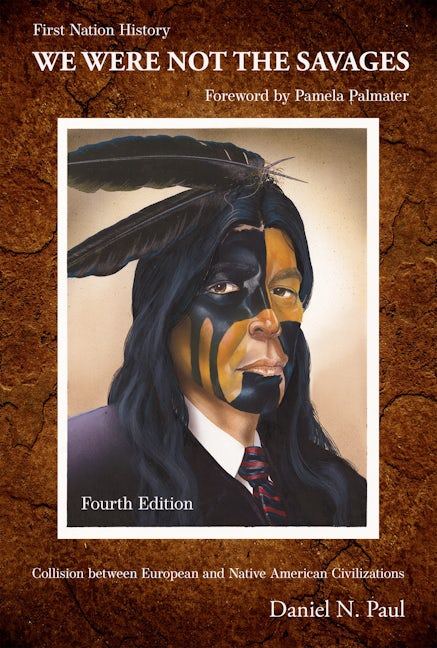
The title of this book We Were Not the Savages speaks to the truth of what happened when Europeans invaded Mi’kmaw lands in the 17th century. Prior to the European invasion the Mi’kmaq lived healthy lives and for thousands of years had lived in harmony with nature in the land they called Mi’kma’ki. This book sets the record straight. When the Europeans arrived they were welcomed and sustained by the Mi’kmaq. Over the next three centuries their language, their culture, their way of life were systematically ravaged by the newcomers to whom they had extended human kindness. The murderous savagery of British scalp proclamations, starvation, malnutrition and Canada’s Indian residential and day schools all but wiped out the Mi’kmaq. Yet the Mi’kmaq survived and today stand defending the land, the water and nature’s bounty from the European way of life, which threatens the natural world we live in and need to survive.
Since the first edition was published in 1993, Daniel Paul’s ongoing research confronts the mainstream record of Canadian settler colonialism and reveals that the mistreatment of Indigenous Peoples is not confined to the past. In this 4th edition the author shares his research, which catalogues not only the historical tragedy but the ongoing attempts to silence the Mi’kmaq and other Indigenous Peoples. Paul’s work continues to give the Mi’kmaq a voice that must be heard.


Daniel N. Paul was born in 1938 on the Indian Brook Reserve, Nova Scotia, and now resides in Halifax with his wife Patricia. Paul, a freelance lecturer and journalist, is an ardent activist for human rights. He is a justice of the peace, a member of the NS Police Commission and has served on several other provincial commissions, including the Human Rights Commission and the Nova Scotia Department of Justice’s Court Re-structuring Task Force. He holds, among many awards, honorary degrees from the University of Sainte Anne and Dalhousie University and is a member of both the Order of Canada and the Order of Nova Scotia. Previously, Paul was employed by the Department of Indian Affairs and was the founding executive director of the Confederacy of Mainland Mi’kmaq (CMM). His writing career includes a novel, Chief Lightning Bolt, several booklets, magazine articles, hundreds of newspaper columns, chapters for a dozen or so edited books.
: Foreword
: Civilization, Democracy and Government
: Mi’kmaq Social Values and Economy
: European Greed and the Mi’kmaq Resolve to Fight
: Persecution, War, Alliance and Terrorism
: The Treaty of 1725 and Proclamations
: Flawed Peace and the Treaty of 1749
: More Bounties for Human Scalps and the Treaty of 1752
: The Futile Search for a Just Peace, 1752–1761
: Burying of the Hatchet Ceremony of 1761 and the Royal Proclamation of 1763
: Dispossession and the Imposition of Poverty
: The Edge of Extinction
: Confederation and the Indian Act
: Twentieth-Century Racism and Centralization
: The Struggle For Freedom
: Select Bibliography