


Some error occured while loading the Quick View. Please close the Quick View and try reloading the page.
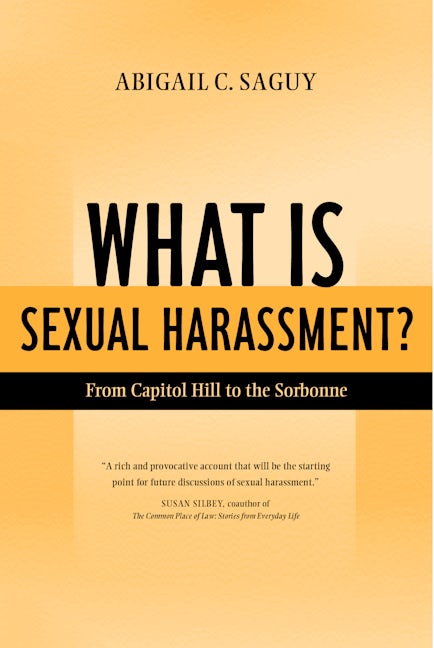
In France, a common notion is that the shared interests of graduate students and their professors could lead to intimate sexual relations, and that regulations curtailing those relationships would be both futile and counterproductive. By contrast, many universities and corporations in the United States prohibit sexual relationships across hierarchical lines and sometimes among coworkers, arguing that these liaisons should have no place in the workplace. In this age of globalization, how do cultural and legal nuances translate? And when they differ, how are their subtleties and complexities understood? In comparing how sexual harassment—a concept that first emerged in 1975—has been defined differently in France and the United States, Abigail Saguy explores not only the social problem of sexual harassment but also the broader cultural concerns of cross-national differences and similarities.

Price: $34.95
Pages: 252
Publisher: University of California Press
Imprint: University of California Press
Publication Date:
13 August 2003
Trim Size: 9.00 X 6.00 in
ISBN: 9780520237414
Format: Paperback

Abigail C. Saguy is Assistant Professor of Sociology at the University of California, Los Angeles.
List of Illustrations
Acknowledgments
Introduction: The Making of a Concept
1. Sexual Harassment Law on the Books: Opportunity Loss v. Violence
2. Sexual Harassment Law in Action: Legitimacy and Liability
3. Sexual Harassment in the Press: National Scandal, Pride, or Superiority?
4. Discrimination, Violence, Professionalism, and the Bottom Line: How Interview Respondents Frame Sexual Harassment
Conclusion: Institutions, Framing, and Political Power
Epilogue: Plus ça change, plus c’est la même chose
Appendix: Methodological Details
Notes
Bibliography
Index
Acknowledgments
Introduction: The Making of a Concept
1. Sexual Harassment Law on the Books: Opportunity Loss v. Violence
2. Sexual Harassment Law in Action: Legitimacy and Liability
3. Sexual Harassment in the Press: National Scandal, Pride, or Superiority?
4. Discrimination, Violence, Professionalism, and the Bottom Line: How Interview Respondents Frame Sexual Harassment
Conclusion: Institutions, Framing, and Political Power
Epilogue: Plus ça change, plus c’est la même chose
Appendix: Methodological Details
Notes
Bibliography
Index