


Some error occured while loading the Quick View. Please close the Quick View and try reloading the page.
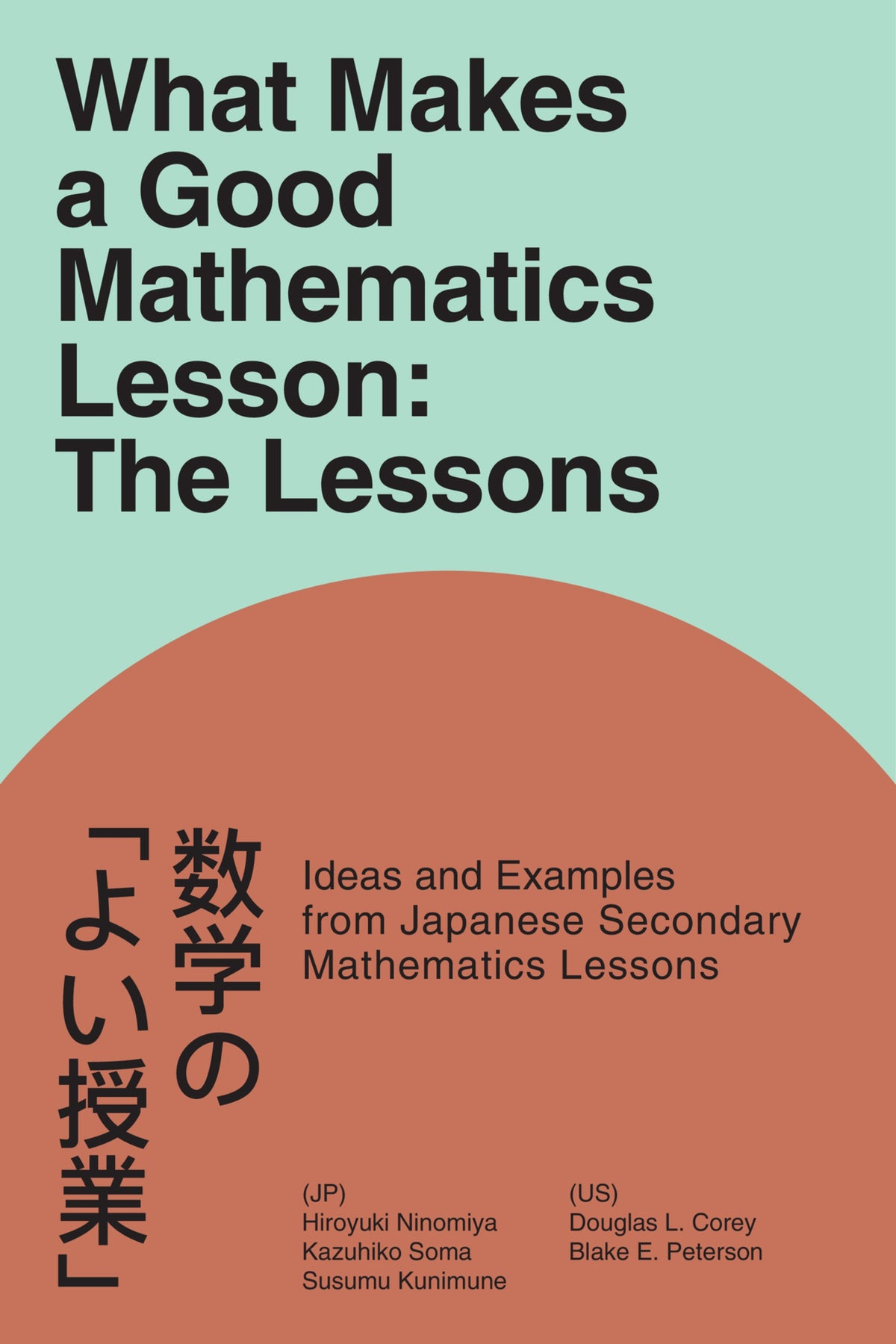
Have you ever wondered What Makes a Good Mathematics Lesson?
For many years, this has been a topic of conversation between American mathematics educators Douglas Corey and Blake Peterson, and their Japanese colleagues Hiroyuki Ninomiya, Kazuhiko Soma, and Susumu Kunimune. This conversation led these Japanese mathematics educators to articulate “key considerations” that should be addressed when preparing a good mathematics lesson and the “criteria” that can be used as guidelines when reflecting on the quality of a lesson after it has been taught.
The three considerations are:
Make the Goal of the Lesson Clear
Thoughtfully Decide on the Problem and its Presentation
Plan Ways to Incorporate Students’ Ideas
And the questions corresponding to the criteria are:
Were Students Proactively Engaged and Did They Continue to Think for Themselves?
Were the Objectives Appropriately Set and Achieved?
In What Makes a Good Mathematics Lesson: The Lessons, 27 Japanese middle school teachers describe lessons in which they implemented the key considerations and two criteria. At the end of this book, four US teachers each describe their adaptation of one of these 27 lessons in their classroom and contextualize the key considerations and criteria for their respective situations.
In What Makes a Good Mathematics Lesson: The Theory, the Japanese authors discuss the conceptual underpinning of the three key considerations and two criteria. The Theory also includes an introductory chapter written by the American mathematics educators contextualizing Japanese mathematics education for an English-speaking audience.


Douglas L. Corey is a Professor of Mathematics Education at Brigham Young University.
Hiroyuki Ninomiya is a Professor of Mathematics Education at Saitama University.
Blake E. Peterson is a Professor of Mathematics Education at Brigham Young University.
Kazuhiko Soma is a Professor of Mathematics Education at Hokkaido University.
Susumu Kunimune is a Professor Emeritus of Mathematics Education at Shizuoka University.
Chapter 1. Introduction: Contextualizing the Lessons; Blake E. Peterson
Section 1. 27 Japanese Mathematics Lessons
Chapter 2. Multiplying Numbers; Takurou Wakamatsu
Chapter 3. The Purpose of Expressing Quantities with Variables; Daisuke Morita
Chapter 4. The Meaning of Algebraic Expressions; Kumi Yoshimura
Chapter 5. Using Variables and Expressions; Kenji Sakamoto
Chapter 6. Equations with Fractional Coefficients; Yasunori Suzuki
Chapter 7. Using Linear Equations; Yousuke Morooka
Chapter 8. Inverse Proportion Graphs; Naoki Yachimoto
Chapter 9. Using Proportions; Miki Mochizuki
Chapter 10. The Surface Area of Cones; Masao Kondou
Chapter 11. Cross-Sections of a Cube; Kenji Sakamoto
Chapter 12. Representative Values; Takurou Wakamatsu
Chapter 13. The Use of Formula Calculations; Naoki Yachimoto
Chapter 14. Simultaneous Equations and Their Solutions; Kazunori Numazawa
Chapter 15. Using Simultaneous Equations (Three-Variable Simultaneous Linear Equations); Kouji Kishimoto
Chapter 16. How to Solve for the Equation of a Line; Yasunori Suzuki
Chapter 17. The Use of Linear Functions; Kazunori Numazawa
Chapter 18. How to Find the Properties of Figures (The Meaning of Proofs); Naoki Yachimoto
Chapter 19. Using the Properties of Figures (Five-Pointed Stars); Kouji Kishimoto
Chapter 20. Construction and Proofs; Miki Mochizuki
Chapter 21. Various Probabilities; Yasunori Suzuki
Chapter 22. Large and Small Square Roots; Takurou Wakamatsu
Chapter 23. The Meaning of the Function 2; Kazunori Numazawa
Chapter 24. Using Functions; Miki Mochizuki
Chapter 25. Using Conditions for Triangle Similarity; Kenji Sakamoto
Chapter 26. Using the Characteristics of Circles; Tooru Aoki
Chapter 27. Using the Pythagorean Theorem; Ikumi Kawai"
Chapter 28. Use of Sampling; Masao Kondou
Section 2. Four US Mathematics Lessons
Chapter 29. Solving Equations with Variable on Both Sides; Jose Carrillo
Chapter 30. Solving For the Equation of a Line; Nikki Mendenhall
Chapter 31. Various Probabilities; Jill Durrant
Chapter 32. Piece-wise Functions and Attributes of Linear and Quadratic Change; Travis Lemon