


Some error occured while loading the Quick View. Please close the Quick View and try reloading the page.
Learn Inner Nurturing and End Emotional Eating
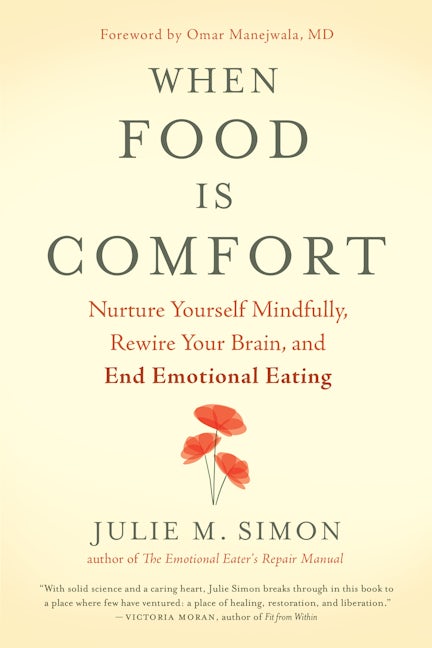
If you regularly eat when you’re not truly hungry, choose unhealthy comfort foods, or eat beyond fullness, something is out of balance. Recent advances in brain science have uncovered the crucial role that our early social and emotional environment plays in the development of imbalanced eating patterns. When we do not receive consistent and sufficient emotional nurturance during our early years, we are at greater risk of seeking it from external sources, such as food. Despite logical arguments, we have difficulty modifying our behavior because we are under the influence of an emotionally dominant part of the brain.
The good news is that the brain can be rewired for optimal emotional health. When Food Is Comfort presents a breakthrough mindfulness practice called Inner Nurturing, a comprehensive, step-by-step program developed by an author who was herself an emotional eater. You’ll learn how to nurture yourself with the loving-kindness you crave and handle stressors more easily so that you can stop turning to food for comfort. Improved health and self-esteem, more energy, and weight loss will naturally follow.
If you regularly eat when you’re not truly hungry, choose unhealthy comfort foods, or eat beyond fullness, something is out of balance. Recent advances in brain science have uncovered the crucial role that our early social and emotional environment plays in the development of imbalanced eating patterns. When we do not receive consistent and sufficient emotional nurturance during our early years, we are at greater risk of seeking it from external sources, such as food. Despite logical arguments, we have difficulty modifying our behavior because we are under the influence of an emotionally dominant part of the brain.
The good news is that the brain can be rewired for optimal emotional health. When Food Is Comfort presents a breakthrough mindfulness practice called Inner Nurturing, a comprehensive, step-by-step program developed by an author who was herself an emotional eater. You’ll learn how to nurture yourself with the loving-kindness you crave and handle stressors more easily so that you can stop turning to food for comfort. Improved health and self-esteem, more energy, and weight loss will naturally follow.

Price: $19.95
Pages: 336
Publisher: New World Library
Imprint: New World Library
Publication Date:
20 March 2018
Trim Size: 9.00 X 6.00 in
ISBN: 9781608685509
Format: Paperback
BISACs:
SELF-HELP / Eating Disorders & Body Image, BODY, MIND & SPIRIT / Mindfulness & Meditation, BODY, MIND & SPIRIT / Inspiration & Personal Growth, HEALTH & FITNESS / Diet & Nutrition / Diets, PSYCHOLOGY / Emotions, HEALTH & FITNESS / Diet & Nutrition / Weight Loss

Julie M. Simon, MA, MBA, LMFT, is a licensed psychotherapist and life coach with more than twenty-seven years of experience helping overeaters stop dieting, heal their relationships with themselves and their bodies, lose excess weight, and keep it off. She is the author of The Emotional Eater’s Repair Manual and the founder of the popular Twelve-Week Emotional Eating Recovery Program. She lives in Los Angeles.
TABLE OF CONTENTS
Introduction
Emotional Eater Questionnaire
Part One — Parental Nurturing: Beyond Food and Shelter
1. The Quality of Early Caregiving is Key
2. What’s Love Got to Do with It
3. It’s All in Your Head
4. The Body Remembers
5. Yes, But I Had Great Parents
Part Two — Inner Nurturing: Becoming Your Own Best Friend
6. Developing a Supportive Voice Within
7. Skill #1: Pop the Hood: Name and Track Emotions and Bodily Sensations
8. Skill #2: Practice Self-Validation
9. Skill #3: Reinforce the Alliance and Offer Love, Support and Comfort
10. Skill #4: Get Clear on Needs
11. Skill #5: Catch and Reframe Self-Defeating Thoughts
12. Skill #6: Highlight Resources and Provide Hope
13. Skill #7: Address Needs and Set Gentle Limits
Part Three — Creating Nurturing Connections
14. Taking It to the Street
15. Attracting Nurturing Others
16. Nurturing our Relationships
Afterword
Acknowledgments
Bibliography
Index
About the Author
Introduction
Emotional Eater Questionnaire
Part One — Parental Nurturing: Beyond Food and Shelter
1. The Quality of Early Caregiving is Key
2. What’s Love Got to Do with It
3. It’s All in Your Head
4. The Body Remembers
5. Yes, But I Had Great Parents
Part Two — Inner Nurturing: Becoming Your Own Best Friend
6. Developing a Supportive Voice Within
7. Skill #1: Pop the Hood: Name and Track Emotions and Bodily Sensations
8. Skill #2: Practice Self-Validation
9. Skill #3: Reinforce the Alliance and Offer Love, Support and Comfort
10. Skill #4: Get Clear on Needs
11. Skill #5: Catch and Reframe Self-Defeating Thoughts
12. Skill #6: Highlight Resources and Provide Hope
13. Skill #7: Address Needs and Set Gentle Limits
Part Three — Creating Nurturing Connections
14. Taking It to the Street
15. Attracting Nurturing Others
16. Nurturing our Relationships
Afterword
Acknowledgments
Bibliography
Index
About the Author