


Some error occured while loading the Quick View. Please close the Quick View and try reloading the page.
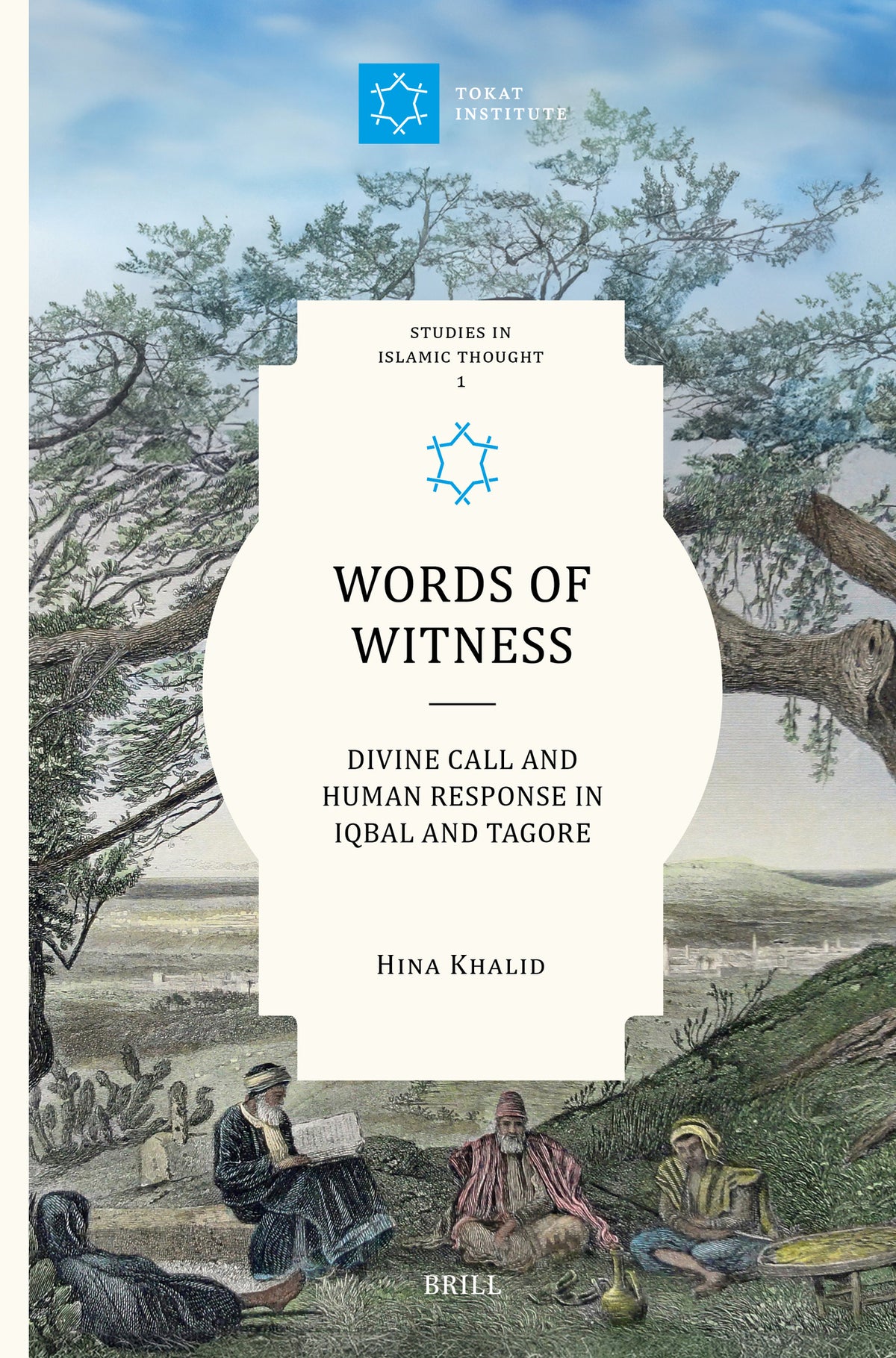
In Words of Witness, Hina Khalid offers a comparative exploration of the theologies of Muhammad Iqbal (d. 1938) and Rabindranath Tagore (d. 1941). From their vast writings spanning multiple languages, she draws attention to the striking conceptual resonances across their worldviews—particularly their metaphysics, anthropologies, and political philosophies. The book demonstrates how both poets envision the God–world relationship as one of a dynamic “call and response,” and thus situate the finite in unceasing connection with the infinite. For both Iqbal and Tagore, human beings are called upon to become active participants in the divine creativity unfolding throughout the cosmos, and to craft their social and political worlds in modes that reflect as well as enact this sacred artistry.

Price: $59.00
Pages: 220
Publisher: Brill
Imprint: Brill
Publication Date:
14 October 2026
ISBN: 9789004768314
Format: Paperback

Rabindranath Tagore (1861–1941) and Muhammad Iqbal (1877–1938) were two of the leading intellectuals of pre-Independence India and Pakistan, but rarely have they been so carefully studied together as in this impressive book. Noting the distinct but converging Muslim and Hindu frames within which they faced the challenges of their times, Hina Khalid highlights surprising convergences in their theological presuppositions, agendas for action, and educational programs. Moreover, she thereby also restores theology’s relevance amid the cosmic, human, and political realities of our times, exemplifying a comparative theology that is relevant in today’s multi-religious world.
— Francis X. Clooney, SJ, Harvard Divinity School
Words of Witness is a wonderful exercise in creative theology that brings together dialogical interpretation and understanding of human and divine subjectivity expressed in the work of two major figures from modern Indian literature, Tagore and Iqbal. Theoretically sophisticated, textually supple, and located within a modern context, it nevertheless presents the critical triad of God–world–self at the core of the literary output of these figures as theology and a metaphysics of correspondence and connection rooted in Sufism and Yoga-Vedanta traditions. And it further demonstrates that a more nuanced approach to political theology and sovereignty ought to be rooted in theological reflection.
— Sajjad H. Rizvi, University of Exeter
Words of Witness fills a major lacuna in the study of modern South Asian thought through a comparative reading of Hindu–Muslim theo-poetic traditions. Focusing on Rabindranath Tagore and Muhammad Iqbal, it offers a groundbreaking analysis of their shared cosmological visions—divine creativity, the relationality of finite and infinite, and a dynamic of call-and-response between God and the human being.
— Muhammad U. Faruque, author of Sculpting the Self
Words of Witness is a beautifully crafted work of comparative theology that brings Iqbal and Tagore into sustained and illuminating dialogue. Across multiple languages and genres, Khalid shows how each thinker imagines human existence as a response to the divine call—a metaphysical-anthropological vision shaped by the relational interplay between the infinite and the finite. She leads readers into a genuinely dialogical mode of interpretation, allowing Iqbal and Tagore’s conceptual worlds to refract and enrich one another.
— James Madaio, Czech Academy of Sciences
— Francis X. Clooney, SJ, Harvard Divinity School
Words of Witness is a wonderful exercise in creative theology that brings together dialogical interpretation and understanding of human and divine subjectivity expressed in the work of two major figures from modern Indian literature, Tagore and Iqbal. Theoretically sophisticated, textually supple, and located within a modern context, it nevertheless presents the critical triad of God–world–self at the core of the literary output of these figures as theology and a metaphysics of correspondence and connection rooted in Sufism and Yoga-Vedanta traditions. And it further demonstrates that a more nuanced approach to political theology and sovereignty ought to be rooted in theological reflection.
— Sajjad H. Rizvi, University of Exeter
Words of Witness fills a major lacuna in the study of modern South Asian thought through a comparative reading of Hindu–Muslim theo-poetic traditions. Focusing on Rabindranath Tagore and Muhammad Iqbal, it offers a groundbreaking analysis of their shared cosmological visions—divine creativity, the relationality of finite and infinite, and a dynamic of call-and-response between God and the human being.
— Muhammad U. Faruque, author of Sculpting the Self
Words of Witness is a beautifully crafted work of comparative theology that brings Iqbal and Tagore into sustained and illuminating dialogue. Across multiple languages and genres, Khalid shows how each thinker imagines human existence as a response to the divine call—a metaphysical-anthropological vision shaped by the relational interplay between the infinite and the finite. She leads readers into a genuinely dialogical mode of interpretation, allowing Iqbal and Tagore’s conceptual worlds to refract and enrich one another.
— James Madaio, Czech Academy of Sciences
Hina Khalid, Ph.D. (2024), University of Cambridge, is a scholar of Islamic aesthetics and comparative theology. Her publications have centred around philosophical, spiritual, and literary themes across the Islamic, Christian, and Hindu traditions.