


Some error occured while loading the Quick View. Please close the Quick View and try reloading the page.
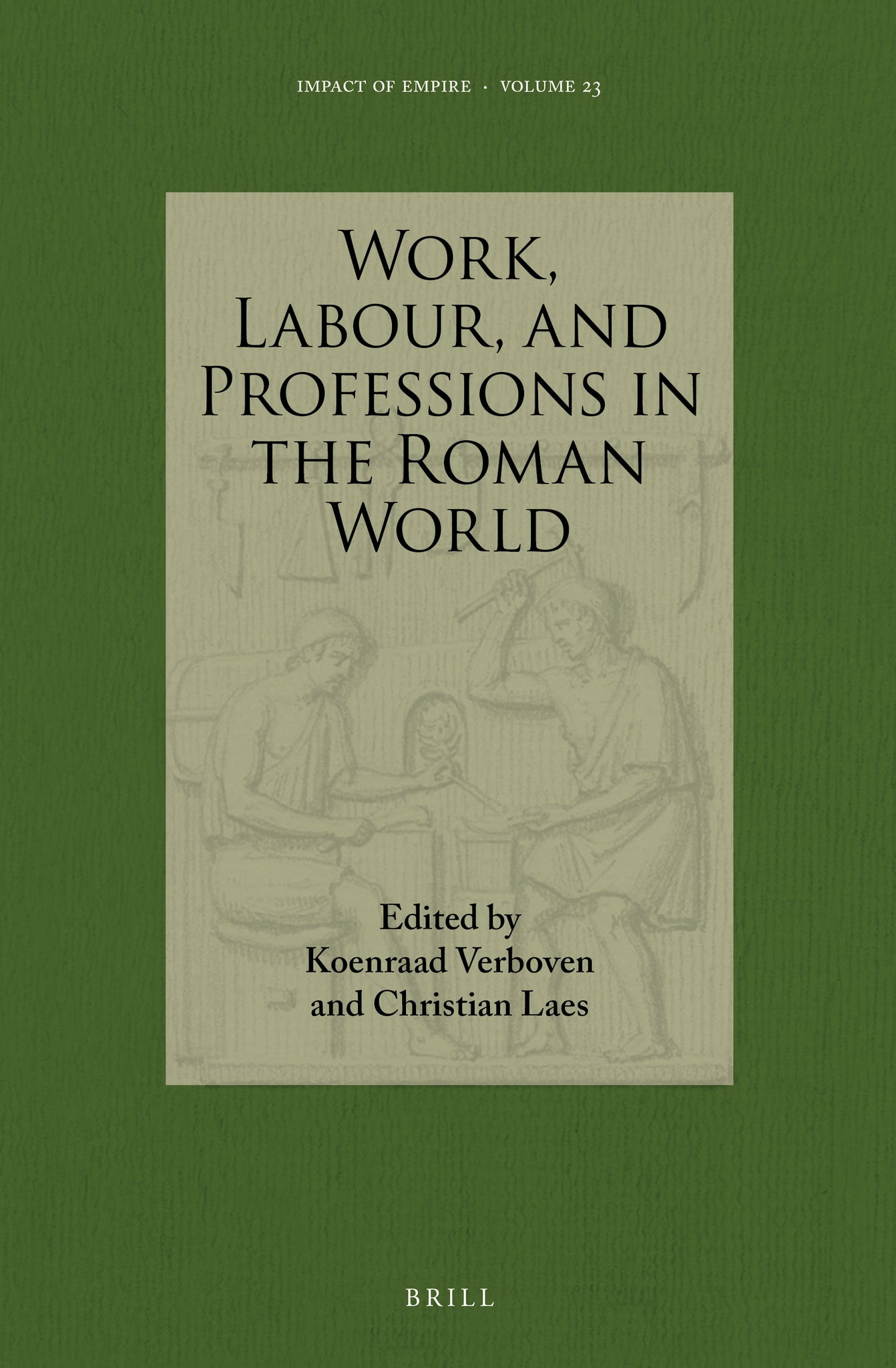
The economic success of the Roman Empire was unparalleled in the West until the early modern period. While favourable natural conditions, capital accumulation, technology and political stability all contributed to this, economic performance ultimately depended on the ability to mobilize, train and co-ordinate human work efforts. In Work, Labour, and Professions in the Roman World, the authors discuss new insights, ideas and interpretations on the role of labour and human resources in the Roman economy. They study the various ways in which work was mobilised and organised and how these processes were regulated. Work as a production factor, however, is not the exclusive focus of this volume. Throughout the chapters, the contributors also provide an analysis of work as a social and cultural phenomenon in Ancient Rome.

Price: $182.00
Pages: 356
Publisher: Brill
Imprint: Brill
Series: Impact of Empire
Publication Date:
27 October 2016
ISBN: 9789004331655
Format: Hardcover

"Despite the highly specialized nature of the subject matter as surveyed above, the volume represents a valuable contribution to scholarship by offering an updated guide to a complex field."
Josaphat Tam in BMCR 2017.10.29 ''The papers highlight the variability of labour forms employed, and how firms, social networks and administrative institutions affected the organisation of labour. As such, the volume advocates more nuanced understandings of how social contexts affected economic performance – without necessarily ascribing a positive role to social institutions in lowering transaction costs. (...) In this sense, this collection of essays forms a welcome addition to the scholarly debate.'' Tymon de Haas, Clio 2018.1.002
Josaphat Tam in BMCR 2017.10.29 ''The papers highlight the variability of labour forms employed, and how firms, social networks and administrative institutions affected the organisation of labour. As such, the volume advocates more nuanced understandings of how social contexts affected economic performance – without necessarily ascribing a positive role to social institutions in lowering transaction costs. (...) In this sense, this collection of essays forms a welcome addition to the scholarly debate.'' Tymon de Haas, Clio 2018.1.002
Koenraad Verboven is professor of Ancient History at Ghent University. He has published extensively on social and economic history, including a recent edited volume,Ownership and Exploitation of Land and Natural Resources in the Roman World. (OUP, 2015)
Christian Laes is professor of Latin and Ancient History at the University of Antwerp and adjunct professor at the University of Tampere. He has published five monographs and over seventy international contributions on the socio-cultural history of Roman and Late Antiquity.
Contributors are: Seth Bernard, Sarah Bond, Miko Flohrl, Miriam Groen-Vallinga, Cameron Hawkins, Claire Holleran, Christian Laes, Catharina Lis, Jinyu Liu, Elizabeth Murphy, Hugo Soly, Laurens Tacoma, Nicolas Tran, Koenraad Verboven and Arjan Zuiderhoek.
Christian Laes is professor of Latin and Ancient History at the University of Antwerp and adjunct professor at the University of Tampere. He has published five monographs and over seventy international contributions on the socio-cultural history of Roman and Late Antiquity.
Contributors are: Seth Bernard, Sarah Bond, Miko Flohrl, Miriam Groen-Vallinga, Cameron Hawkins, Claire Holleran, Christian Laes, Catharina Lis, Jinyu Liu, Elizabeth Murphy, Hugo Soly, Laurens Tacoma, Nicolas Tran, Koenraad Verboven and Arjan Zuiderhoek.