


Some error occured while loading the Quick View. Please close the Quick View and try reloading the page.
Winner, 2023 Robert L. Jervis and Paul W. Schroeder Best Book Award, International History and Politics Section, American Political Science Association
Honorable Mention, 2023 Barrington Moore Award, Comparative and Historical Sociology Section, American Sociological Association
Honorable Mention, 2023 Francesco Guicciardini Prize for Best Book in Historical International Relations, Historical International Relations Section, International Studies Association
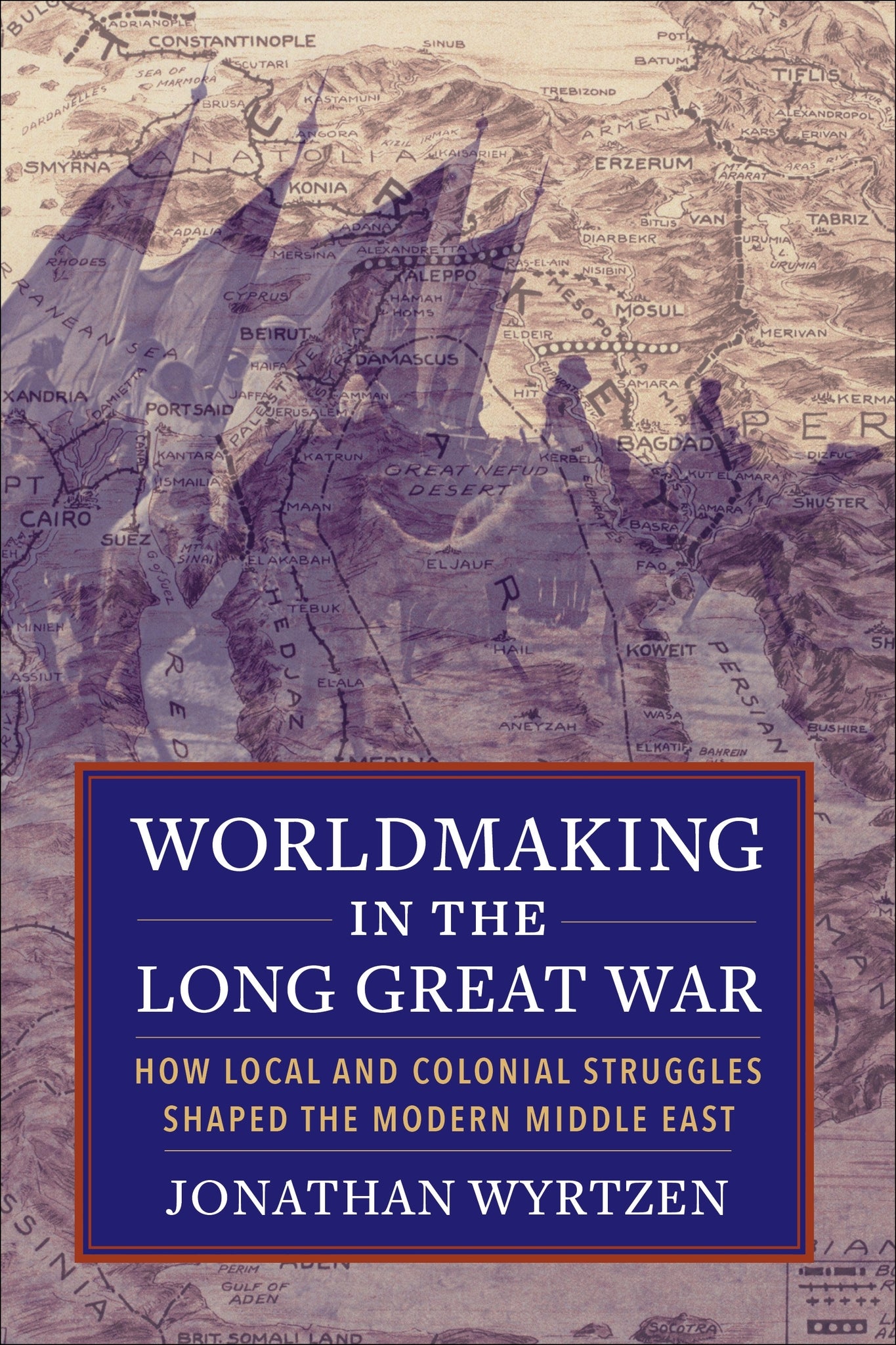
It is widely believed that the political problems of the Middle East date back to the era of World War I, when European colonial powers unilaterally imposed artificial borders on the post-Ottoman world in postwar agreements. This book offers a new account of how the Great War unmade and then remade the political order of the region. Ranging from Morocco to Iran and spanning the eve of the Great War into the 1930s, it demonstrates that the modern Middle East was shaped through complex and violent power struggles among local and international actors.
Jonathan Wyrtzen shows how the cataclysm of the war opened new possibilities for both European and local actors to reimagine post-Ottoman futures. After the 1914–1918 phase of the war, violent conflicts between competing political visions continued across the region. In these extended struggles, the greater Middle East was reforged. Wyrtzen emphasizes the intersections of local and colonial projects and the entwined processes through which states were made, identities transformed, and boundaries drawn. This book’s vast scope encompasses successful state-building projects such as the Turkish Republic and the Kingdom of Saudi Arabia as well as short-lived political units—including the Rif Republic in Morocco, the Sanusi state in eastern Libya, a Greater Syria, and attempted Kurdish states—that nonetheless left traces on the map of the region. Drawing on a wide range of sources, Worldmaking in the Long Great War retells the origin story of the modern Middle East.


— Fatma Müge Göçek, author of Denial of Violence: Ottoman Past, Turkish Present, and Collective Violence Against the Armenians, 1789–2009
Covering the entirety of the region, from North Africa to Arabia, and carrying the story through into the 1930s, this book shows convincingly how the post-Ottoman Middle East, rather than being simply an arbitrary creation of imperial mapmaking, was profoundly shaped by the decisions and struggles of its peoples.
— Erez Manela, author of The Wilsonian Moment: Self-Determination and the International Origins of Anticolonial Nationalism
In the Middle East, World War I did not end in 1918—it continued into the early 1930s. Jonathan Wyrtzen’s Worldmaking in the Long Great War offers a concise, well-written account of these state-building conflicts, which drew the map of the region as we know it today.
— Charles Kurzman, author of Democracy Denied, 1905–1915: Intellectuals and the Fate of Democracy
This is the postcolonial correction of WWI history we have been waiting for. Jonathan Wyrtzen has written an epic reinterpretation of how the Great War transformed the region stretching from Morocco to Iran. The voices and actions of Arabs, Turks, Berbers, Kurds, Persians, Armenians, Jews, and others ring loud and clear. A must-read for all teachers and scholars of modern world history and Middle Eastern politics.
— Elizabeth F. Thompson, author of How the West Stole Democracy from the Arabs: The Syrian Congress of 1920 and the Destruction of Its Historic Liberal-Islamic Alliance
Wyrtzen turns what might have been an overwhelming and dizzying array of subfields into a decisive argument for an updated perspective on a region and a war so often bogged down in Eurocentric, superficial, and dismissive cliches.
Especially and unreservedly recommended for community, college, and university library 20th Century Middle East History & Politics collections and supplemental curriculum studies syllabus.
An ambitious, and rather admirably compact, survey of history between 1911 and 1934...a very approachable volume capable of introducing students and scholars to the history of the early twentieth century...succinct and convincing.
A major feature of Worldmaking in the long great war is the need to move decisively away from the ‘standard narrative’ that the Sykes–Picot Agreement, alongside other wartime agreements and postwar peace treaties, settled or imposed modern polities and boundaries across the Middle East.
A thought-provoking history and will be of interest to readers with an interest in Middle Eastern and North African history and politics as well as modern European history.
The book’s main strength is recognizing the colonized local actors’ role in struggling for self-determination and contesting the Eurocentric framework and historiography.
Preface
Acknowledgments
Introduction
Part I: Unmaking the Greater Ottoman Order
1. Geostrategic Questions, Colonial Scrambles, and the Road to the Great War
2. The Many Fronts of the Ottomans’ Great War, 1914–1918
Part II: Reimagining the Post-Ottoman Middle East
3. The Middle East’s So-Called Wilsonian Moment, 1918–1920
4. Emerging Polities in the Early 1920s
Part III: Remaking the Modern Middle East
5. Kurdish Uprisings, the Rif War, and the Great Syrian Revolt, 1924–1927
6. Endgame Struggles in Kurdistan, Cyrenaica, and Arabia, 1927–1934
Conclusion
Notes
Bibliography
Index