


Some error occured while loading the Quick View. Please close the Quick View and try reloading the page.
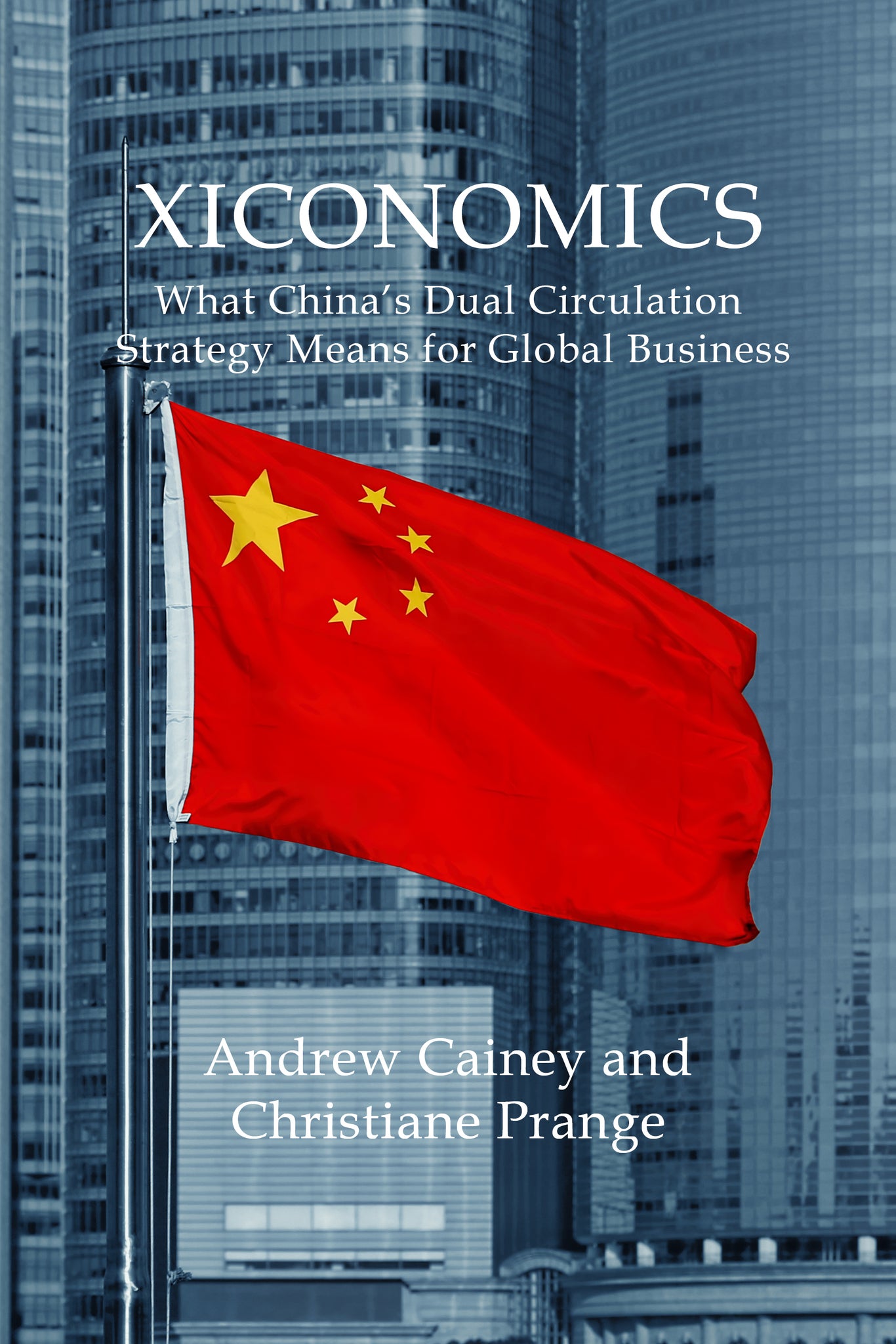
Matters of ideology and security have become deeply entwined in China’s economic and business environment. The context is more politicized, more uncertain. At the heart of Xiconomics is the Dual Circulation Strategy, which marks out clear dividing lines between China’s domestic economy and the rest of the world. It sets out how China seeks to manage the links between the two just when western countries are also focusing on decoupling and "friendshoring". In order to prosper, business leaders and policy-makers need to understand these new international dynamics.
In this concise and incisive analysis, Andrew Cainey and Christiane Prange explain what is happening in China and how this affects its relations with other countries. They identify what foreign companies need to do, how strategies need to change, and what this all means for managing the China business as part of a global portfolio, under a range of geopolitical scenarios.


— Joerg Storm, Global Head IT Infrastructure, Mercedes Benz Mobility, Stuttgart
This book is an essential immediate read for all senior business leaders with a responsibility for doing business inside China, or with the potential to encounter Chinese influenced businesses elsewhere. The authors deconstruct Xiconomics and their inside track enables them to decode and make Xiconomics accessible to those with a business interest in the potentially enormous benefits and significant risks associated with engaging with China.
— Wilf Blackburn, former CEO, Allianz China Life
An invaluable guide for business people and policy makers facing the challenge of mapping out strategies for productive engagement with China going forward.
— Peter Williamson, Judge Business School, University of Cambridge
Xiconomics should be essential reading for anyone grappling with understanding, and adjusting to, the profound changes that have occurred to China’s business environment in Xi’s era.
— Xin Sun, King’s College London
Now more than ever, business success in China means both understanding the broader social, political and historical context, and dealing with uncertainty. Drawing on their extensive experience, the authors describe how China is evolving and then lay out the strategic options and capabilities that companies need to succeed. This book is a must.
— Catherine Bradley CBE, non-executive director, Kingfisher plc
Cainey and Prange have pulled off a rare feat with this book: being incisive and detailed while remaining accessible and succinct. Anyone interested in the wider politics of international business in China will gain much from reading Xiconomics.
— William Hurst, Chong Hua Professor of Chinese Development, University of Cambridge
Andrew Cainey has advised businesses and governments on China for over twenty years. He is a senior associate fellow at the Royal United Services Institute; a founding director of the UK National Committee on China; and an advisory board member for Lumen Capital Investors, a Singapore-based multi-family office.
Christiane Prange is a Professor of Strategy and International Business with universities in Europe and globally. She previously taught at Tongji University and Jiaotong University (Antai College) in China. She also advises multinational companies on their internationalization and agile strategies.
Introduction
Part I Dual circulation strategy and Xiconomics
1. What is dual circulation strategy?
2. Dual circulation: more continuity than change
3. Xiconomics and the China Policy puzzle
4. Putting the Xi into Xiconomics
Part II Three questions for global business
5. How will China’s internal business environment develop?
6. What role will China play in the world of external circulation?
7. Internal and external: separate or connected?
Part III Implications for global business
8. Multinationals and China
9. How dual circulation changes the game
10. Ambidexterity and connectivity
11 Resilience and agility in the face of uncertainty
12. Conclusion: navigating the contradictions in China’s ambitions