

Filter
-
Antiques & Collectibles
-
Architecture
-
Art
-
Bibles
-
Biography & Autobiography
-
Body, Mind & Spirit
-
Business & Economics
-
Comics & Graphic Novels
-
Computers
-
Cooking
-
Crafts & Hobbies
-
Design
-
Education
-
Family & Relationship
-
Fiction
-
Foreign Language Study
-
Games & Activities
-
Gardening
-
Health & Fitness
-
History
-
House & Home
-
Humor
-
Juvenile Fiction
-
Juvenile Nonfiction
-
Language Arts & Disciplines
-
Law
-
Literary Collections
-
Literary Criticism
-
Mathematics
-
Medical
-
Miscellaneous
-
Music
-
Nature
-
Performing Arts
-
Pets
-
Philosophy
-
Photography
-
Poetry
-
Political Science
-
Psychology
-
Reference
-
Religion
-
Self-Help
-
Science
-
Social Science
-
Sports & Recreation
-
Study Aids
-
Technology & Engineering
-
Transportation
-
Travel
-
True Crime
-
Young Adult Fiction
-
Young Adult Nonfiction
-
Antiques & Collectibles
-
Architecture
-
Art
-
Bibles
-
Biography & Autobiography
-
Body, Mind & Spirit
-
Business & Economics
-
Comics & Graphic Novels
-
Computers
-
Cooking
-
Crafts & Hobbies
-
Design
-
Education
-
Family & Relationship
-
Fiction
-
Foreign Language Study
-
Games & Activities
-
Gardening
-
Health & Fitness
-
History
-
House & Home
-
Humor
-
Juvenile Fiction
-
Juvenile Nonfiction
-
Language Arts & Disciplines
-
Law
-
Literary Collections
-
Literary Criticism
-
Mathematics
-
Medical
-
Miscellaneous
-
Music
-
Nature
-
Performing Arts
-
Pets
-
Philosophy
-
Photography
-
Poetry
-
Political Science
-
Psychology
-
Reference
-
Religion
-
Self-Help
-
Science
-
Social Science
-
Sports & Recreation
-
Study Aids
-
Technology & Engineering
-
Transportation
-
Travel
-
True Crime
-
Young Adult Fiction
-
Young Adult Nonfiction
4 products


African Rivers
Regular price $170.00 Save $-170.00
The Nile, Congo, Niger, Chad and Zambezi are names that evoke watershed periods in Africa's history. Yet, until now, scholars have paid little attention to Africa's riverine environment or how it has shaped the continent's civilizations.
African rivers are not only part of the ecosystem but also hold immense ecological, political, economic, and sociocultural significance. At the same time, there are numerous challenges to their exploitation and sustainability due to human activities, transboundary conflicts, and climate change.
This book explores major thematic preoccupations with the study of African rivers. The first section discusses the epistemology of rivers in Africa, reviewing historical perspectives and identifying associations of rivers with identity and spirituality in Africa. The second section turns to the economy of African rivers, namely their commercial and economic benefits, political perspectives and dimensions, ecological and hydrological impacts, as well as their impacts on agricultural management and food security in the continent. In the third section, challenges associated with the exploitation, management, and sustainability of African rivers are discussed including geopolitics, dam construction, eco-tourism, transboundary disputes, and water scarcity. Beyond merely pointing out these challenges, however, the authors also propose solutions for the future of sustainable river resources in Africa. Ultimately, the book aims to promote knowledge of African rivers to help governments, corporations, and communities define and address their future needs
African rivers are not only part of the ecosystem but also hold immense ecological, political, economic, and sociocultural significance. At the same time, there are numerous challenges to their exploitation and sustainability due to human activities, transboundary conflicts, and climate change.
This book explores major thematic preoccupations with the study of African rivers. The first section discusses the epistemology of rivers in Africa, reviewing historical perspectives and identifying associations of rivers with identity and spirituality in Africa. The second section turns to the economy of African rivers, namely their commercial and economic benefits, political perspectives and dimensions, ecological and hydrological impacts, as well as their impacts on agricultural management and food security in the continent. In the third section, challenges associated with the exploitation, management, and sustainability of African rivers are discussed including geopolitics, dam construction, eco-tourism, transboundary disputes, and water scarcity. Beyond merely pointing out these challenges, however, the authors also propose solutions for the future of sustainable river resources in Africa. Ultimately, the book aims to promote knowledge of African rivers to help governments, corporations, and communities define and address their future needs

Forests and the Power of Marginalised People in Southern Africa
Regular price $120.00 Save $-120.00
Decades after independence and the end of apartheid, why have forest communities in Zimbabwe and South Africa not been able to recover the land and resource rights they lost under colonialism?
This book explores the politics of conservation in southern Africa through the lens of chronic liminality, a 'state of in-betweenness' or 'waiting', to explain the status quo in local people-state forest relationships and why progress has been so slow. Using the Dwesa-Cwebe Nature Reserve, the Gwayi Forest and Mafungabusi Forest as cases studies, it examines the consequences on people living in and around protected areas of neoliberal approaches to conservation and of the legacy of colonial property relations.
The book asks why local communities have not engaged in collective or rebellious action against the government and how they have instead found themselves in a liminal position, caught between waiting for conditions to change and advancing their rights through collective action. It also asks why states have likewise pursued a politics of liminality and continue to prevaricate about whether to restore local rights or maintain the status quo around forest reserves. Overall, the book advances scholarship around conservation in Africa and other postcolonial regions by providing a different perspective on the continued marginalisation of local people and arguing for a need to rethink forest ownership and management.
Published in association with the Collaborative Research Centre FUTURE RURAL AFRICA, funded by the German Research Council (DFG).
This book explores the politics of conservation in southern Africa through the lens of chronic liminality, a 'state of in-betweenness' or 'waiting', to explain the status quo in local people-state forest relationships and why progress has been so slow. Using the Dwesa-Cwebe Nature Reserve, the Gwayi Forest and Mafungabusi Forest as cases studies, it examines the consequences on people living in and around protected areas of neoliberal approaches to conservation and of the legacy of colonial property relations.
The book asks why local communities have not engaged in collective or rebellious action against the government and how they have instead found themselves in a liminal position, caught between waiting for conditions to change and advancing their rights through collective action. It also asks why states have likewise pursued a politics of liminality and continue to prevaricate about whether to restore local rights or maintain the status quo around forest reserves. Overall, the book advances scholarship around conservation in Africa and other postcolonial regions by providing a different perspective on the continued marginalisation of local people and arguing for a need to rethink forest ownership and management.
Published in association with the Collaborative Research Centre FUTURE RURAL AFRICA, funded by the German Research Council (DFG).

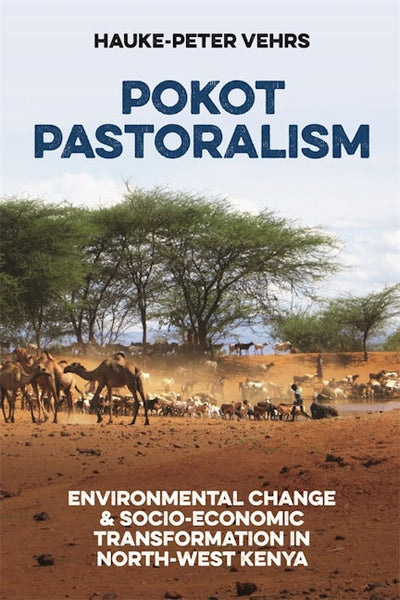
Pokot Pastoralism
Regular price $36.95 Save $-36.95
Examines how pastoral peoples imagine, or even design, their futures under the pressure of changing environments and large-scale government projects.
In East Africa and beyond, pastoral groups find themselves and their livelihoods under increasing threat when dealing with rapid environmental change. On the one hand, they contemplate major upheaval as a result of landscape and climate change on a scale never seen before. At the same time, these often-marginalised groups find themselves subsumed by the wider interests of national political economies prioritising new investment in land as well as encouraging tourism. This book investigates one such group - the nomadic pastoralists in East Pokot in north-west Kenya - and traces their social and ecological transformation over the past two hundred years to show how modern challenges are linked to the past history and also shape the perceptions of pastoral futures.
In East Pokot the grass bush savannah upon which the pastoral lifestyle depends has strongly declined over a long period of time, with encroachment of acacia. Though traditionally cattle-rearing, its people have been forced to diversify into raising other browsing animals as well as cattle husbandry. The development efforts of the Kenyan government to use natural resources have also threatened their environment and their way of life. Bringing a long view to the history of human-environmental relations, the author reveals a more complex picture of change that, contrary to earlier assumptions, is not due exclusively to the pastoralists' pasture management, but also to the extinction of wildlife populations in the region, which were hunted heavily in colonial times. Attempts to move beyond Pokot territory, to the regions west of Lake Baringo and to the hard-fought Laikipia Plateau, have often been compromised by violent conflicts. While a younger generation looks to develop new sources of income through the job opportunities created by geothermal energy production, and diversify into other agricultural activities, this has also brought a dynamic social transformation: increasing production and sale of alcohol, decreasingly nomadic lifestyle, growing differences between the older and younger generations, and so on. Contributing to debates on future rural Africa, ecological history and environmental change, the book will appeal to anthropologists, sociologists, geographers, historians and development scholars.
Published in association with the Collaborative Research Centre FUTURE RURAL AFRICA, funded by the German Research Council (DFG).
In East Africa and beyond, pastoral groups find themselves and their livelihoods under increasing threat when dealing with rapid environmental change. On the one hand, they contemplate major upheaval as a result of landscape and climate change on a scale never seen before. At the same time, these often-marginalised groups find themselves subsumed by the wider interests of national political economies prioritising new investment in land as well as encouraging tourism. This book investigates one such group - the nomadic pastoralists in East Pokot in north-west Kenya - and traces their social and ecological transformation over the past two hundred years to show how modern challenges are linked to the past history and also shape the perceptions of pastoral futures.
In East Pokot the grass bush savannah upon which the pastoral lifestyle depends has strongly declined over a long period of time, with encroachment of acacia. Though traditionally cattle-rearing, its people have been forced to diversify into raising other browsing animals as well as cattle husbandry. The development efforts of the Kenyan government to use natural resources have also threatened their environment and their way of life. Bringing a long view to the history of human-environmental relations, the author reveals a more complex picture of change that, contrary to earlier assumptions, is not due exclusively to the pastoralists' pasture management, but also to the extinction of wildlife populations in the region, which were hunted heavily in colonial times. Attempts to move beyond Pokot territory, to the regions west of Lake Baringo and to the hard-fought Laikipia Plateau, have often been compromised by violent conflicts. While a younger generation looks to develop new sources of income through the job opportunities created by geothermal energy production, and diversify into other agricultural activities, this has also brought a dynamic social transformation: increasing production and sale of alcohol, decreasingly nomadic lifestyle, growing differences between the older and younger generations, and so on. Contributing to debates on future rural Africa, ecological history and environmental change, the book will appeal to anthropologists, sociologists, geographers, historians and development scholars.
Published in association with the Collaborative Research Centre FUTURE RURAL AFRICA, funded by the German Research Council (DFG).

Pokot Pastoralism
Regular price $130.00 Save $-130.00
Examines how pastoral peoples imagine, or even design, their futures under the pressure of changing environments and large-scale government projects.
In East Africa and beyond, pastoral groups find themselves and their livelihoods under increasing threat when dealing with rapid environmental change. On the one hand, they contemplate major upheaval as a result of landscape and climate change on a scale never seen before. At the same time, these often-marginalised groups find themselves subsumed by the wider interests of national political economies prioritising new investment in land as well as encouraging tourism. This book investigates one such group - the nomadic pastoralists in East Pokot in north-west Kenya - and traces their social and ecological transformation over the past two hundred years to show how modern challenges are linked to the past history and also shape the perceptions of pastoral futures.
In East Pokot the grass bush savannah upon which the pastoral lifestyle depends has strongly declined over a long period of time, with encroachment of acacia. Though traditionally cattle-rearing, its people have been forced to diversify into raising other browsing animals as well as cattle husbandry. The development efforts of the Kenyan government to use natural resources have also threatened their environment and their way of life. Bringing a long view to the history of human-environmental relations, the author reveals a more complex picture of change that, contrary to earlier assumptions, is not due exclusively to the pastoralists' pasture management, but also to the extinction of wildlife populations in the region, which were hunted heavily in colonial times. Attempts to move beyond Pokot territory, to the regions west of Lake Baringo and to the hard-fought Laikipia Plateau, have often been compromised by violent conflicts. While a younger generation looks to develop new sources of income through the job opportunities created by geothermal energy production, and diversify into other agricultural activities, this has also brought a dynamic social transformation: increasing production and sale of alcohol, decreasingly nomadic lifestyle, growing differences between the older and younger generations, and so on. Contributing to debates on future rural Africa, ecological history and environmental change, the book will appeal to anthropologists, sociologists, geographers, historians and development scholars.
Published in association with the Collaborative Research Centre FUTURE RURAL AFRICA, funded by the German Research Council (DFG).
In East Africa and beyond, pastoral groups find themselves and their livelihoods under increasing threat when dealing with rapid environmental change. On the one hand, they contemplate major upheaval as a result of landscape and climate change on a scale never seen before. At the same time, these often-marginalised groups find themselves subsumed by the wider interests of national political economies prioritising new investment in land as well as encouraging tourism. This book investigates one such group - the nomadic pastoralists in East Pokot in north-west Kenya - and traces their social and ecological transformation over the past two hundred years to show how modern challenges are linked to the past history and also shape the perceptions of pastoral futures.
In East Pokot the grass bush savannah upon which the pastoral lifestyle depends has strongly declined over a long period of time, with encroachment of acacia. Though traditionally cattle-rearing, its people have been forced to diversify into raising other browsing animals as well as cattle husbandry. The development efforts of the Kenyan government to use natural resources have also threatened their environment and their way of life. Bringing a long view to the history of human-environmental relations, the author reveals a more complex picture of change that, contrary to earlier assumptions, is not due exclusively to the pastoralists' pasture management, but also to the extinction of wildlife populations in the region, which were hunted heavily in colonial times. Attempts to move beyond Pokot territory, to the regions west of Lake Baringo and to the hard-fought Laikipia Plateau, have often been compromised by violent conflicts. While a younger generation looks to develop new sources of income through the job opportunities created by geothermal energy production, and diversify into other agricultural activities, this has also brought a dynamic social transformation: increasing production and sale of alcohol, decreasingly nomadic lifestyle, growing differences between the older and younger generations, and so on. Contributing to debates on future rural Africa, ecological history and environmental change, the book will appeal to anthropologists, sociologists, geographers, historians and development scholars.
Published in association with the Collaborative Research Centre FUTURE RURAL AFRICA, funded by the German Research Council (DFG).
