A story of wartime intelligence, super-power relations and spies and their handlers - seen through the experience of Melita Norwood.
On September 11th 1999 The Times newspaper carried the front page article "Revealed: the quiet woman who betrayed Britain for 40 years. The spy who came in from the Co-op." Melita Norwood, the last of the atomic spies, hadfinally been run to ground, but at 87 she was deemed too old to prosecute. Her crime: the shortening of the Soviet Union's atomic bomb project by up to 5 years. At a time when the world faces fresh dilemmas caused by the proliferation of nuclear weapons, this is the remarkable story of a much earlier drama. After the atomic bomb strikes on Hiroshima and Nagasaki in August 1945, British and American intelligence estimated the earliest date for the production of a Soviet bomb to be 1953. In fact, the Soviet Union went nuclear in 1948, and tested an atomic bomb in 1949. The Soviet Union's bomb coincided with the onset of The Cold War, and threatened humankind with extinction. Melita Norwood was a member of one of those communist spy networks in America and Britain, who by guaranteeing those weapons of mass destruction threw down a challenge to America as sole superpower in the post-Second World War era. This fascinating book sets her in the context of the times, and uses her as a prism and focus through which to investigate the whole milieu.
Dr DAVID BURKE is a Supervisor for the Rise of the Secret World: Governments and Intelligence Communities since 1900 at the University of Cambridge.
British Spies and Irish Rebels
Regular price
$39.95
Save $-39.95
Using recently opened archives, this book provides new insights into the history of the British intelligence community and helps explain Anglo-Irish relations during a time of momentous change. The lessons it draws still echo today, as Britain contends with the threat posed by violent militants, whether from Ireland or further afield.
One of the Irish Times' Books of the Year, 2008 The struggle between British intelligence agencies and Irish revolutionaries has lasted for centuries - and still goes on. But it was at its most intense during the first half of the twentieth century. Ireland experienced a bloody rebellion, bitter partition and a stuttering march towards independence. Britain grappled with imperial decline and world war, while government agencies were worrying about being stabbed in the back by their Irish neighbour. Using recently opened archives, this book reveals for the first time how intelligence and intelligence agencies shaped Anglo-Irish relations during this formative period. The book casts light on characters long kept in the shadows - IRA gunrunners, Bolshevik agitators, Nazi saboteurs, British double agents. It shows what happened when Irish revolutionaries stopped fighting, formed governments and started sharing information with London - while doing everything possible to hide this from the Irish public. It also fills in a missing chapter in the history of the British intelligence community, tracing its evolution from amateurishbeginnings, through a painful adolescence, to the sophisticated apparatus that is largely still with us. The book probes some deeper questions about intelligence and the complex Anglo-Irish relationship. What has the most influence on government policy? The work of professional intelligence agencies? Or the misconceptions and preconceptions that politicians and civil servants bring to their jobs? Why are secrets so seductive - and sometimes so misleading? Packed with anecdotes and unexpected paradoxes, this book provides new insights into the history of the British intelligence community and helps explain the twists and turns of Anglo-Irish relations during a time of momentous change. The lessons it draws still echo today, as Britain contends with the threat posed by violent militants, whether from Ireland or further afield.
PAUL MCMAHON received his bachelor's degree from University College Dublin, before studying for an MPhil and a PhD at Cambridge University. He has worked as a management consultant and policy advisor focussing on climate change and food security.
John de Vere, Thirteenth Earl of Oxford (1442-1513)
Regular price
$95.00
Save $-95.00
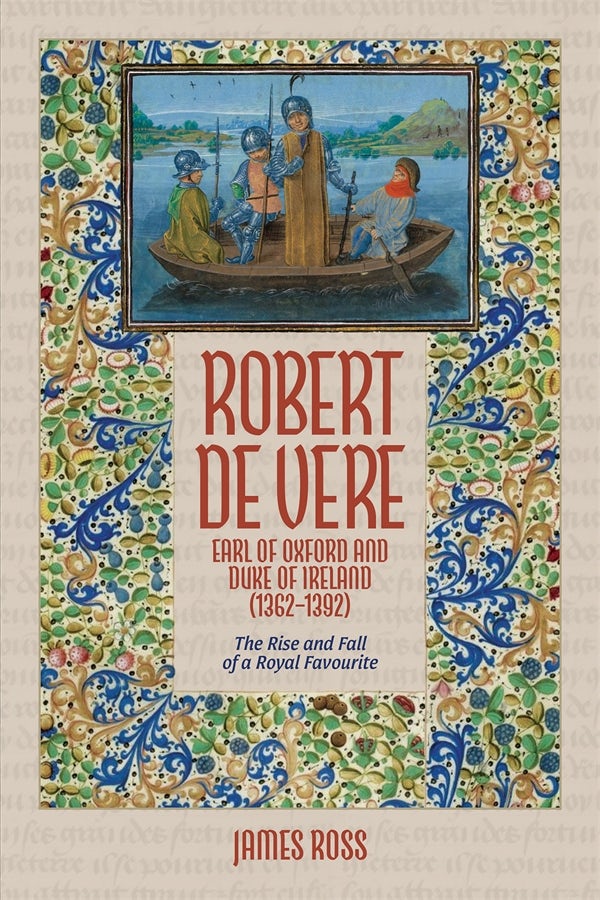
First book to deal with de Vere's life and extraordinary career, during the Wars of the Roses and beyond.
Earl of Oxford for fifty years, and subject of six kings of England during the political strife of the Wars of the Roses, John de Vere's career included more changes of fortune than almost any other. He recovered his earldom afterthe execution of his father and brother for treason, but his resistance to Edward IV led to a decade in prison. He escaped in time to lead Henry Tudor's vanguard at Bosworth in 1485 and subsequently enjoyed twenty-five years as perhaps "the foremost man of the kingdom", virtually ruling East Anglia for the king. This is the first full-length study of de Vere's life and career. Through this lens it also tackles a number of broader themes. It reconsiders the role of the nobility under Henry VII, challenging the common perception of Henry as an anti-aristocratic king. It also explores East Anglian political society in the second half of the fifteenth century, how the earl came to dominate it, how successfully he exercised his power, and the personnel, including the Paston family, he used to run the region.
James Ross holds his doctorate from the University of Oxford.
Robert `Curthose', Duke of Normandy [c.1050-1134]
Regular price
$36.95
Save $-36.95
The acclaimed biography of the eldest son of William the Conqueror, whose failure to secure the kingdom of England has overshadowed his role in capturing Jerusalem during the First Crusade.
This detailed biography offers a reappraisal of the career of Robert Curthose, William the Conqueror's eldest son and duke of Normandy from 1087 to 1106, locating the duke's career in the social, cultural and political context ofthe period. Robert's relationship with members of his family shaped the political landscape of England and Normandy for much of the late eleventh and early twelfth centuries: indeed, even after his incarceration, from 1106 to 1134, his son William Clito (d. 1128) continued the fight against Robert's brother, Henry I. Twice driven into exile, Robert defeated his father in battle and eventually succeeded to the duchy of Normandy, although the throne of England was seized by William Rufus and then Henry I. For twenty years Robert successfully defended Normandy, developing policies to counter the vastly superior English resources at the disposal of his brothers. Robert's leading role in the success of the First Crusade [1095-99] also made him one of the most famous warriors of his age. He returned to Western Europe in 1100, a chivalric hero with a reputation that stretched from Scotland to Palestine. This bookreturns Robert Curthose to centre stage in the bloody drama of this period, a drama so often dominated by accounts from a royal and English perspective.
Dr William M. Aird is Lecturer in History, School of History, Classics and Archaeology, University of Edinburgh.
The Cross Goes North
Regular price
$49.95
Save $-49.95
37 studies of the adoption of Christianity across northern Europe over1000 years, and the diverse reasons that drove the process.
In Europe, the cross went north and east as the centuries unrolled: from the Dingle Peninsula to Estonia, and from the Alps to Lapland, ranging in time from Roman Britain and Gaul in the third and fourth centuries to the conversion of peoples in the Baltic area a thousand years later. These episodes of conversion form the basic narrative here. History encourages the belief that the adoption of Christianity was somehow irresistible, but specialists show theunderside of the process by turning the spotlight from the missionaries, who recorded their triumphs, to the converted, exploring their local situations and motives. What were the reactions of the northern peoples to the Christian message? Why would they wish to adopt it for the sake of its alliances? In what way did they adapt the Christian ethos and infrastructure to suit their own community? How did conversion affect the status of farmers, of smiths, of princes and of women? Was society wholly changed, or only in marginal matters of devotion and superstition? These are the issues discussed here by thirty-eight experts from across northern Europe; some answers come from astute re-readings of the texts alone, but most are owed to a combination of history, art history and archaeology working together.
MARTIN CARVER is Professor of Archaeology, University of York.
A Companion to Bede
Regular price
$29.99
Save $-29.99
A full and accessibly-written survey of Bede and his works, including a chapter on his legacy for subsequent history.
The Venerable Bede is a crucial figure for Anglo-Saxonists, arguably the most important, known character from the period. A scholar of international standing from an early period of the Anglo-Saxon church [c.672-732], he was the author not only of the well-known Ecclesiastical History of the English People, but also of scriptural commentaries, hagiographies, scientific works, admonitory letters, and poetry. This book provides an informative, comprehensive, and up-to-date guide to Bede and his writings, underlining in particular his importance in the development of European history and culture. It places Bede in his contemporary Northumbria and early Anglo-Saxon England, dedicates individual chapters to his works, and includes a chapter on Bede's legacy for subsequent history.
GEORGE HARDIN BROWN is Professor of English emeritus, Stanford University.
The Funeral Achievements of Henry V at Westminster Abbey
Regular price
$115.00
Save $-115.00
Ground-breaking new studies of Henry V's chapel, tomb and funeral service have new revelations and insights into the time.
Before Henry V set out in 1415 on the campaign which culminated in victory at Agincourt, he made a will laying down precise instructions for a chantry chapel to be constructed in Westminster Abbey after his death, so that he could be buried close to his saintly ancestor Edward the Confessor. Seven years later the king died at Vincennes, and his body was brought back for burial in the Abbey; the elaborate funeral took place on 7 November 1422. His chapel was probably finally completed in the 1440s, and remains a distinctive feature of Westminster Abbey to this day. This book, stimulated by the 600th anniversary of the death of this iconic king, sheds new light on his funeral service and the design of his ornate chantry chapel and tomb. It also considers each of the "funeral achievements" - saddle, helm, shield and sword - traditionally associated with him. Drawing on up-to-date research by experts in each field, with exciting input from new technologies, it investigates the construction and form of the arms and weapons, as well as providing fascinating insights into the material culture and commemoration of royalty in the fifteenth century and beyond. Anne Curry is Emeritus Professor of Medieval History at the University of Southampton. Susan Jenkins is Curator of Westminster Abbey.
Anglo-Norman Studies XXIX
Regular price
$120.00
Save $-120.00
A series which is a model of its kind EDMUND KING, HISTORY
A particular area of interest in this volume is the landscape and economy of late Anglo-Saxon and Anglo-Norman England, with papers on castles, deer parks, marshlands, fisheries, and taxation. Two complementary papers discuss neglected aspects of the Bayeux Tapestry: gesture, and the representation of identity and status. Other papers survey the deaths of kings, the role of the Norman vicomte, the estates of the king's wife in Anglo-Saxon England, and lay piety. John Gillingham's Allen Brown Memorial Lecture considers right conduct in battle.
C.P. Lewis is Reader in History at the Institute of Historical Research, University of London.
Contributors: JOHNGILLINGHAM, STEPHEN CHURCH, MARK GARDINER, ALBAN GAUTIER, MARK HAGGER, RYAN LAVELLE, MICHAEL LEWIS, ANDREW LOWERRE, GALE OWEN-CROCKER, HUGH THOMAS, HIROKAZU TSURUSHIMA, ANDREW WAREHAM, XIANG DONG WEI.
The Haskins Society Journal 14
Regular price
$95.00
Save $-95.00
Recent research on the Anglo-Saxon, Anglo-Norman, Viking and Angevin worlds of the eleventh and twelfth centuries.
The latest volume of the Haskins Society Journal presents recent research on the Anglo-Saxon, Anglo-Norman, Viking and Angevin worlds of the eleventh and twelfth centuries, and includes topics ranging from emotional communities in the middle ages, English identity, and the artistic construction of sacred space to the organization of royal estates, Jewish credit operations, the English colonization of Wales, and more. This volume of the Haskins Society Journal includes papers read at the 21st Annual Conference of the Charles Homer Haskins Society at Cornell University in October 2002 as well as other submissions. Contributors include Barbara Rosenwein, Kate Rambridge,Nicholas Brooks, Ryan Lavelle, Robin Mundill, Diane Korngiebel, Ryan Crisp, Philadelphia Ricketts, Louis Hamilton, and Brigitte Bedos-Rezak.
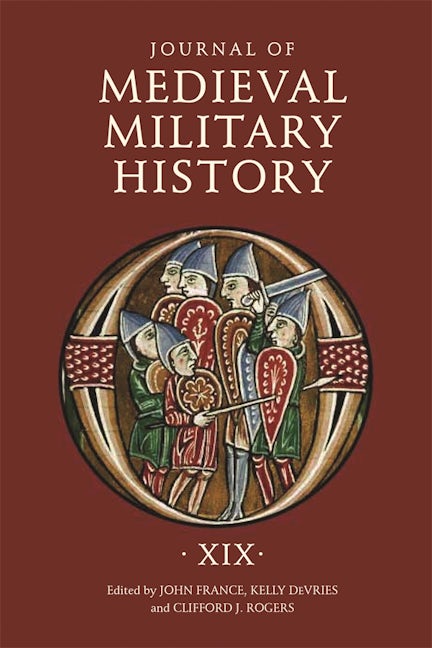
Journal of Medieval Military History
Regular price
$120.00
Save $-120.00
"The leading academic vehicle for scholarly publication in the field of medieval warfare." Medieval Warfare
The essays in this volume of the Journal continue its proud tradition of presenting cutting-edge research with a wide chronological and geographical range, from eleventh-century Georgia (David IV's use of the methods described in De velitatione bellica) to fifteenth-century England and France (a detailed analysis of the use of the under-appreciated lancegay and similar weapons). Iberia and the Empire are also addressed, with a study of Aragonese leaders in the War of the Two Pedros, a discussion of Prince Ferdinand's battle-seeking strategy prior to the battle of Toro in 1476, and an analysis and transcription of a newly-discovered Habsburg battle plan of the early sixteenth century, drawn up for the war against Venice. The volume also embraces different approaches, from cultural-intellectual history (the afterlife of the medieval Christian Warrior), to experimental archaeology (the mechanics of raising trebuchets), to comparison of "the face of battle" in a medieval illuminated manuscript with its depiction in modern films, to archivally-based administrative history (recruitment among the sub-gentry for Edward I's armies).
Contributors: David S. Bachrach, Daniel Bertrand, Peter Burkholder, Ekaitz Etxeberria Gallastegi, Michael John Harbinson, Steven Isaac, Donald J. Kagay, Tomaž Lazar, Mamuka Tsurtsumia
The Reign of Chivalry
Regular price
$36.95
Save $-36.95
Richard Barber, author of Holy Grail: The History of a Legend and King Arthur: Hero and Legend, has written an engaging and intriguing book on one of the most original concepts of the medieval mind. Profusely illustrated and redesigned for a new generation of readers.
Profusely illustrated and redesigned for a new generation of readers, Richard Barber's classic The Reign of Chivalry presents a broad picture of the chivalric world, and shows how chivalry affected or was affected by greatsocial movements, great writers and great events, and analyses the legacy it passed down to later ages. The opening chapter looks at the central figure of the whole chivalric world, the knight, and asks why he is such a different figure from other fighting men. Following sections deal with chivalry in relation to the main themes of medieval literature, especially the vast cycle of Arthurian romances, and discuss the attitudes towards chivalry of writers such as Jean Froissart, whose pages cast a golden glow over the harsh realities of war. Later sections look at chivalry's influence on the Renaissance and later culture, beginning with the knight's transition to gentleman. The element by which chivalry is now most remembered, its respectful, even adoring, attitude towards women, is the subject of a wide-ranging discussion, covering both medieval reality and modern ideals.
Richard Barber, author of Holy Grail: History of a Legend, Myths and Legends of the British Isles and King Arthur: Hero and Legend, has written an engaging and intriguing book on one of the most original concepts of the medieval mind.
Norwegian Runes and Runic Inscriptions
Regular price
$29.99
Save $-29.99
Readable, enjoyable and provides a clear overview of runes and their importance to reading the past. EARLY MEDIEVAL EUROPE
Runes, a unique functional writing system, exclusive to northern and eastern Europe, were used for some 1300 years in Scandinavia, from about AD 200 till around the end of the fourteenth century, when the runic alphabet finally gave way to the modern writing system. They were not written, but carved - in stone, and on jewellery, weapons, utensils and wood. The content of the inscriptions is very varied, from owner and carpenter attributions on artefacts to memorials to the deceased on erected stones; contrary to popular belief, they are not necessarily magical or mystical, and the post-it notes of today have their forerunners in such runic reminders as: "Buy salt, and don't forgetgloves for Sigrid." The typical medieval runic inscription varies from the deeply religious to the highly trivial [or perhaps crucial], such as "I slept with Vigdis when I was in Stavanger." This book presents an accessibleaccount of the Norwegian examples throughout the period of their use. The runic inscriptions are discussed not only from a linguistic point of view but also as sources of information on Norwegian history and culture.
TERJE SPURKLAND is Associate Professor of Nordic Medieval Studies at the University of Oslo.
The Dukes of Burgundy [4 volume set]
Regular price
$115.00
Save $-115.00
Richard Vaughan's classic history of Burgundy under the four Valois dukes, now available as a specially-priced 4 volume set.
First published nearly forty years ago, Richard Vaughan's masterly 4 volume set history of the Valois dukes of Burgundy has never been surpassed. Beginning with Philip the Bold, Vaughan describes the emergence of the Burgundian state. John the Fearless defended and developed its power ruthlessly during his ducal reign, which reached its apogee under Philip the Good. Charles the Bold ruled a state that was recognised as one of the major powers of medieval Europe, his ambition extending to an alliance with England. With the death of Charles fighting the Swiss army at Nancy in 1477, Richard Vaughan brings this history of the Burgundian dukedom to a triumphantconclusion.
Anglo-Norman Studies XXVII
Regular price
$120.00
Save $-120.00
A series which is a model of its kind EDMUND KING, HISTORY
This volume contains the usual wide range of topics, and offers some unusual and provocative perspectives, including an examination of what the evidence of zooarchaeology can reveal about the Conquest. The other subjects discussedare the battle of Alençon; the impact of rebellion on Little Domesday; Lawrence of Durham; Thomas Becket; Peter of Blois; Anglo-French peace conferences; episcopal elections and the loss of Normandy; Norman identity in southern Italian chronicles; and the Normans on crusade.
Contributors: RICHARD BARTON, NAOMI SYKES, LUCY MARTEN, MIA MÜNSTER-SWENDSEN, JOHN D. COTTS, J.E.M. BENHAM, JÖRG PELTZER, JULIE BARRAU, EMILY ALBU, EWAN JOHNSON, G. A. LOUD, HANNA VOLLRATH.
Richard II and the English Royal Treasure
Regular price
$190.00
Save $-190.00
Detailed documents describing Richard II's holdings of treasure highlight the magnificence of the 14th-century English court, often underrated by historians.
Awarded the 'première medaille des Antiquités de France' for 2016 by the Académie des Inscriptions et Belles-Lettres
The remarkable treasure of gold and silver from England and France which Richard II had amassed by the end of his reign in 1399 is fully revealed for the first time in this richly illustrated book. The author explores the nature of the objects themselves, their provenance and later fate, and examines the crucial role the treasure played in diplomacy and in financing the Hundred Years War, especially at the time of Agincourt. This fresh analysis is based on the discovery in the National Archives at Kew of a roll over 28 metres long, compiled around the time of Richard's deposition. English courtiers and Valois princes are named as the donors of many gifts. Concealed among the treasure are valuables Richard seized from the magnates he executed or exiled in 1397. Publication in full of this exceptional inventory leads to completely new perspectives on Richard II's court and on its splendour in the last years of the fourteenth century.
Jenny Stratford began her career in the Department of Manuscripts, the British Library. Her books include The Bedford Inventories (1993). She is a Senior Research Fellow of the Institute of Historical Research, University of London.
Peasants and Production in the Medieval North-East
Regular price
$120.00
Save $-120.00
Evidence from unused sources sheds much light on the peasant economy of the later middle ages.
The peasant economy in north-east England, and indeed throughout the country as a whole, underwent many changes during the later Middle Ages, but owing to the lack of evidence it has been difficult to come to definite conclusions.This pioneering survey uses previously unexploited sources, principally from tithe data, to offer new interpretations of the patterns for change and the scope for adaptability. The author argues that the peasant economy in this region of England was profoundly affected by war in the early fourteenth century and then disease with the arrival of the Black Death in 1349, calling into question the orthodox theories of overpopulation in explaining the "crisis"of the late Middle Ages: even at its medieval peak, the population of northeast England was sparse by comparison with areas further south. Nor did the availability of land and improved living standards lead to demographic recovery in the fifteenth and early sixteenth centuries. He also shows that despite their vulnerability to crises, peasant cultivators were highly responsive to change. Far from being primitive subsistence farmers oblivious to the marketand its signals, medieval peasants in the Durham region were subtle and successful decision-makers regarding the production and marketing of their output.
BEN DODDS is Lecturer in History at the University of Tallahassee.
Medieval Clothing and Textiles 1
Regular price
$95.00
Save $-95.00
First volume in new series dedicated to medieval clothing and textiles, drawing from a range of disciplines and with a special focus on reconstruction and re-enactment.
The study of medieval clothing and textiles has aroused great attention in recent years, as part of the growing concern in material culture as a whole; apart from its own intrinsic interest, it has much to reveal about life at thetime. This exciting new series aims to offer all those interested in the subject the fruits of the best research in the area. Interdisciplinary in approach, it will feature work from the fields of social and economic history, history of techniques and technology, art history, archaeology, literary and non-literary texts, and language, while experimental reconstruction of medieval techniques or artifacts will also form a particular focus. The contents of each volume are selected to cover a broad geographical scope, as well as a range of periods from early medieval to the late Middle Ages. The journal also publishes short reviews of new books. Topics in this first volume include Anglo-Saxon embroidery; textiles and textile imagery in the Exeter Book; the tippet; the regulation of clerical dress; and evidence for dress and textiles in late medieval English wills. ROBIN NETHERTON is a costumehistorian. Her research focuses on Western European clothing between the twelfth and fifteenth centuries. GALE R. OWEN-CROCKER is Professor of Anglo-Saxon Culture, University of Manchester. She has a special interest in dress throughout the medieval period - she advises on dress entries to the Toronto Old English Dictionary and has consulted for many museums and television companies.
The Artillery of the Dukes of Burgundy, 1363-1477
Regular price
$170.00
Save $-170.00
A major new exploration of the history and development of gunpowder weapons in the 15th century based on the artillery of the Dukes of Burgundy.
The four Valois Dukes of Burgundy created, in little more than a century, a fabulously wealthy and independent state. Their centralised control and chancellery have bequeathed to us a vast treasure trove of documents, including accounts and inventories of the Masters of the artillery under the later Dukes. Although many of these were extracted and transcribed in the late nineteenth century, modern historians have largely ignored their unprecedented insights into fifteenth-century guns and their use. When Charles the Bold, the last Valois Duke, took on the combined Swiss confederate forces in 1476 he lost not just the battles and his personal fortune, but much of his artillerytrain as well. Of the dozens of cannons captured, at least 25 pieces survive in Swiss museums. The documents that survive from the Valois state give us, almost for the first time in medieval Europe, the ability to see the course of history in a period when Europe was undergoing some of the most profound changes before the 20th century. The Artillery of the Dukes of Burgundy is the first attempt to combine all these sources, bringing newand fresh insights into the development and use of artillery in the fifteenth century. Moreover this is the first modern study of medieval cannon, one of the most important discoveries of the post-classical world.
KELLY DeVRIES has authored numerous books and articles on medieval warfare. ROBERT DOUGLAS SMITH formerly Head of Conservation in the Royal Armouries, Tower of London, is an acknowledged expert on medieval artillery. This study is thefirst major fruit of their combined researches.
The Present and the Past in Medieval Irish Chronicles
Regular price
$130.00
Save $-130.00
A new analysis of a vital source for the history of Ireland and Scotland in the middle ages.
Ireland has the most substantial corpus of annalistic chronicles for the early period in western Europe. They are crucial sources for understanding the Gaelic world of Ireland and Scotland, and offer insights into contacts with the wider Christian world. However, there is still a high degree of uncertainty about their development, production, and location prior to 1100, which makes it difficult to draw sound conclusions from them. This book analyses the principal Irish chronicles, especially the "Annals of Ulster", "Annals of Tigernach", and the Chronicum Scotorum, identifying their inter-relationships, the main changes to the texts, and the centres where they were written in the tenth and eleventh centuries - a significant but neglected period. The detailed study enables the author to argue that the chroniclers were in contact with each other, exchanging written notices of events, and that therefore the chronicle texts reflect the social connections of the Irish ecclesiastical and secular elites. The author also considers how the sections describing the early Christian period (approximately 431 to 730 AD) were altered by subsequent chroniclers; by focussing on the inclusion of material on Mediterranean events as well as on Gaelic kings, and by comparing the chronicles with other contemporary texts, he reconstructs the chronicles' contents and chronology at different times, showing how the accounts were altered to reflect and promote certain views of history. Thus, while enabling readers to evaluate the sources more effectively, he also demonstrates that the chronicles were sophisticated and significant documents in themselves, reflecting different facets of contemporary medieval society and their shifting attitudes to creating and changing accounts of the past.
Dr Nicholas Evans is an Honorary Research Fellow at the University of Glasgow.
Henry Ireton and the English Revolution
Regular price
$130.00
Save $-130.00
A devout puritan, Henry Ireton was an immediate parliamentarian activist rising to the rank of Commissary-General of the New Model Army. Ireton shared Oliver Cromwell's religious enthusiasm and acted as one of his political mentors. Ireton, more than any other individual, even Cromwell, brought about the execution of Charles I. Indeed it was Ireton's influence, symbolised by his marriage to Bridget Cromwell, that did much to persuade Cromwell to become a regicide. Ireton's importance was through the theoretical and practical framework he provided for the revolution of 1647-9. As the 'penman' of the revolutionary army Ireton was an author of its significant political statements. Ireton was at the heart of the army's Heads of the Proposals, their attempt at settlement with the king in 1647, he was its chief negotiator with the Levellers at the Putney and Whitehall Debates and Ireton was chiefly responsible for the 1648 Remonstrance that justified the army's purge of Parliament and called for execution of justice on Charles I. In 1649 both Ireton and Cromwell embarked on the conquest of Ireland, Ireton remaining there asLord Deputy until he died on campaign in 1651.
The Fifteenth Century VI
Regular price
$120.00
Save $-120.00
The most crucial issues in current research are debated in the latest volume in the series.
The essays collected here provide fresh insight into a range of important topics across the period. They discuss religion([both orthodox, as revealed by the lives of anchoresses living in Norwich, and heretical, as practised by lollards living in Coventry); politics (exploring the motivations of individuals seeking election to parliament, and how the way Cade's Rebellion was recorded by contemporaries affected its subsequent perception); law (whether it may be deduced from manorial court rolls that lawyers were employed by peasants, and an examination of the process of peace-making in feuds on the Scottish border); national, ethnic and political identity in the British Isles; social ranking and chivalry (in particular knighthood in Scotland); and verse (a consideration of the poem Lydgate addressed to Thomas Chaucer, and the occasion of its composition).
Contributors: JACKSON W. ARMSTRONG, JACQUELYN FERNHOLTZ, TONY GOODMAN, DAVID GRUMMITT, CAROLE HILL, MAUREEN JURKOWSKI, JENNI NUTTALL, SIMON PAYLING, ANDREA RUDDICK, KATIE STEVENSON, MATTHEW TOMPKINS
The Medieval Horse and its Equipment, c.1150-1450
Regular price
$29.99
Save $-29.99
Over 400 recent finds associated with horses and excavated in London, from the utilitarian to the highly decorated, illustrated and discussed.
Whether knight's charger or beast of burden, horses played a vital role in medieval life. The wealth of medieval finds excavated in London in recent years has, not surprisingly, included many objects associated with horses. This catalogue illustrates and discusses over four hundred such objects, among them harness, horseshoes, spurs and curry combs, from the utilitarian to highly decorative pieces. London served by horse traffic comes vividly in view. The introductory chapter draws on historical as well as archaeological sources to consider the role of the horse in medieval London. It looks at the price of horses and the costs of maintaining them, the hiring of 'hackneys' forriding, the use of carts in and around London, and the work of the 'marshal' or farrier. It discusses the evidence for the size of medieval horses and includes a survey of finds of medieval horse skeletons from London. It answersthe key questions, how large a 'Great Horse' was, and why it took three horses to pull a cart. This is a basic work of reference for archaeologists and those studying medieval artefacts, and absorbing reading for everyone interested in the history of the horse and its use by humankind.
JOHN CLARK is Curator (Medieval) at the Museum of London.
Macaulay and the Enlightenment
Regular price
$190.00
Save $-190.00
A new intellectual biography of Thomas Babington Macaulay, showing how nineteenth-century British liberal culture retained and transformed the ideas of the Enlightenment in a rapidly changing world.
Macaulay and the Enlightenment sheds new light on both familiar and unfamiliar aspects of the life and ideas of this most famous of nineteenth-century British historians. Thomas Babington Macaulay (1800-1859) was a prominent representative of mainstream British liberalism in the first half of the nineteenth century. He was also a Member of Parliament and government minister, and famously spent several years as a member of the governing council in India, where he promoted legal and educational reforms.
One of the book's key contributions is the investigation of Enlightenment influences on the more well-known aspects of Macaulay's thought: history, politics, social and economic issues, religion, revolution and colonialism. The book also offers new revelations about Macaulay's attitude towards women, and provides insight into his views on art, nature and animals.
In this study, Macaulay emerges as a more subversive, at times even radical, figure than previously assumed. The book thus emphasizes the transformation of Enlightenment ideas into early nineteenth-century liberalism.
The Autobiography of Gerald of Wales
Regular price
$39.95
Save $-39.95
The autobiography of Gerald of Wales, translated from the Latin, offers a compelling picture of medieval life.
Gerald of Wales, the son of a Norman Baron and the grandson of a Welsh Princess, is one of the most gifted and entertaining of medieval writers. His autobiography, translated from the Latin, presents the story of an Archdeacon who, despite his passionate efforts, never became a Bishop; it is the self-revelation of a man as able and courageous as he was vain and eccentric, and as devout and serious as he was flamboyant and humorous, a vivid picture of twelfth-century kings and prelates, of politics and travel, full of strange adventures at home and abroad, told with frankness and power, and without a counterpart in the literature of his day. Moreover, the volume presents a vivid picture of medieval life in general.
The late H. E. BUTLER was Professor of Latin at University College, London.
The Medieval Crusade
Regular price
$95.00
Save $-95.00
Papers on major themes in current scholarly work on the medieval crusade, including the Templars and Jewish-Christian polemics.
These papers explore major themes in recent scholarship on the medieval crusade and its religious, political and cultural context, re-evaluating the issue of "were the Templars guilty?" and suggesting their problem was one of organisation; one study looks at the impact and effect of the crusade on Jewish-Christian relations, another at crusaders and their interaction with indigenous Christians in the county of Edessa as a case study of developments in other crusader states; and there are papers on Peter the Hermit, on the political and religious context and impact of the Fourth Crusade, on the influence of the crusade on Piers Plowman, and on the political context for the failure of crusading ideals in fifteenth-century Burgundy.
Contributors ALFRED ANDREA, ROBERT CHAZAN, KELLY DEVRIES, CHRISTOPHER McEVITT, THOMAS MADDEN, JONATHAN RILEY-SMITH, WILLIAM E. ROGERS, JAY RUBINSTEIN
SUSAN J. RIDYARD is Professor of History, University of the South.
The Haskins Society Journal 16
Regular price
$95.00
Save $-95.00
The latest volume of the Haskins Society Journal, presenting recent research on the Anglo-Saxon, Anglo-Norman, Viking and Angevin worlds of the eleventh and twelfth centuries, includes topics ranging from examinations of the cultures of power and peacemaking to analyses of patterns of religious patronage, ethnic stereotyping, law and theology, the Renaissance of the Twelfth Century, and politics in the Ireland of Lionel of Antwerp.
Contributors: THOMAS N. BISSON, PAUL DALTON, BRIAN GOLDING, TRACEY-ANNE COOPER, FLORIN CURTA, JASON TALIADOROS, GILBERT STACK, ALEX NOVIKOFF, PETER CROOKS
The English and French Navies, 1500-1650
Regular price
$120.00
Save $-120.00
Challenges the received wisdom about the relative weakness of French naval power when compared with that of England.
This book traces the advances and deterioration of the early modern English and French sea forces and relates these changes to concurrent developments within the respective states. Based on extensive original research in correspondence and memoirs, official reports and accounts, receipts of the exchequer and inventories in both France, where the sources are disparate and dispersed, and England, the book explores the rise of both kingdoms' naval resources from the early sixteenth to the mid seventeenth centuries. As a comparative study, it shows that, in sharing the Channel and with both countries increasing their involvement in maritime affairs, English and French naval expansion was intertwined. Directly and indirectly, the two kingdoms influenced their neighbours' sea programmes. The book first examines the administrative transformations of both navies, then goes on to discuss fiscal and technological change, and finally assesses the material expansion of the respective fleets. In so doing it demonstrates the close relationship between naval power and state strength in early modern Europe. One important argument challenges the received wisdom about the relative weakness of French naval power when compared with that of England.
A History of the Abbey of Bury St Edmunds, 1182-1256
Regular price
$170.00
Save $-170.00
Definitive history of the Abbey of Bury St Edmunds during a crucial period in its history.
St Edmund's Abbey was one of the most highly privileged and wealthiest religious houses in medieval England, one closely involved with the central government; its history is an integral part of English history. This book (the first of two volumes) offers a magisterial and comprehensive account of the Abbey during the thirteenth century, based primarily on evidence in the abbey's records [over 40 registers survive]. The careers of the abbots, beginning withthe great Samson, provide the chronological structure; separate chapters study various aspects of their rule, such as their relations with the convent, the abbey's internal and external administration and its relations with itstenants and neighbours, with the king and the central government. Chapters are also devoted to the monks' religious, cultural and intellectual life, to their writings, book collection and archives. Appendices focus on the mid-thirteenth century accounts which give a unique and detailed picture of the organisation and economy of St Edmunds' estates in West Suffolk, and on the abbey's watermills and windmills.
Dr ANTONIA GRANSDEN is former Reader atthe University of Nottingham.
The Twilight of the East India Company
Regular price
$120.00
Save $-120.00
Examines how and why the East India Company was transformed from a commercial trading company to an institution of government, and then abolished.
This book examines the development of British commercial, financial and political relations with India and the Far East during the final period of the East India Company's reign as the sovereign power in India. This was a most turbulent period for British commerce with India. The period began with the renewal of the East India Company's Charter and its component monopolies of trade with India and China, but this was quickly followed by the outbreak of theNapoleonic Wars, which spread to the east and saw the completion of Britain's assertion of power over India and much of Southeast Asia. However, the war also strengthened those political forces in Britain campaigning against the Company's monopolies of trade with India and China, which were consequently abolished under the Charter Acts of 1813 and 1833. The spectacular growth of the British economy following industrialisation brought new forces to bear upon India, with the rise of manufactured exports to the east. But the course of commercial relations did not run smoothly, and economic crises in Britain and India in 1833 and 1848 swept away commercial firms in both countries, andcaused severe economic retrenchments. This instability severely hampered efforts to facilitate the export of capital to India during the first half of the century. Finally the rebellion of 1857 spelt the death knell for the Company, and ushered in a new phase of Anglo-Indian economic relations, in which British foreign investment grew substantially.
Anthony Webster is Head of the History Department at Liverpool John Moores University.
English Government in the Thirteenth Century
Regular price
$120.00
Save $-120.00
Papers on aspects of the growth of royal government during the century.
The size and jurisdiction of English royal government underwent sustained development in the thirteenth century, an understanding of which is crucial to a balanced view of medieval English society. The papers here follow three central themes: the development of central government, law and justice, and the crown and the localities. Examined within this framework are bureaucracy and enrolment under John and his contemporaries; the Royal Chancery; the adaptation of the Exchequer in response to the rapidly changing demands of the crown; the introduction of a licensing system for mortmain alienations; the administration of local justice; women as sheriffs; and a Nottinghamshire study examining the tensions between the role of the king as manorial lord and as monarch.
Contributors: NICK BARRATT, PAUL R. BRAND, DAVID CARPENTER, DAVID CROOK, ANTHONY MUSSON, NICHOLAS C. VINCENT, LOUISE WILKINSON
Sustaining the Fleet, 1793-1815
Regular price
$130.00
Save $-130.00
An assessment of the work of the contractors who were commissioned by the Victualling Board to provision the fleet in this period.
Provisioning the fleet, and the army overseas, during the French Wars of 1793-1815 was a major undertaking. This book explains how the Victualling Board in London handled this enormous task, focusing in particular on contractors -that is the merchants and brokers, who provided a vast range of commodities including flour and biscuit, salt beef and pork, as well as huge quantities of fresh water and coal, and every other item needed. It shows how these merchants could be large or small concerns, and provides detailed case studies of different kinds of contractors, including examples of contractors based both in Britain and in the navy's overseas bases. The book demonstrates how, overall, the contracting system represented the mobilisation of a substantial part of the British economy for war; how the performance of contracting was effective, with little or no corruption; and how the contractors took considerable financial risks and made only reasonable margins. It assesses the performance of the Victualling Board, arguing that this was good, and that the problem in the major area of weakness - accounting - was quickly addressed following a major crisis in 1808-09. It concludes that this was "an impressive performance" by the state, but that the overwhelming advantage was the resilience of the market, and that it was "upon the success of the contractors that the war at sea was won."
For most of his career, ROGER KNIGHT was on the staff of the National Maritime Museum, leaving as Deputy Director in 2000. Since then he has taught at the Greenwich Maritime Institute at the University of Greenwich, where he is currently Visiting Professor of Naval History. MARTIN WILCOX completed a doctorate in maritime history at the University of Hull, and has been employed as postdoctoral research fellow at Greenwich Maritime Institute since 2006.
`The Furie of the Ordnance'
Regular price
$39.95
Save $-39.95
Shows how new developments in guns and artillery played a decisive role in the English Civil War.
NEW LOW PRICE The English Civil War has frequently been depicted as a struggle between Cavaliers and Roundheads in which technology played little part. The first-hand sources now tell us that this romantic picture is deeply flawed - revealing a reality of gunpowder, artillery, and a grinding struggle of siege and starvation.
As with naval warfare, developments in gun technology drastically changed land warfare in the years leading up to 1642. The Civil War was itself shaped largely by the availability of munitions. A failure to procure them in 1643 and 1644 - combined with abortive attempts on London - ultimately proved the downfall of the Royalists. Moreover afinal move away from fortified local garrisons reshaped both the nature of warfare in England, and the country itself.
STEPHEN BULL is Curator of Military History and Archaeology, Lancashire Museums.
Liber Eliensis
Regular price
$60.00
Save $-60.00
First translation into English of 12th-century history of Ely from its foundation, including the Danish sack, Hereward's resistance to the Normans, and the repercussions of Becket's martyrdom.
This is the first ever translation from Latin into English of an important source for English and ecclesiastical history. The Liber Eliensis is an account of the history of the Isle of Ely compiled by a monk of Ely monastery in the later twelfth century. He uses evidence from the monastery's Latin and Old English archives, combined with chronicle data and biographies of saints and heroes, to tell the story of Ely in three parts. The first book, chiefly concerned with the abbesses of Ely (St Aethelthryth founded the house as a double house under female leadership), extends from the conversion of East Anglia to Christianity to the aftermath of the Danish sack; the second bookcovers 970-1109, when the Benedictine monastery was ruled by abbots, and includes an account of Hereward's resistance to William the Conqueror; the third book begins at the point when Ely first became the seat of a bishop, and extends to the compiler's own times, ending with the martyrdom of Thomas Becket.
The translation does full justice to the compiler's gift for story-telling and his wide range of source material; it gives priority to the readings of the oldest manuscript of the Liber Eliensis, but covers all the material in the later but fuller recension of the Latin text presented in E.O. Blake's 1962 edition. The volume is completed with notes on the text and sources and an introductory essay.
JANET FAIRWEATHER is a freelance researcher and translator, a member of the classics faculty, Cambridge University.
Women's Experiences of the Second World War
Regular price
$120.00
Save $-120.00
Using a very wide range of detailed sources, the book surveys the many different experiences of women during the Second World War.
Many existing studies on the role of women in the Second World War concentrate on women's increasing participation in the workplace and on their struggles to cope with rationing and shortages. This book goes further, exploring women's wartime experiences much more fully. Drawing on a wide range of sources including oral interviews, scrapbooks, personal letters, diaries, newspaper articles, Mass Observation files and memoirs, the book illustrates some of the similarities and differences of women's wartime experiences in different situations in different countries. Specific subjects covered include experiences of exile and living under occupation, of coping with proximity to fighting and to the frontline, and of dealing with everyday life in trying circumstances. The book draws out how factors such as political beliefs, nationalism, economics, religion, ability, geography and culture all had an impact. Overall, the book reveals a great deal about the complexities and nuances of women's experiences in this period of enormous upheaval.
Contributors: Patricia Chappine, Nupur Chaudhuri, Sylvie Crinquand, Beth Hessel, Sarah Hogenbirk, Regina Lark, Bernice Lindner, Alexis Peri, Kelly Spring, Michael Timonin, Angela Wanhalla, Wai-Yin Christina Wong.
Prophecy, Politics and the People in Early Modern England
Regular price
$130.00
Save $-130.00
A study of prophetic traditions in early modern England, their influence and popularity.
The influence of the non-Biblical vernacular prophetic traditions in early modern England was considerable; they had both a mass appeal, and a specific relevance to the conduct of politics by elites. Focussing particularly on Mother Shipton, the Cheshire prophet Nixon, and Merlin, this book considers the origins of these prophetic traditions, their growth and means of transmission, and the way various groups in society responded to them and in turn tried to control them. Dr Thornton also sheds light on areas where popular culture and politics were uneasily interlinked: the powerful political influence of those outside elite groups; the variations in political culture across the country; and the considerable continuing power of mystical, supernatural, and 'non-rational' ideas in British social and political life into the nineteenth century. Dr TIM THORNTON teaches at the University of Huddersfield where he is head of department, History, English, Languages and Media.
Crusading Spirituality in the Holy Land and Iberia, c.1095-c.1187
Regular price
$29.99
Save $-29.99
Argues for a new context for the origins and development of crusading, as an imitation of Christ.
For much of the twelfth century the ideals and activities of crusaders were often described in language more normally associated with a monastic rather than a military vocation; like those who took religious vows, crusaders were repeatedly depicted as being driven by a desire to imitate Christ and to live according to the values of the primitive Church. This book argues that the significance of these descriptions has yet to be fully appreciated, and suggests that the origins and early development of crusading should be studied within the context of the "reformation" of professed religious life in the twelfth century, whose leading figures (such as St Bernard of Clairvaux) advocated the pursuit of devotional undertakings modelled on the lives of Christ and his apostles. It also considers topics such as the importance of pilgrimage to early crusading ideology and the relationship between the spiritualityof crusading and the activities of the Military Orders, offering a revisionist assessment of how crusading ideas adapted and evolved when introduced to the Iberian peninsula in c.1120. In so doing, the book situates crusading within a broader context of changes in the religious culture of the medieval West.
Dr WILLIAM PURKIS is Senior Lecturer in Medieval History at the University of Birmingham.
A History of the Mothers' Union
Regular price
$36.95
Save $-36.95
One of the most significant works on Anglican and Women's history to be published in recent years. Includes a foreword by the Archbishop of Canterbury.
This book tells the story of how a parish women's meeting started in 1876 by a Victorian vicar's wife is now the most authentic and powerful organization of women in the new global Christianity. Its cross-disciplinary approach examines how religious faith and shifting ideologies of womanhood and motherhood in the imperial and post colonial worlds acted as a source of empowerment for conservative women in their homes, communities and churches. In contrast to much of feminist history, A History of the Mothers' Union 1876-2008: Women, Anglicanism and Globalisation shows how the beliefs of ordinary women led them to become advocates and activists long before women had the vote or could be ordained priests.
Having survived an identity crisis over social and theological liberalism in the 1960s, the Mothers' Union provides a model of unity and reconciled diversity for a divided world wide church. Today it is hailed by the Archbishop of Canterbury and international development practitioners as an outstanding example of global Christian engagement with poverty and social transformation issues at the grass roots.
The material is arranged both thematically and chronologically. Case studies of Australia, Ghana and South Africa trace how the Mothers' Union arrived with white British women but evolved into indigenous organizations.
CORDELIA MOYSE is Adjunct Professor of Church History at Lancaster Theological Seminary, Lancaster, PA, USA.
Fighting at Sea in the Eighteenth Century
Regular price
$75.00
Save $-75.00
Naval warfare is vividly brought to life, from first contact through how battles were won and lost to damage repair.
Our understanding of warfare at sea in the eighteenth century has always been divorced from the practical realities of fighting at sea under sail; our knowledge of tactics is largely based upon the ideas of contemporary theorists[rather than practitioners] who knew little of the realities of sailing warfare, and our knowledge of command is similarly flawed. In this book the author presents new evidence from contemporary sources that overturns many old assumptions and introduces a host of new ideas. In a series of thematic chapters, following the rough chronology of a sea fight from initial contact to damage repair, the author offers a dramatic interpretation of fighting at sea inthe eighteenth century, and explains in greater depth than ever before how and why sea battles (including Trafalgar) were won and lost in the great Age of Sail. He explains in detail how two ships or fleets identified each other to be enemies; how and why they manoeuvred for battle; how a commander communicated his ideas, and how and why his subordinates acted in the way that they did.
The Battle of Crécy, 1346
Regular price
$45.95
Save $-45.95
First ever large-scale study of Crécy and its context, bringing out its true importance in English and French history.
With additional contributions from Françoise Autrand, Christophe Piel, Michael Prestwich, and Bertrand Schnerb.
On the evening of 26 August 1346, the greatest military power in Christendom, the French royal army withPhilip VI at its head, was defeated by an expeditionary force from England under the command of Edward III. A momentous event that sent shock waves across Europe, the battle of Crécy marked a turning point in the English king's struggle with his Valois adversary. While the French suffered humiliation and crippling casualties, compounded by the consequential loss of Calais a year later, the self-confidence and military reputation of the English - from their king down to the lowliest of archers - soared. Well over half a century before Agincourt, the English had emerged as the most respected fighting force in Europe.
This book assesses the significance of Crécy, and offers new interpretations of both the battle itself and the campaign that preceded it. It includes the latest research on the composition and organisation of the English and French armies, a penetrating analysis of the narrative sources and a revealing re-appraisal of the battlefield. It concludes with a fresh look at the role of the archer in Edward III's victory.
Dr ANDREW AYTON is senior lecturer in history at the University of Hull; Sir PHILIP PRESTON is an independent scholar, and founding secretary of the Battle of Crécy Trust.
A Catalogue of English Mediaeval Rolls of Arms
Regular price
$120.00
Save $-120.00
The editing is done with great skill . . . this is a masterly treatment of the subject. ENGLISH HISTORICAL REVIEW
Aspilogia' means materials of heraldry, and this first volume in the series on heraldry published by the Society of Antiquaries is a comprehensive listing of the known medieval rolls of arms of English origin. The rolls vary fromvery grand and luxurious painted manuscripts to simple records made by heralds using descriptive code, and this book is the best guide to them. It includes details of all known copies and variants, and includes rolls which are only known to us through later transcripts.
Blood Waters
Regular price
$120.00
Save $-120.00
Far from the romanticised image of the swashbuckling genre of maritime history, the eighteenth-century Caribbean was a 'marchlands' in which violence was a way of life and where solidarities were transitory and highly volatile.
This book paints a picture of the eighteenth-century British Caribbean as a frontier zone in which war, international rivalry, disease and slavery are paramount themes. It explores the lure of the region as a vaunted site of potential wealth and derring-do, the fragility of tropical campaigns, the nature of slave insurrection, and the efforts of indigenous peoples (here, the Miskito of the Mosquito Coast and the Black Caribs of St Vincent) to carve out some autonomy from the British and Bourbon powers. It also explores the mutiny of a slave-ship and its unsuccessful raiding ventures in order to show how the dominant European powers sought to contain piracy in an expanding plantation complex. The book emphasizes the contrarieties of struggle, the difficulties preventing subaltern groups, whether slaves, free blacks, indigenous peoples or soldiers and sailors, from forging broader alliances, and the importance of tropical disease in shaping military outcomes. It warns against romanticizing resistance in the eighteenth-century Caribbean, showing that it was instead a 'marchlands' in which violence was a way of life and where solidarities were transitory and highly volatile.
Pain and Suffering in Medieval Theology
Regular price
$120.00
Save $-120.00
Examines the works of Paris theologians to show how they dealt with the questions of human pain and suffering.
Questions of pain and suffering occur frequently in medieval theological debate. Here, Dr Mowbray examines the innovative views of Paris's masters of theology in the thirteenth century, illuminating how they constructed notions ofpain and suffering by building a standard terminology and conceptual framework. Such issues as the Passion of Christ, penitential suffering, suffering and gender, the fate of unbaptized children, and the pain and suffering of souls and resurrected bodies in hell are all considered, to demonstrate how the masters established a clear and precise consensus for their explanations of the human condition.
DONALD MOWBRAY gained his PhD from the University of Bristol.
The Chronica Maiora of Thomas Walsingham (1376-1422)
Regular price
$49.95
Save $-49.95
First complete translation of detailed chronicle of medieval England, one of Shakespeare's most important sources.
Winner of a CHOICE Outstanding Academic Title Award
Translated by David Preest with introduction and notes by James G. Clark Thomas Walsingham's Chronica maiora is one of the most comprehensive and colourful chronicles to survive from medieval England. Walsingham was a monk at St Albans Abbey, a royal monastery and the premier repository of public records, and therefore well placed to observe the political machinations of this period at close hand. Moreover, he knew the monarchs and many of the nobles personally and is able to offer insights into their actions unmatched by any other authority. It is this chronicle, transmitted through popular Tudor histories, that informed some of the central dramas of Shakespeare's History cycle. Covering almost fifty years, the narrative provides the most authoritative account of one of the most turbulent periods in English history, from thelast years of Edward III (1376-77) to the premature death of Henry V (1422). Walsingham describes the many dramas of this period in vivid detail, including the Peasants' Revolt (1381), the deposition and murder of Richard II (1399-1400), The Welsh revolt of Owain Glyn Dwr (1403) and Henry V's victory at Agincourt (1415); they are brought to life here in this new translation.
Saints' Cults in the Celtic World
Regular price
$29.99
Save $-29.99
Saints' cults flourished in the medieval world, and the phenomenon is examined here in a series of studies.
The way in which saints' cults operated across and beyond political, ethnic and linguistic boundaries in the medieval British Isles and Ireland, from the sixth to the sixteenth centuries, is the subject of this book. In a series of case studies, the contributions highlight the factors that allowed particular cults to prosper in, or that made them relevant to, a variety of cultural contexts. The collection has a particular emphasis on northern Britain, andthe role of devotional interests in connecting or shaping a number of polities and cultural identities (Pictish, Scottish, Northumbrian, Irish, Welsh and English) in a world of fluid political and territorial boundaries. Althoughthe bulk of the studies are concerned with the significance of cults in the insular context, many of the articles also touch on the development of pan-European devotions (such as the cults of St Brendan, The Three Kings or St George).
Contributors: James E. Fraser, Thomas Owen Clancy, Fiona Edmonds, John Reuben Davies, Karen Jankulak, Sally Crumplin, Joanna Huntington, Steve Boardman, Eila Williamson, Jonathan Wooding
The World of the Stonors
Regular price
$120.00
Save $-120.00
First full-length survey of the Stonors, an important gentry family during the middle ages, exploring the wide connections they fostered.
The Stonor letters and papers are second in quantity only to the Paston letters. Nevertheless, while studies of the parvenu Pastons of Norfolk abound, no historian has used the Stonor archive to write about this significantly longer-established gentry family from Oxfordshire, despite the fact that their letters and papers have been available in print since the early twentieth century and have been recently re-issued. This present study helps to rectify that oversight. It argues that lineage, land and lordship were crucial elements in the Stonors' world, both materially and culturally, providing them with status and identity. They asserted their gentle lineage using a range of symbolic and other means, but did not neglect the more mundane management of their scattered lands. Ties of lordship with the influential helped them to retain these lands, and it is clear that the Stonors worked hard to fosterrelationships with kin and neighbours: indeed, their letters and papers allow us a far more extensive yet intimate view of all these social ties [extending over several counties] than is usually possible for the gentry.
Dr ELIZABETH NOBLE teaches in the School of the Humanities, University of New England, New South Wales.
The Diary of Samuel Rogers, 1634-1638
Regular price
$85.00
Save $-85.00
Rogers's diary offers a direct and personal expression of the meaning of English Puritanism on the eve of the civil war.
Samuel Rogers began his diary just before his twenty-first birthday. He was a godly minister from godly stock - his grandfather, father and uncle were all part of the Puritan Movement - and his diary begins as Samuel finishes hiseducation at Emmanuel College, Cambridge. Samuel expresses his intense loneliness as chaplain to the unsatisfactory Dennys of Bishops Stortford, and his efforts to obtain comfort from the nearby godly community - including visitsto Wethersfield, where his father was lecturer. His isolation eases, and his diary ends, shortly after he is appointed chaplain to the family of Lady Mary de Vere, whose contacts with prominent members of the godly he details in his pages. The diary's unrivalled view, from a day-to-day puritan perspective, of what the 1630s were like for a godly minister 'in the battlefield' makes it a valuable record. For Rogers, everything is of religious relevance: in addition to the social detail of the diary there is also a real and persuasive revelation of the spiritual meaning of Puritanism.
The History of the Normans by Amatus of Montecassino
Regular price
$120.00
Save $-120.00
This translation of Amatus's L'Ystoire de li Normant identifies the events of the Norman conquest of southern Italy and Sicily as recorded in one of the earliest chronicles.
Amatus of Montecassino was the earliest historian of the Norman conquest of southern Italy and Sicily. His History of the Normans, written c.1080, includes the sieges of Bari and Salerno, the conquest of Sicily, Robert Guiscard'sbrigand's life, as well as tales of miracles and prophecies. It is also a text of great value for study of the Gregorian Reform and of the abbey of Montecassino, one of the most important cultural and religious centres of eleventh-century Christendom. This book provides a vivid translation of this intriguing contemporary history; while the introduction and extensive annotation locate the "History" securely in its contemporary context and provide a full discussion of its purpose and themes, and of the various problems of authorship and transmission associated with it.
Thirteenth Century England X
Regular price
$120.00
Save $-120.00
Aspects of the political, social, cultural, economic and ecclesiastical history of medieval England re-examined.
This collection presents new and original research into the long thirteenth century, from c.1180-c.1330, with a particular focus on the reign of Edward II and its aftermath. Other topics examined include crown finances, markets and fairs, royal stewards, the aftermath of the Barons' War, Wace's Roman de Brut, and authority in Yorkshire nunneries; and the volume also follows the tradition of the series by looking beyond England, with contributions onthe role of Joan, wife of Llywelyn the Great in Anglo-Welsh relations, Dublin, and English landholding in Ireland, while the continental connection is represented by a comparison of aspects of English and French kingship.
Contributors: David Carpenter, Nick Barratt, Emilia Jamroziak, Michael Ray, Susan Stewart, Louise J. Wilkinson, Sean Duffy, Beth Hartland, Francoise Le Saux, Henry Summerson, Janet Burton, H.S.A. Fox, David Crook, Margo Todd,Seymour Phillips
Hanover and the British Empire, 1700-1837
Regular price
$130.00
Save $-130.00
A reappraisal of the links between Hanover and Great Britain, highlighting their previously un-explored importance.
The dynastic union which existed between Great Britain and Hanover between 1714 and 1837 is often seen as simply a subject for diplomatic historians, of not much consequence. In fact, as this book shows, the connection between Great Britain and Hanover was an important theme which featured significantly in political and intellectual writing at the time, both in Hanover and in Britain, especially in discourses, including in pamphlet literature, about the nature of "empire", Britain's empire and Hanover's place within it. The book traces the evolution of such thinking over the entire period of the union, demonstrating that there was a strong European element to British imperial thinking, alongside the well-recognised overseas maritime commercial element. It examines how Hanover affected British policy in Europe throughout the period, and how the British connection affected Hanover, both in periods of peace and periods of warfare, when Hanoverian mercenaries were used extensively by Britain, and when Hanover often felt that its interests were not best served by the British connection. Overall, the book shows that Britain's relationshipwith Hanover was much deeper and more complex than personal union, and that Europe and Hanover featured very significantly in British imperial thinking.
NICK HARDING is Visiting Assistant Professor at the University ofNorth Florida.
The Foundations of Medieval English Ecclesiastical History
Regular price
$115.00
Save $-115.00
Contributions on fundamental aspects of medieval ecclesiastical history, demonstrating the importance of primary documents.
The work of historians in providing new editions of primary documents, and other aids to research, has tended to go largely unsung, yet is crucial to scholarship, as providing the very foundations on which further enquiry can be based. The essays in this volume, conversely, celebrate the achievements in this field by a whole generation of medievalists, of whom the honoree, David Smith, is one of the most distinguished. They demonstrate the importance of such editions to a proper understanding and elucidation of a number of problems in medieval ecclesiastical history, ranging from thirteenth-century forgery to diocesan administration, from the church courts to the cloisters, and from the English parish clergy to the papacy. Contributors: CHRISTOPHER BROOKE, C.C. WEBB, JULIA BARROW, NICHOLAS BENNETT, JANET BURTON, CHARLES FONGE, CHRISTOPHER HARPER-BILL, R.H. HELMHOLZ, PHILIPPA HOSKIN, BRIAN KEMP, F. DONALD LOGAN, ALISON MCHARDY
Cornish Wrecking, 1700-1860
Regular price
$36.95
Save $-36.95
Shows how the image of Cornish wreckers as villains deliberately luring ships on to the rocks is a myth.
Highly Commended in Class 6 - Non-Fiction: History and Creative Arts of the Holyer an Gof Awards 2011.
Although the popular myth of Cornish wrecking is well-known within British culture, this book is the first comprehensive, systematic inquiry to separate out the layers of myth from the actual practices. Weaving in legal, social and cultural history, it traces the development of wreck law - the right to salvage goods washed on shore - and explores the responses of a coastal populace who found their customary practices increasingly outside the law, especially as local individual rights were being curtailed and the role of centralised authority asserted. This groundbreaking study also considers the myths surrounding wrecking, showing how these developed over time, and how moral attitudes towards wrecking changed. Overall, the picture of evil wreckers deliberately luring ships onto the rocks is dispelled, to be replaced by a detailed picture of a coastal populace - poor and gentry alike - who were involved in a multi-faceted, sophisticated coastal practice and who had their own complex popular beliefs about the harvest and salvage of goods washing ashore from shipwreck.
CATHRYN J. PEARCE holds a PhD in Maritime History from Greenwich Maritime Institute. A former associate professor of history with the University of Alaska Anchorage's Kenai Peninsula College, she is now with University Campus Suffolk where she continues to research on the relationship of coastal people with the sea.
The East India Company's London Workers
Regular price
$120.00
Save $-120.00
An assessment of how the East India Company managed the labourers in its London warehouses, which was one of the largest commercial workforces in its day.
The East India Company, which was by 1800 a commercial organisation of unrivalled size and complexity managing a vast empire in Asia, also played a crucial role in the British economy, particularly in London, where the Company wasthe largest employer of civilian labour in the early nineteenth century, with thousands of workmen in its metropolitan warehouses. This book provides a detailed examination of the management strategies used by the Company to control its London warehouse labourers and to maintain acceptable levels of commercial and corporate efficiency. It shows how benevolence formed an integral part of the Company's domestic business practices, with discipline, punishment, regulation and restriction counterbalanced by incentives, rewards and paternalistic practices, such as fair and regular wages, pensions, a comprehensive welfare scheme, free medical treatment and an in-house savings bank. The book also outlines how, when the Charter Act of 1833 brought about the closure of the vast majority of the Company's London warehouses, the directors instigated a pioneering redundancy compensation scheme for the labourers.
MARGARET MAKEPEACE is a Senior Archivist in the India Office Records at the British Library.
Seafarers, Merchants and Pirates in the Middle Ages
Regular price
$29.99
Save $-29.99
A vivid and highly-illustrated history of seafaring in the Middle Ages based on archaeological evidence and contemporary accounts.
The first sailors braved the North Sea and the Baltic in open wooden boats: their aims were varied - to fish, to trade, to conquer and plunder. Without maps or compasses, they steered by the sun or by landmarks on the coast. Nevertheless they discovered Iceland and North America and explored the rivers that flowed through Europe and Russia into the Black Sea.
With the Frisians and the Vikings, extensive trade routes, better ships, larger harboursand wealthy coastal towns developed. The pinnacle of these advances was the Hansa, an association of port cities running from Bruges to Riga.
In recent years archaeologists have discovered much about the development of their ships: the elegant Viking longboat, the ubiquitous cog, the carrack and the caravel. Much, too, has been revealed about life in Viking settlements and the bustling Hanseatic cities. In the first paperback edition of this engaging and highly-illustrated study, Dirk Meier brings to life the world of the medieval seaman, based on evidence from ship excavations and contemporary accounts of voyages.
Dr Dirk Meier teaches ancient and medieval history and is Head of Coastal Archaeology at the Christian Albrechts University in Kiel, Germany.
Alfred's Wars: Sources and Interpretations of Anglo-Saxon Warfare in the Viking Age
Regular price
$45.95
Save $-45.95
Collection of source material and crucial interpretations, offering a comprehensive guide to Anglo-Saxon warfare.
Selected by Choice as an Outstanding Academic Title. The warfare of the late Anglo-Saxon period had momentous consequences for the development of the English state following Alfred the Great's reign. This book provides acomprehensive guide, with extracts in translation from the principal sources for our knowledge, accompanied by the most important interpretations by scholars through the ages, and new introductions by the present author. It looksat every aspect of the topic, from land and sea forces to logistics and campaigning, from fortifications and the battlefield to the final peacemaking. In so doing, it highlights the significance of warfare and its organisation for the late Anglo-Saxon state, and the multitude of ways in which it was recorded and remembered.
Dr Ryan Lavelle is Senior Lecturer in Medieval History at the University of Winchester.
North-East England in the Later Middle Ages
Regular price
$130.00
Save $-130.00
The medieval development of the distinct region of north-east England explored through close examination of landscape, religion and history.
The recent surge of interest in the political, ecclesiastical, social and economic history of north-eastern England is reflected in the essays in this volume. The topics covered range widely, including the development of both rural and urban life and institutions. There are contributions on the well-known richness of Durham cathedral muniments, its priory and bishopric, and there is also a particular focus on the institutions and practices which evolved to deal with Scottish border problems. A number of papers broach lesser-known subjects which accordingly offer new territory for exploration, among them the distinctive characteristics of local jurisdiction in the northern counties, the formation of north-eastern landscapes, the course of agrarian development in the region and the emergence of a northern gentry class alongside the better known ecclesiastical and lay magnates. CHRISTIAN D. LIDDY is Lecturer in History at the University of Durham, where R.H. BRITNELL is Emeritus Professor.
The First Pacific War
Regular price
$120.00
Save $-120.00
Survey of the neglected naval campaign of the Crimean War highlights its impact on international relations with China and Japan as well as Russia.
The `Crimean War' was much more than a series of battles in the Crimea. One of the most neglected aspects has been the naval campaign in the Pacific Ocean - as highlighted in this full-scale survey, which brings out the involvement of China and Japan.
The campaign took a joint British and French squadron from Chile to Kamchatka, to be defeated in battle at Petropavlovsk - where the British Admiral committed suicide. Despite their victory, the Russians withdrew from all their Pacific coastal settlements, and the British and French concentrated on searching for the mouth of the Amur River, thought to be a Russian base. The Russians in turn also concentrated there, in order to build a base, sending repeated expeditions along the river. Both China, who claimed to rule along the Amur, and Japan, only just `opened up' by Commodore Perry's expedition, were involved - indeed, the British used a Japanese port as their advanced base. The United States had only recently reached the Pacific coast and several Americans had their eyes on Russian Alaska and Hawaii as territories for future acquisitions. All this meant the Allies hadto tread very delicately in Pacific waters. The war in Europe ended before a decisive action could take place in the Pacific. Ironically, having lost in the fighting, the Russians ended with a great advance in their territory.
Managing British Colonial and Post-Colonial Development
Regular price
$130.00
Save $-130.00
A survey of the Crown Agents during a turbulent and eventful period.
Britain's Crown Agents' Office is a unique development agency. Until the early 1960s, its clients were colonial governments, and, thereafter, the administrations of dependencies and newly independent countries. As well as purchasing a large proportion of its customers' imports, it provided them with finance and managed their investments. It was thus one of the largest buyers of goods in the UK, and, after, the Bank of England, the country's biggest financial institution. This book, the sequel to the author's Managing the British Empire: The Crown Agents, 1833 -1914 (Boydell, 2004), examines the Agents' various development roles, including the disastrous venture into secondary banking in 1967 which collapsed in 1974, then the largest bankruptcy in British financial history. The book contributes to a number of current debates in development studies, adds to our understanding of the London financial market and the competitiveness of British industry, and shows how present day aid agencies can learn much from the arrangements of the past.
British Traders in the East Indies, 1770-1820
Regular price
$120.00
Save $-120.00
An in-depth study of the British traders who extended British commercial activity beyond the area controlled by the East India Company.
This book provides an in-depth analysis of the British private traders who engaged in the intra-Asian trade, known to contemporaries as the "country trade", between 1770 and 1820, providing much detail on who the traders were, howthey conducted their operations, and how they interacted with indigenous societies in a complex and very volatile region. It examines their relations with East India Company, and their moves beyond the Company's orbit to open upindependently new spheres of British commercial, political, and imperial influence. It discusses their social and political interaction with Malays, their good understanding of local societies, their use of the Malay language, their adoption of local practices and procedures, and their gathering of many forms of useful knowledge, all of which underpinned the growth in commercial activity and made the traders indispensable to East India Company officials. It explores their often fractious rivalry with the Dutch, and analyses the decline of the country trade following the establishment of Singapore in 1819. Throughout, the book provides many case studies of individual traders. W.G. Miller was Southeast Asian Studies Librarian at the Australian National University from 1974 to 1997 and a Visiting Fellow at the College of Asia and the Pacific at the Australian National University from 2004 to 2018.
Transhumance and the Making of Ireland's Uplands, 1550-1900
Regular price
$120.00
Save $-120.00
First full survey of how transhumance operated in Ireland from the sixteenth century to the beginning of the twentieth.
WINNER: American Conference for Irish Studies Donald Murphy Prize for Distinguished First Book 2021 Special Commendation, Publication Prize in Irish History, NUI Awards 2021
SHORTLISTED: European Association of Archaeologists Book Prize 2023
The rearing of cattle is today a fairly sedentary practice in Ireland, Britain and most of north-west Europe. But in the not-so-distant past it was common for many rural households to take their livestock to hill and mountain pastures for the summer. Moreover, ethnographic accounts suggest that a significant number of people would stay in seasonal upland settlements to milk the cows and produce butter and cheese. However, these movements all but died out in the nineteenth and twentieth centuries, meaning that today transhumance is mainly associated with Alpine and Mediterranean landscapes.
This book is the first major interdisciplinary approach to the diversity and decline of transhumance in a northern European context. Focusing on Ireland from c.1550 to 1900, it shows that uplands were valuable resources which allowed tenant households to maintain larger herds of livestock and adapt to global economic trends. And it places the practice in a social context, demonstrating that transhumance required highly organized systems of common grazing, and that the care of dairy cows amounted to a rite of passage for young women in many rural communities.
Old Age and the English Poor Law, 1500-1700
Regular price
$120.00
Save $-120.00
Based on documents from two Suffolk villages, this study examines the operation of the poor law and the individual effort the elderly poor needed to make to survive.
This study is a test-case of the old poor law. In its exploration of the virtually unknown world of the aged poor in sixteenth- and seventeenth-century England, it asks how the elderly poor managed to survive in a pre-industrial economy, and answers through focusing on the many factors that make up the experience of old age - status, health, wealth, and local culture - in two Suffolk villages. Botelho demonstrates that the poor law did not, nor did it intend to, provide complete support, and she documents the individual efforts of the poor as they made their own old age arrangements, drawing as heavily upon their own initiatives as upon charity and legislated relief.
LYNN BOTELHO is Associate Professor of History, Indiana University of Pennsylvania.
Edgar, King of the English, 959-975
Regular price
$130.00
Save $-130.00
Fresh assessments of Edgar's reign, reappraising key elements using documentary, coin, and pictorial evidence.
King Edgar ruled England for a short but significant period in the middle of the tenth century. Two of his four children succeeded him as king and two were to become canonized. He was known to later generations as "the Pacific" or"the Peaceable" because his reign was free from external attack and without internal dissention, and he presided over a period of major social and economic change: early in his rule the growth of monastic power and wealth involved redistribution of much of the country's assets, while the end of his reign saw the creation of England's first national coinage, with firm fiscal control from the centre. He fulfilled King Alfred's dream of the West Saxon royalhouse ruling the whole of England, and, like his uncle King Æthelstan, he maintained overlordship of the whole of Britain.
Despite his considerable achievements, however, Edgar has been neglected by scholars, partly because his reign has been thought to have passed with little incident. A time for a full reassessment of his achievement is therefore long overdue, which the essays in this volume provide.
CONTRIBUTORS: SIMON KEYNES, SHASHIJAYAKUMAR, C.P, LEWIS, FREDERICK M. BIGGS, BARBARA YORKE, JULIA CRICK, LESLEY ABRAMS, HUGH PAGAN, JULIA BARROW, CATHERINE KARKOV, ALEXANDER R. RUMBLE, MERCEDES SALVADOR-BELLO.
Dress in Anglo-Saxon England
Regular price
$37.95
Save $-37.95
Splendid . . . the major overview of Anglo-Saxon clothing and textile from the 5th to 11th centuries. . . . Owen-Crocker has become the authority reconstructors call upon. . . . A wise and scholarly book. TOEBI Newsletter
Based on the revised and expanded edition of 2004, this paperback is an encyclopaedic study of English dress from the fifth to the eleventh centuries, drawing evidence from archaeology, text and art (manuscripts, ivories, metalwork, stone sculpture, mosaics), and also from re-enactors' experience. It examines archaeological textiles, cloth production and the significance of imported cloth and foreign fashions. Dress is discussed as a marker of gender, ethnicity, status and social role - in the context of a pagan burial, dress for holy orders, bequests of clothing, commissioning a kingly wardrobe, and much else - and surviving dress fasteners and accessories are examined with regardto type and to geographical/chronological distribution. There are colour reconstructions of early Anglo-Saxon dress and a cutting pattern for a gown from the Bayeux tapestry; Old English garment names are discussed, and there isa glossary of costume and other relevant terms.
GALE OWEN-CROCKER is Professor of Anglo-Saxon Culture at the University of Manchester. She has a special interest in dress throughout the medieval period - she advises ondress entries to the Toronto Old English Dictionary and has consulted for many museums and television companies. She is co-editor of the journal Medieval Clothing and Textiles.
Global Perspectives on Early Medieval England
Regular price
$130.00
Save $-130.00
Interrogations of materiality and geography, narrative framework and boundaries, and the ways these scholarly pursuits ripple out into the wider cultural sphere.
Early medieval England as seen through the lens of comparative and interconnected histories is the subject of this volume. Drawn from a range of disciplines, its chapters examine artistic, archaeological, literary, and historical artifacts, converging around the idea that the period may not only define itself, but is often defined from other perspectives, specifically here by modern scholarship.
The first part considers the transmission of material culture across borders, while querying the possibilities and limits of comparative and transnational approaches, taking in the spread of bread wheat, the collapse of the art-historical "decorative" and "functional", and the unknowns about daily life in an early medieval English hall. The volume then moves on to reimagine the permeable boundaries of early medieval England, with perspectives from the Baltic, Byzantium, and the Islamic world, including an examination of Vercelli Homily VII (from John Chrysostom's Greek Homily XXIX), Hārūn ibn Yaḥyā's Arabic descriptions of Barṭīniyah ("Britain"), and an consideration of the Old English Orosius. The final chapters address the construction of and responses to "Anglo-Saxon" narratives, past and present: they look at early medieval England within a Eurasian perspective, the historical origins of racialized Anglo-Saxonism(s), and views from Oceania, comparing Hiberno-Saxon and Anglican Melanesian missions, as well as contemporary reactions to exhibitions of Anglo-Saxon kingdoms and Pacific Island cultures.
Contributors: Debby Banham, Britton Elliott Brooks, Caitlin Green, Jane Hawkes, John Hines, Karen Louise Jolly, Kazutomo Karasawa, Carol Neuman de Vegvar, John D. Niles, Michael W. Scott, Jonathan Wilcox
Journal of Medieval Military History
Regular price
$120.00
Save $-120.00
Latest volume in the leading forum for debate on aspects of medieval warfare.
The essays in this latest edition of the Journal, by leading experts in the field, are a witness to the flourishing state of the subject, and provide significant contributions to various important on-going debates and controversies. They include wide-ranging discussions of state formation and the role of women in medieval warfare, and an energetic argument against viewing medieval warfare as cavalry-dominated. A trio of articles dealing with issuesof bravery and cowardice, though based on Anglo-Saxon and Anglo-Norman evidence, advance our knowledge of one of the all-pervasive aspects of the military history of the middle ages. Similarly, an experimentally-based study of theeffectiveness of arrows against mail armor reaches conclusions that will cast light on combat from Visigothic Spain to Crusader Outremer to fifteenth-century Bohemia. In addition, the Journal includes in-depth studies of Iberianwar-dogs, the naval battle of Zierikzee at the start of the fourteenth century, and [reflecting the editors' broad understanding of the scope of the field] the war-related activities of Dutch magistrates at the turn of the sixteenth century.
Contributors: STEPHEN MORILLO, BERNARD S. BACHRACH, RUSS MITCHELL, RICHARD ABELS, STEVEN ISAAC, WILLIAM SAYERS, JAMES P. WARD, J. F. VERBRUGGEN, ROBERT BURNS
Elves in Anglo-Saxon England
Regular price
$120.00
Save $-120.00
Elves and elf-belief during the Anglo-Saxon period are reassessed in this lively and provocative study.
Anglo-Saxon elves [Old English ælfe] are one of the best attested non-Christian beliefs in early medieval Europe, but current interpretations of the evidence derive directly from outdated nineteenth- and early twentieth-century scholarship. Integrating linguistic and textual approaches into an anthropologically-inspired framework, this book reassesses the full range of evidence. It traces continuities and changes in medieval non-Christian beliefs with a new degree of reliability, from pre-conversion times to the eleventh century and beyond, and uses comparative material from medieval Ireland and Scandinavia to argue for a dynamic relationship between beliefs and society. Inparticular, it interprets the cultural significance of elves as a cause of illness in medical texts, and provides new insights into the much-discussed Scandinavian magic of seidr. Elf-beliefs, moreover, were connected withAnglo-Saxon constructions of sex and gender; their changing nature provides a rare insight into a fascinating area of early medieval European culture.
Shortlisted for the Katharine Briggs Folklore Award 2007
ALARIC HALL is a fellow of the Helsinki Collegium for Advanced Studies.
Journal of Medieval Military History
Regular price
$120.00
Save $-120.00
The leading academic vehicle for scholarly publication in the field of medieval warfare. Medieval Warfare
The articles here focus on activities in north-western Europe, with a reconsideration of the location of the battle of Stamford Bridge (1066), an examination of the role of open battles in the civil wars of the Anglo-Norman and Angevin kings, a re-assessment of the strategy of Edward I's war against Philip IV in 1297-98, and an analysis of the role of cavalry "coureurs" in late-medieval France. But regions further to the south and east are by no means neglected, with a dissection of the military rhetoric of Pere III of Aragon and his queen, Elionor of Sicily, and a discussion of the earliest European gunpowder recipes, from Friuli (1336) and Augsburg (1338- c. 1350). The volume also offers studies of the campaigns culminating in the battles of Firad in 634 and Qinnasrīn in 1134.
Erasmus Darwin's Gardens
Regular price
$75.00
Save $-75.00
This first full study of Erasmus Darwin's gardening, horticulture and agriculture shows he was as keen a nature enthusiast as his grandson Charles.
Famous as the author of the Botanic Garden (1791) and grandfather of Charles Darwin (1809-1882), Erasmus Darwin (1731-1802) was a larger-than-life enlightenment natural philosopher (scientist) and writer who practised as a doctor across the English Midlands for nearly half a century. A practical gardener and horticulturist, Darwin created a botanic garden near Lichfield - which galvanised his poetry - and kept other gardens, an orchard and small "farm" in Derby. Informed by his medical practice and botanical studies, Darwin saw many parallels between animals, plants and humans which aroused hostility during the years of revolution, warfare and reaction, but helped him to write Zoonomia (1794/96) and Phytologia (1800) - his major studies of medicine, agriculture and gardening. Captivated by the changing landscapes and environments of town and country and supported by social networks such as those in Lichfield and Derby, Darwin avidly exchanged ideas about plants, animals and their diseases with family, patients, friends such as the poet Anna Seward (1742-1809), farmers, fellow doctors, huntsmen and even the local mole catcher. The is the first full study of Erasmus Darwin's gardening, horticulture and agriculture. It shows him as keen a nature enthusiast as his contemporary Rev. Gilbert White of Selbourne (1720-1793) or his grandson Charles, fascinated with everything from swarming insects and warring bees to domestic birds and dogs, pigs and livestock on his farm to fungi growing from horse dung in Derby tan yards. Ranging over his observations of plant physiology and anatomy to the use of plant "bandages" in his orchard and electrical machines to hasten seed germination to explosive studies of vegetable "brains", nerves and sensations, the book demonstrates the ways in which Erasmus Darwin's landscape and garden experiences transformed his understanding of nature. They provided him with insights into medicine and the environmental causes of diseases, the classification of plants and animals, chemistry, evolution, potential new medicines and foodstuffs and the ecological interdependency of the natural economy. Like the amorous vegetables of the Loves of the Plants (1789) which fascinated, scandalised and titillated late Georgian society, the many living creatures of Darwin's gardens and farm encountered in this book were for him real, dynamic, interacting and evolving beings who helped inspire and re-affirm his progressive social and political outlook.
The History of the Holy War
Regular price
$29.99
Save $-29.99
Translation of eye-witness account of Third Crusade, with emphasis on Richard the Lionheart.
The Estoire de la Guerre Sainte, an early example of vernacular chronicle, by the Norman poet Ambroise, presents an eye-witness account of the Third Crusade (1188-92) in a highly-polished rhetorical style. Central is the character of Richard the Lion Heart, Ambroise's hero, but the narrative is also enlivened by short anecdotes, sometimes heroic and sometimes more down-to-earth, about other participants. It depicts clearly the privations and sufferings of the ordinary crusaders, whether at the siege of Acre or on the march, and provides both a detailed record of events and a personal perspective on the Islamic warriors and their leaders, in particular Saladin and Saphadin. Ambroise also shows remarkable knowledge of contemporary weapons of war, such as siege engines and types of ship. This volume offers a prose translation into English. Detailed notes identify most of the participants and clarify literary, biblical and historical allusions, while the introduction looks at historical, literary and philological aspects of the poem and assesses its significance as literary artefact and historical record, setting it in context and bringing forward new evidence about the identity of the poet.
Dr MARIANNE AILES teaches in the Department of French, University of Bristol; MALCOLM BARBER is Professor of History at Reading University.
London Marine Insurance 1438-1824
Regular price
$130.00
Save $-130.00
The first comprehensive history of marine insurance transacted in London from the industry's beginnings, to the early-nineteenth-century, when legislative change ended parliamentary monopolies over the business.
This book describes the development and evolution of the customary, legal, and commercial institutions of marine insurance, alongside its developing organisational structures. It analyses major market interventions during the period, including state-sponsored initiatives in the late sixteenth century, the introduction of new corporate forms in the early eighteenth century, and the formation and maturation of Lloyd's of London. The book examines the impact of crises such as the Smyrna catastrophe of 1693 and the South Sea Bubble, and makes comparisons with developments in other marine insurance markets. In revealing how the London insurance market changed over centuries, the book discusses issues of risk and uncertainty, the financial revolution, the development of trade, and the reciprocal developmental roles of markets and the state. Overall, it highlights the ways that efficient and effective marine insurance capable of adapting according to circumstance was vital to the growth of trade and the economy.
Calais: An English Town in France, 1347-1558
Regular price
$120.00
Save $-120.00
The first comprehensive history of Calais under English rule, casting new light on the development of its vigorous political and commercial society.
The capture of Calais by Edward III was an exploit which, coming shortly after his victory at Crecy, carried his fame as a warrior to the furthest corners of Europe. The melodramatic incident at the end of the siege with the leading citizens pleading for their lives brought the king even more public notice. Equally well known is the sad remark of Mary Queen of England in 1558 that, following its loss to the French, the name of Calais would be graven on herheart. This book fills in the gap between these two milestones. It allows the reader to understand not only the military and political importance of the town for the English but also its key role in the English economy. Utilising the richness of the personal sources surviving, from the mid fifteenth century to the last years of English rule, it also provides a more intimate picture of the vibrant life of the town with its crowds of courtiers, soldiers and merchants all enjoying and profiting from the opportunities offered by 'an English town in France'.
Dr SUSAN ROSE is an Associate Lecturer at the Open University.
Revolutionary England and the National Covenant
Regular price
$130.00
Save $-130.00
An assessment of the importance of oaths, and the taking of, and the idea of national covenants during a turbulent time in English history.
This book studies the oaths and covenants taken during the late sixteenth to the late seventeenth century, a time of great religious and political upheaval, assessing their effect and importance. From the reign of Mary I to the Exclusion crisis, Protestant writers argued that England was a nation in covenant with God and urged that the country should renew its contract with the Lord through taking solemn oaths. In so doing, they radically modified understandings of monarchy, political allegiance and the royal succession. During the civil war, the tendering of oaths of allegiance, the Protestation of 1641 and the Vow and Covenant and Solemn League and Covenant of 1643 (all describedas embodiments of England's national covenant) also extended the boundaries of the political nation. The poor and illiterate, women as well as men, all subscribed to these tests of loyalty, which were presented as social contracts between the Parliament and the people. The Solemn League and Covenant in particular continued to provoke political controversy after 1649 and even into the 1690s many English Presbyterians still viewed themselves as bound by itsterms; the author argues that these covenants had a significant, and until now unrecognised, influence on 'politics-out-of-doors' in the eighteenth century.
EDWARD VALLANCE is Lecturer in Early Modern British History, University of Liverpool.
Scotland and the Wider World
Regular price
$120.00
Save $-120.00
Provides for a historical perspective of Scotland's interaction with the world beyond its borders.
As one of the most prolific historians of his generation, Allan I. Macinnes, Emeritus Professor of History at the University of Strathclyde, has been foremost in promoting an international rather than insular approach to the study of Scotland. In a distinguished career he has written extensively on the Scottish Highlands, the British revolutions, the formation of the United Kingdom, the Jacobite movement, and Scottish involvement in the British Empire. The chapters collected here reflect the extent of these interests and a commitment to understanding Scotland - or indeed, other territorial units - in an international or global context. Covering a period from the sixteenth to the nineteenth century, essays examine the complex interaction of the peoples of the British and Irish isles; they consider Scottish participation in Britannic and European conflict; and they explore Scottish involvement in business networks, political unions, and maritime empires. From intellectual and cultural exchange to political and military upheaval, Scotland and the Wider World will be key reading for anyone interested in the antecedents to Scotland's current international standing.
Journal of Medieval Military History
Regular price
$130.00
Save $-130.00
The Journal of Medieval Military History continues to consolidate its now assured position as the leading academic vehicle for scholarly publication in the field of medieval warfare. Medieval Warfare
This volume continues to reflect the vibrancy and diversity of the field, through the rich variety of topics and methodologies its chapters treat, and its geographical and chronological range. It includes an analytical narrative of the eastern campaigns of Henry II (1003-1017), demonstrating the strength and sophistication of German military institutions in this early period; a social-history approach to the First Crusade, looking at how European trends towards increasing political participation by the common people played out in the crusading army; an argument for radical change in Scandinavian naval warfare in the thirteenth century, including tactical innovations and the use of new types of large warships; and a toponymonographical approach to the continued presence of Pecheneg soldiers employing steppe tactics in Hungary in the thirteenth century. There are also essays on the sources used by English and French chroniclers to describe battles; the use of practical experimentation to determine the importance of different types of soft armor in helping mail to resist arrows; the role and importance of cavalry in the siege-based warfare of the later Hundred Years War; and the siege of Pisa in 1499, drawing on archival records to illustrate the logistical challenges facing the besiegers. The volume also includes freshly re-examined and re-edited manuscript texts of late-medieval gunpowder recipes.
Cottage Gardens and Gardeners in the East of Scotland, 1750-1914
Regular price
$130.00
Save $-130.00
This pioneering study tells the story of the emergence of rural workers' gardens during a period of unprecedented economic and social change in the most dynamic and prosperous region of Scotland.
Much criticised as weed-infested, badly cultivated and disfigured by the dung heap before the cottage door, eighteenth-century cottage gardens produced only the most basic food crops. But the paradox is that Scottish professional gardeners at this time were highly prized and sought after all over the world. And by the eve of the First World War Scottish cottage gardeners were raising flowers, fruit and a wide range of vegetables, and celebrating their successes at innumerable flower shows.
This book delves into the lives of farm servants, labourers, weavers, miners and other workers living in the countryside, to discover not only what vegetables, fruit and flowers they grew, and how they did it, but also how poverty, insecurity and long and arduous working days shaped their gardens. Workers' cottage gardens were also expected to comply with the needs of landowners, farmers and employers and with their expectations of the industrious cottager. But not all the gardens were muddy cabbage and potato patches and not all the gardeners were ignorant or unenthusiastic. The book also tells the stories of the keen gardeners who revelled in their pretty plots, raised prize exhibits for village shows and, in a few cases, found gardening to be a stepping-stone to scientific exploration.
The British Naval Staff in the First World War
Regular price
$130.00
Save $-130.00
Reassesses the role of the British Naval Staff during the First World War, challenging many widely-held views, and casting much new light on controversial issues and individuals.
Winner of the Society for Nautical Research's prestigious Anderson Medal, 2010. Nicholas Black examines the role of the Naval Staff of the Admiralty in the 1914-18 war, reassessing both the calibre of the Staff and the function and structure of the Staff. He challenges historians such as Arthur Marder and naval figures such as Captains Herbert Richmond and Kenneth Dewar who were influential in creating the largely bad press that the Staff has receivedsubsequently, showing that their influence has, at times, been both unhealthy and misinformed. The way in which the Staff developed during the war from a small, overstretched and often manipulated body, to a much more highly specialised and successful one is also examined, reassessing the roles of key individuals such as Jellicoe and Geddes, and suggesting that the structure of the Staff has been misunderstood and that it was a rather more sophisticated body than historians have traditionally appreciated. Black also looks at how the Staff performed in various major naval issues of the war: the role of the Grand Fleet, the war against the U-boat, the Dardanelles Operation and the implementation of the economic blockade against Germany. Overall, the book complements, and at times challenges, both operational histories of the war and biographies of the leading individuals involved.
NICHOLAS BLACK is Head of History at Dulwich College.
Medieval Suffolk: An Economic and Social History, 1200-1500
Regular price
$39.95
Save $-39.95
A comprehensive survey of the economy and society of late medieval Suffolk.
Suffolk was one of the most important regions of England in the middle ages. Even by 1200 it was wealthy, densely populated, highly commercialised and urbanised; and it survived the impact of three of the most tumultuous events ofthe last millennium, the Great Famine (1315-22), the Black Death (1349) and the Peasants' Revolt (1381), to become by 1500 one of the richest and most industrialised regions of England, based on cloth manufacture, fishing and tanning. This volume describes, documents and analyses these events. It combines an accessible and readable summary of the current state of knowledge with fresh insights drawn from extensive investigations of primary sources. Overall, it offers a guide to and re-evaluation of the history of late medieval Suffolk.
Town Hall Birmingham - A History in Pictures
Regular price
$29.99
Save $-29.99
A pictorial history of Birmingham Town Hall, showing the many events, occasions and people to which it has played host.
Birmingham's magnificent Town Hall has hosted events of every kind and variety during its long life. Now, after a 35m refurbishment and restored to the original 1834 design, it reopens in October 2007 - an occasion which this pictorial history commemorates. Lavishly illustrated with some 250 pictures, it recalls many of the astonishing events and occasions that the Hall has witnessed in its 173-year history. These range from royal visits by Queen Victoriaand subsequent monarchs, outsize banquets, usage in wartime, legendary speakers including Charles Dickens and the many famous personalities of each decade, even a riot. The Hall's amazingly rich musical history is also traced, from the days when Mendelssohn, Dvorak and Elgar conducted their new works in person, through appearances by every international musician of subsequent decades right through the phenomena of all night jazz and the coming of The Beatles and The Rolling Stones, to its temporary closure in 1996.
The Battle of Yorktown, 1781: A Reassessment
Regular price
$120.00
Save $-120.00
An accessible and authoritative account of the battle of Yorktown (1781), the last major battle in the American War of Independence, where an outnumbered British Army surrendered to American forces under George Washington and their French allies.
Yorktown [1781], where a British Army, commanded by Lord Cornwallis, surrendered to the American forces under George Washington and their French allies, has generally been considered one of the decisive battles of the American Warof Independence. This accessible and authoritative account of the battle and the wider campaign goes back to original source material [diaries, letters, speeches, and newspapers], offering both a narrative of the events themselves, and an analysis of how the defeat came about and why it came to be seen as crucial. It shows that the battle was really a siege, that it involved relatively few numbers, and relatively little fighting, and was not immediately seen as decisive, with the war continuing for a further two years. It sets the battle and campaign in the wider context of a war which included action in the West Indies, Europe, Africa, Asia, and at sea; shows how movements of theFrench and British navies were a crucial factor; and, overall, reassesses the causes and significance of the battle.
JOHN D. GRAINGER, a former school-teacher, is the author of numerous books on military history, rangingfrom the Roman period to the twentieth century.
The Siege of Malta, 1565
Regular price
$29.99
Save $-29.99
An eyewitness account of one of the greatest-ever battles as a few men under the Knights of St John took on a huge Turkish armada.
This is the history of one of the great battles of the world, written by a private soldier who was an eye-witness. The siege of Malta was a crucial moment in the long struggle between Islam and Christendom for domination of the Mediterranean, fought out by unequal forces on the small island which commands the sea-routes at the centre of that sea. The Knights of St John were a survival from the medieval world, the largest of the surviving crusading orders,and they had been driven out of their base on Rhodes in the eastern Mediterranean after a great onslaught by the Turks in 1522. Now, forty-three years later, the Turkish ruler, Suleyman the Magnificent, who had been the victor atRhodes, was determined to finish them off. He sent out a huge armada, carrying the pick of his army, under two commanders. Against this powerful force, the Knights could only raise a handful of men and mercenaries, and had to depend on the fortifications they had raised in the thirty-five years since they first came to Malta, which bore no comparison to the massive walls and ditches on Rhodes. Francisco Balbi di Correggio was a humble soldier of fortune who enlisted under the charismatic command of the Grand Master of the Order, Jean de la Valette. The extraordinary drama that unfolded after the first appearance of the Turkish fleet in the summer of 1565 is told in his own words, giving equal credit to the courage and leadership of the Knights and the grim determination of the ordinary people of Malta.
"Turbulent Foresters"
Regular price
$190.00
Save $-190.00
A richly detailed history of Ashdown Forest -- home of Winnie-the-Pooh.
The seeming tranquility of many rural landscapes can hide a combative history. This biography of one such landscape, Ashdown Forest in the Weald of Sussex, exemplifies the evolving conflicts that have taken place over many centuries. Wealth and poverty, power and exclusion, have all characterised this landscape through the ages. When a thirteenth-century boundary was erected to form a hunting park it was imposed upon a landscape which for centuries had provided sustenance for peasant families, for swine herds, for itinerant groups, all of whom had developed grazing and collecting rights and customary ties with the area. Conflict between manorial lords and commoners, "turbulent foresters", was born, and the evolution of this conflict over succeeding centuries is the recurring motif of this book. We move through the exploitation of iron ore and timber during the Tudor period, learn of the real threats of enclosure, of military occupation, to be followed by a landscape aesthetic bringing wealthy incomers, attracted by scenery easily reachable from London by train. All sides felt that the Forest was theirs by right. Victorian law-suits, twentieth-century protective legislation and a growing environmental consciousness have all left their mark. And the struggle for Ashdown continues amid ongoing development pressures. This book demonstrates that multi-layered conflict has been a characteristic feature of what still miraculously remains the largest area of internationally recognised heath in the South-East of England.
The Italian Solo Concerto, 1700-1760
Regular price
$170.00
Save $-170.00
The composition of the solo concerto studied as an evolving debate (rather than a static technique), and for its stylistic features.
The solo concerto, a vast and important repertory of the early to mid eighteenth century, is known generally only through a dozen concertos by Vivaldi and a handful of works by Albinoni and Marcello. The authors aim to bring thisrepertory to greater prominence and have, since 1995, been involved in a research programme of scoring and analysing over nine hundred concertos, representing nearly the entire repertory available in early prints and manuscripts.Drawing on this research, they present a detailed study and analysis of the first-movement ritornello form, the central concept that enabled composers to develop musical thinking on a large scale. Their approach is firstly to present the ritornello form as a rhetorical argument, a musical process that dynamically unfolds in time; and secondly to challenge notions of a linear stylistic development from baroque to classical, instead discovering composers trying out different options, which might themselves become norms against which new experiments could be made.
SIMON McVEIGH is Professor of Music, Goldsmiths College, University of London; JEHOASH HIRSHBERG is Professor in the Musicology Department, Hebrew University of Jerusalem.
Norwegian Runes and Runic Inscriptions
Regular price
$39.95
Save $-39.95
An accessible account of Norwegian runic inscriptions from their first appearance around AD200 until their demise around 1400.
Runes, a unique functional writing system, exclusive to northern and eastern Europe, were used for some 1300 years in Scandinavia, from about AD 200 till around the end of the fourteenth century, when the runic alphabet, called fuþark after the six first characters, finally gave way to the modern writing system. Runes were not written, but carved - in stone, and on jewellery, weapons, utensils and wood. The content of the inscriptions is very varied, from owner and carpenter attributions on artefacts to memorials to the deceased on erected stones; contrary to popular belief, they are not necessarily magical or mystical, and the post-it notes of today have their forerunners in such runic reminders as: "Buy salt, and don't forget gloves for Sigrid." The typical medieval runic inscription varies from the deeply religious to the highly trivial [or perhaps crucial], such as "I slept with Vigdis when I wasin Stavanger." This book presents an accessible account of the Norwegian examples throughout the period of their use. The runic inscriptions are discussed not only from a linguistic point of view but also as sources of information on Norwegian history and culture.
TERJE SPURKLAND is Associate Professor of Nordic Medieval Studies at the University of Oslo.
Henry I and the Anglo-Norman World
Regular price
$120.00
Save $-120.00
Aspects of the reign of King Henry re-examined, from royal biography to administrative history.
It is a testament to C. Warren Hollister's ongoing influence that the reign of Henry I, until his work on the period relatively neglected, is now a vibrant field of inquiry - to which this collection, a special volume of the Haskins Society Journal dedicated to his memory, makes a significant contribution. Its distinguished contributors, many former Hollister students, cover a wide range of areas: royal biography; political history, including Church-Staterelations and relations with neighbors such as Maine and Ireland as well as the English people Henry ruled; administrative history, including fiscal management; and prosopography, especially of the major developments in the Anglo-Norman aristocracy under Henry's reign. This volume thus continues and extends Hollister's scholarly legacy.
Contributors: ROBERT S. BABCOCK, RICHARD E. BARTON, STEPHANIE MOOERS CHRISTELOW, DAVID CROUCH, RAGENA C. DE ARAGON, LOIS L. HUNEYCUTT, DAVID S. SPEAR, HEATHER J. TANNER, KATHLEEN THOMPSON, ANN WILLIAMS, SALLY N. VAUGHN.
Crippen
Regular price
$65.00
Save $-65.00
How did the case of the 'mild mannered murderer', Hawley Harvey Crippen, come to have such an enduring cultural resonance?
Almost as notorious as Jack the Ripper, US citizen and homeopath Dr Hawley Harvey Crippen was forty-eight years old when he was hanged in London in November 1910 for the murder and mutilation of his wife. When Cora Crippen vanished in February 1910, he claimed that she had returned to the United States. Yet the discovery of a dismembered body, buried beneath the cola cellar of their house, and Crippen's attempt to flee to Canada with his cross-dressed mistress exposed and convicted him. The case aroused enormous public interest at the time, and it has remained in the popular imagination ever since, memorialised in crime history, fiction, film and even musical theatre. As late as 2007, some American academics were claiming that the dead body was not Cora's and that Crippen was in fact innocent. This book aims to account for the endurance of the Dr Crippen murder case in the cultural imagination. Highlighting the case's disruptive blending of cultural traditions, it discusses historical precedents, analyses diverse literary traditions, looks at broadside balladry and music-hall repertoire and addresses queer theory discourses. The book shows how the case, part throwback to earlier crime sensations and part presage of a new understanding of criminality, represents a watershed in the representation of criminality and played a distinctive role in the development of crime fiction.
Anglo-Norman Studies XXX
Regular price
$120.00
Save $-120.00
The latest collection of articles on Anglo-Norman topics, with a particular focus on Wales.
The 2007 conference on Anglo-Norman Studies, the thirtieth in the annual series, was held in Wales, and there is a Welsh flavour to the proceedings now published. Five of the thirteen papers cover Welsh topics in the long twelfthcentury: Church reform, political culture, the supposed resurgence of Powys as a political entity, and interpreter families in the Marches, besides a broad and compelling historiographical survey of the place of the Normans in Welsh history. Twelfth-century England is represented by papers on chivalry and kingship [in literature and life], the Evesham surveys, lay charters, and Henry of Blois and the arts. Essays which focus on the southern Italian city ofTrani and on the crusader history of Ralph of Caen explore wider Norman identities. Finally, there are two broad surveys contextualizing the Anglo-Norman experience: on the careers of the clergy and on how warriors were identified before heraldry.
CONTRIBUTORS: HUW PRYCE, LAURA ASHE, JULIA BARROW, HOWARD B. CLARKE, JOHN REUBEN DAVIES, JUDITH EVERARD, NATASHA HODGSON, CHARLES INSLEY, ROBERT JONES, PAUL OLDFIELD, DAVID STEPHENSON, FREDERICK SUPPE,JEFFREY WEST.
The Lawn Road Flats
Regular price
$29.95
Save $-29.95
The story of a modernist building with a significant place in the history of Soviet espionage in Britain, where communist spies rubbed shoulders with British artists, sculptors and writers
The Isokon building, also know as Lawn Road Flats, in London was the haunt of some of the most prominent Soviet agents working against Britain in the 1930s and 40s, among them Arnold Deutsch, the controller of the group of Cambridge spies who came to be known as the "Magnificent Five" after the Western movie The Magnificent Seven; the photographer Edith Tudor-Hart; and Melita Norwood, the longest-serving Soviet spy in British espionage history (andinspiration for Judi Dench's character in Red Joan). However, it wasn't only spies who were attracted to the Lawn Road Flats. The crime writer Agatha Christie wrote her only spy novel N or M? in the Flats, and anumber of other artists, architects and writers were also drawn there, among them the Bauhaus exiles Walter Gropius, László Moholy-Nagy and Marcel Breuer; the sculptors and painters Henry Moore and Barbara Hepworth; the novelist Nicholas Monsarrat; the writer and founder of The Good Food Guide Raymond Postgate; and the poet (and Bletchley Park intelligence officer) Charles Brasch. The Isokon building boasted its own restaurant and dining club, wheremany of the Flats' most famous residents rubbed shoulders with some of the most dangerous communist spies ever to operate in Britain. Agatha Christie often said that she invented her characters from what she observed going on around her. With the Kuczynskis - probably the most successful family of spies in the history of espionage - in residence, she would have had plenty of material.
This book tells the story of a remarkable Modernist building and its even more extraordinary cast of characters.
DAVID BURKE is a historian of intelligence and international relations and author of The Spy Who Came In From the Co-op: Melita Norwood and the Ending of Cold War Espionage and Russia and the British Left: From the 1848 Revolutions to the General Strike.
Medieval Clothing and Textiles 17
Regular price
$75.00
Save $-75.00
The best new research on medieval clothing and textiles, drawing from a variety of angles and approaches.
The essays here take us from the eleventh century, with an exploration of the Bayeux Tapestry, into an examination and reconstruction of an extant thirteenth-century sleeve in France which provides a rare and early example of medieval quilted armour, and finally on to late medieval Sweden and the reconstruction of gilt-leather intarsia coverlets. A study of construction techniques and the evolution of form of gable and French hoods in the late medieval and the early modern periods follows; and the volume also includes a study of the Great Wardrobe under Edward I of England, and what it can tell us about textiles at the time.
The British Navy in Eastern Waters
Regular price
$130.00
Save $-130.00
Provides a comprehensive overview of the activities of the British navy in the Indian and Pacific Oceans from the earliest times to the present.
This book outlines the early voyages of the English East India Company, its building of its own naval forces and its conflicts with Indian states. It examines the opening up of the Pacific Ocean, the wars with the French in the eighteenth and early nineteenth centuries and the activities of the British navy in the later nineteenth century, both off the coasts of China and Japan, and also in the many other places to which the navy's very great power extended. It goes on to consider the wars of the twentieth century, Britain's withdrawal from east of Suez, and Britain's continuing relative decline. Throughout, the book provides accounts of battles and other actions, and relates the activities of the British navy to the wider political situation and to the activities of other European and Asian navies.
The Great Uprising in India, 1857-58
Regular price
$130.00
Save $-130.00
The events of the 1857-8 uprising in India as seen through the eyes of British and Indian eye-witnesses, giving a vivid picture of life in the midst of what one called 'the wind of madness.'
A volume in the Worlds of the East India Company series, edited by Huw Bowen The events of 1857-58 in India are seen here through a series of untold stories which show that they were much more complex than hitherto thought.Drawing on sources in Britain and India, including contemporary East India Company records, together with oral memories from India illustrated with a number of nineteenth century photographs, the author tells of the murder of the British Resident in the princely state of Kotah; of Indians who opposed the Mutiny, and suffered at the hands of the "mutineers"; of a small, but significant, number of Europeans who fought with the Indians against the British;and of the infamous "prize agents" of the East India Company - licensed looters whose rapacity seemed limitless. The book conveys vividly what it was like for different kinds of participants to live through these traumatic events, bringing to life their anxiety and desperation, the grisly bloodshed, and the vast devastation - illustrating overall, as one Indian soldier who served in the East India Company's army put it, "the wind of madness".
Dr ROSIE LLEWELLYN-JONES is author and editor of numerous books on India, the most recent being 'Empire Building: The Construction of British India 1690 to 1860' published in 2023 by Penguin/Viking India.
She is the editor of 'Chowkidar' the Journal of the British Association for Cemeteries in South Asia (BACSA) and was awarded an MBE in 2015 for British Indian Studies
Anglo-Saxonism and the Idea of Englishness in Eighteenth-Century Britain
Regular price
$120.00
Save $-120.00
The importance of the Anglo-Saxon past to England in the eighteenth century, politically and culturally, is here brought out.
A valuable addition to both our understanding of Anglo-Saxonism, and of eighteenth-century culture. Eloquently written, the book will be the key reference for any future understanding of the way in which eighteenth-century culture received the Anglo-Saxon period. David Matthews, Professor of Medieval and Medievalism Studies, University of Manchester.
Long before they appeared in the pages of Ivanhoe and nineteenth-century Old English scholarship, the Anglo-Saxons had become commonplace in Georgian Britain. The eighteenth century - closely associated with Neoclassicism and the Gothic and Celtic revivals - also witnessed the emergence of intertwined scholarly and popular Anglo-Saxonisms that helped to define what it meant to be English. This book explores scholarly Anglo-Saxon studies and imaginative Anglo-Saxonism during a century not normally associated with either. Early in the century, scholars and politicians devised a rhetoric of Anglo-Saxon inheritance in response to the Hanoverian succession, and participants in Britain's burgeoning antiquarian culture adopted simultaneously affective and scientific approaches to Anglo-Saxon remains. Patriotism, imagination and scholarship informed the writing of Enlightenment histories that presented England, its counties and its towns as Anglo-Saxon landscapes. Those same histories encouraged English readers to imagine themselves as the descendants of Anglo-Saxon ancestors - as did history paintings, book illustrations, poetry and drama that brought the Anglo-Saxon past to life. Drawing together these strands of scholarly and popular medievalism, this book identifies Anglo-Saxonism as a multifaceted, celebratory and inclusive idea of Englishness at work in eighteenth-century Britain.
Chronicle of Hainaut by Gilbert of Mons
Regular price
$130.00
Save $-130.00
First full English translation of the 12C Chronicle of Hainaut, offering fascinating insights into European history of the time.
The importance of the late twelfth-century Chronicle of Hainaut (Chronicon Hanoniense) as an historical record cannot be overestimated. Gilbert of Mons was an eye-witness to important events affecting Count Baldwin V of Hainaut, and provides much significant information about persons and affairs within France and the Empire, particularly Count Philip of Flanders, King Philip Augustus and Emperor Frederick Barbarossa; he had a keen interest in noble marriages, making his chronicle an unmatched source for genealogical and prosopographical material for this region. Moreover, his work is a mine of information on a great many subjects, such as the crusades, political events, noble women, the lives of saints, lord-tenant relationships, customary practices and the association of churches with lay advocates; it is particularly informative on military matters, giving detailed accounts of sieges, campaigns and tournaments. This volume presents a clear translation, accompanied by detailed annotations, clarifying the text, and identifying people, events and concepts, an introduction, and bibliography.
The Letters of Margaret of Anjou
Regular price
$130.00
Save $-130.00
2020 CHOICE Outstanding Academic Title Award Winner
New study and edition of the remarkable letter collection of Margaret of Anjou, bringing all her correspondence together in one volume for the first time.
Margaret of Anjou remains a figure of controversy. As wife to the weak King Henry VI, she was on the losing side in the first phase of the Wars of the Roses. Yorkist propaganda vilifying Margaret was consolidated by Shakespeare: his portrait of a warlike and vengeful queen - "a tiger's heart wrapped in a woman's hide" - became the widely-accepted view, which up until recently had been little questioned.
However, Margaret's letters, collected here in full for the first time, have their own story to tell - and present a rather different picture. In her words and the words of her contemporaries, both friend and foe, they reveal a woman who lived according to the noble standards of her time. She enjoyed the hunt, she practised her faith, and she tried to help or protect those who called upon her for assistance, as was expected of a queen and "good lady". Henry's mental breakdown, the birth of their son and growing tensions among the lords of the land forced her to step outside the life she would have expected to live. This study of Margaret's letters establishes the scope of a late medieval queen's concerns, while providing a unique account of this extraordinary woman.
HELEN MAURER and B.M. CRON are both independent scholars; their work has focussed on Margaret of Anjou for many years.
The Ostrogoths from the Migration Period to the Sixth Century
Regular price
$115.00
Save $-115.00
Essays examining the Ostrogoths, the richest and most powerful Germanic tribe to emerge after the fall of the Roman Empire, and their role in the evolution of medieval Europe.
Among the Germanic tribes who ruled the fragments of the western Roman empire, the Ostrogoths enjoyed the greatest wealth and splendour. Conquering Italy itself from the warlord Odoacer, they inherited the buildings, traditions, and administrative apparatus of imperial rule, and revived the empire in Spain, southern Gaul and the northwest Balkans. Aspects of their history and empire examined here include their ethnic identity in Italy and relations (as Asian heretics) with the Catholic Church; the vicissitudes of sixth century Rome, the monuments of the period in Ravenna; their influence on the economy, settlements, and social structures throughout Italy; the interweaving of society and administration with their internal and external politics; and the history of their Spanish empire. There are also studies of the Goths in eastern Europe before the emergence of the Ostrogoths, and under Hunnic rule. The whole significantly advances an understanding of how medieval Europe evolved from the combination of Roman civilisation with Germanic outsiders.
Contributors: S. BARNISH, G.P. BROGLIO, T.S. BROWN, P.C. DIAZ, D.H. GREEN, W. HAUBRICHS, P. HEATHER, M. KAZANSKI, A. KOKOWSKI, F. MARAZZI, G. NOYE, I. WOOD
Political Conflict in East Ulster, 1920-22
Regular price
$120.00
Save $-120.00
Reassesses the context in which the state of Northern Ireland was created.
Most studies of the Irish Revolution focus on republican violence and on the establishment of the Irish Free State in 1922. This book, on the other hand, based on extensive original research, considers the situation in the north of Ireland, which was predominantly unionist and affected much less by republican violence. The book examines unionist violence, including the riots during which Catholic homes and businesses in Lisburn were burned, discusses the establishment of the state of Northern Ireland and its security forces, and explores largely constitutional response of Northern Ireland's nationalist community and how this community was affected. It discusses the relationship between politicians, the British government and local communities, assesses the degree to which unionist violence was a reaction to republican violence, and provides a detailed analysis of the Northern Irish security force, the Ulster Special Constabulary. The book concludes that although the Ulster Special Constabulary was clearly drawn from one community, claims that its membership was deliberately recruited according to its ability to inflict havoc on the Catholic population are not correct.
Service of Ladies
Regular price
$29.99
Save $-29.99
Ulrich von Liechtenstein's extraordinary account of his adventures as a knight-errant is one of the most vivid images of chivalric life.
Ulrich von Liechtenstein's extraordinary account of his adventures as a knight-errant is one of the most vivid images of chivalric life to have come down to us. His knightly autobiography was written in the mid-thirteenth century,and gives an account of the "journey of Venus" which he undertook in 1226 in honour of his lady, in which he claimed to have broken 307 spears in jousts against all comers in the space of a month. Some of it is obviously quietlyexaggerated, written for his friends' entertainment many years later, and he is not above a sly dig at the conventions of courtly love, but he completely accepts its basic ideas. It is full of lively episodes and good stories, aswell as verses in honour of his lady; if the tale has been polished up for effect, it is nonetheless a thoroughly entertaining account of how a knight saw his ideal career in the jousting field. If the name is unexpectedly familiar to modern readers, it is because it was borrowed by the hero of the film A Knight's Tale; Ulrich would have certainly approved of his exploits. Introduction by KELLY DEVRIES.
The Culture of Medieval English Monasticism
Regular price
$120.00
Save $-120.00
Examinations of the culture - artistic, material, musical - of English monasteries in the six centuries between the Conquest and the Dissolution.
The cultural remains of England's abbeys and priories have always attracted scholarly attention but too often they have been studied in isolation, appreciated only for their artistic, codicological or intellectual features and notfor the insights they offer into the patterns of life and thought - the underlying norms, values and mentalité - of the communities of men and women which made them. Indeed, the distinguished monastic historian David Knowles doubted there would ever be sufficient evidence to recover "the mentality of the ordinary cloister monk". These twelve essays challenge this view. They exploit newly catalogued and newly discovered evidence - manuscript books,wall paintings, and even the traces of original monastic music - to recover the cultural dynamics of a cross-section of male and female communities. It is often claimed that over time the cultural traditions of the monasteries were suffocated by secular trends but here it is suggested that many houses remained a major cultural force even on the verge of the Reformation.
James G. Clark is Professor of History at the University of Exeter.
Contributors: DAVID BELL, ROGER BOWERS, JAMES CLARK, BARRIE COLLETT, MARY ERLER, G. R. EVANS, MIRIAM GILL, JOAN GREATREX, JULIAN HASELDINE, J. D. NORTH, ALAN PIPER, AND R. M. THOMSON.
The Buccaneer Explorer
Regular price
$36.95
Save $-36.95
Dampier's observations and descriptions are as valid today as they were in the 17th century and this book is to be commended to anyone who is interested in the great early voyages of exploration. THE REVIEW
William Dampier [1651-1715] is the most remarkable seaman that England produced in the century and a half between Drake and Captain Cook. They each circumnavigated the world once; Dampier did so three times. He commanded the firstgovernment-funded voyage of discovery with a specific mission to report on matters of government and science. A good seaman, but a bad commander, he spent most of his life as a privateer, buccaneer, or pirate, and his career culminated in the capture of the great treasure galleon sent each year from the New World to Spain. But he was also a great writer, author of the first major English travel book, A New Voyage Round the World, and of scientifictreatises and descriptions of natural history. His expedition to Australia was in many ways disastrous, with his ships being lost; but the book that came out of it, A Voyage to New Holland, is rich in evocative accounts ofthe peoples and places he had found or visited. He was not afraid to record things he could not explain, for `better qualified persons who shall come after me', and his books were reference works used extensively not only by subsequent voyagers but by modern scientists who continue to cite his observations. This edited account of his voyages gives an admirable picture of this fascinating and unorthodox figure in his own words. GERALD NORRIS writes on maritime and musical subjects. His books include West Country Pirates and Buccaneers, Stanford, the Cambridge Jubilee and Tchaikovsky and A Musical Gazetteer of Great Britain and Ireland.
Anglo-Norman Studies XLII
Regular price
$95.00
Save $-95.00
A series which is a model of its kind: Edmund King
The wide-ranging articles collected here represent the cutting edge of recent Anglo-Norman scholarship. There is a particular focus on historical sources for the eleventh and twelfth centuries, and especially on the key texts which are used by historians in understanding the past. There are articles on Eadmer's Historia Novorum, Dudo of Saint-Quentin's Historia Normannorum, the historical profession at Durham, and the use of charters to understand the role of women in the Norman march of Wales. Other contributions examine canon law in late twelfth-century England, and Angevin rule in Normandy in the time of Henry fitz Empress. The Old English world is also represented in the volume: there is a fresh investigation into Harold Godwineson's posthumous reputation, and a new interpretation of the reign of Aethelred the Unready.
S.D. CHURCH is Professor of Medieval History at the University of East Anglia.
Contributors: Emma Cavell, Catherine Cubitt, John Gillingham, Mark Hagger, Fraser McNair, Charles C. Rozier, Nicholas Ruffini-Ronzani, Danica Summerlin, Ann Williams
The Medieval Tournament as Spectacle
Regular price
$130.00
Save $-130.00
Fresh insights into the development of the tournament as an opportunity for social display.
The period from the thirteenth to the sixteenth century witnessed a rapid development of the tournament. Alongside the original tourney - a mass battle fought between opposing armies of knights with minimal and rudimentary regulation - new forms of chivalric military contests emerged, in which entertainment featured alongside the necessity of practice for war. The joust featured individual combats, with increasingly elaborate rules and variations in form and accompanying pageantry, while the passage of arms placed tournaments within theatrical and allegorical formats. This volume brings together the latest research on the late medieval tournament, demonstrating how such events, particularly at the courts of France, Burgundy, England and the German principalities, were increasingly integrated in wider festivities, ceremonies and diplomatic negotiations. Published in association with the Royal Armouries, it will appeal to all those interested in chivalric culture and medieval warfare.
The History of the Kings of Britain
Regular price
$45.95
Save $-45.95
New translation of Geoffrey of Monmouth's Latin history - the first work to recount the woes of Lear and the glittering career of Arthur.
This imaginative history of the Britons, written in the twelfth century, is the first work to recount the woes of Lear and the glittering career of Arthur. It rapidly became a bestseller in the British Isles and Francophone Europe, with over 200 manuscripts surviving. Here, an authoritative version of the text is presented with a facing translation, prepared especially for the volume. It also contains a full introduction and notes.
MICHAEL D. REEVE is Kennedy Professor of Latin Emeritus at the Faculty of Classics, University of Cambridge; Dr NEIL WRIGHT is a Senior Language Teaching Officer at the Faculty of History, University of Cambridge.