-
Antiques & Collectibles
-
Architecture
-
Art
-
Bibles
-
Biography & Autobiography
-
Body, Mind & Spirit
-
Business & Economics
-
Comics & Graphic Novels
-
Computers
-
Cooking
-
Crafts & Hobbies
-
Design
-
Education
-
Family & Relationship
-
Fiction
-
Foreign Language Study
-
Games & Activities
-
Gardening
-
Health & Fitness
-
History
-
House & Home
-
Humor
-
Juvenile Fiction
-
Juvenile Nonfiction
-
Language Arts & Disciplines
-
Law
-
Literary Collections
-
Literary Criticism
-
Mathematics
-
Medical
-
Miscellaneous
-
Music
-
Nature
-
Performing Arts
-
Pets
-
Philosophy
-
Photography
-
Poetry
-
Political Science
-
Psychology
-
Reference
-
Religion
-
Self-Help
-
Science
-
Social Science
-
Sports & Recreation
-
Study Aids
-
Technology & Engineering
-
Transportation
-
Travel
-
True Crime
-
Young Adult Fiction
-
Young Adult Nonfiction
-
Antiques & Collectibles
-
Architecture
-
Art
-
Bibles
-
Biography & Autobiography
-
Body, Mind & Spirit
-
Business & Economics
-
Comics & Graphic Novels
-
Computers
-
Cooking
-
Crafts & Hobbies
-
Design
-
Education
-
Family & Relationship
-
Fiction
-
Foreign Language Study
-
Games & Activities
-
Gardening
-
Health & Fitness
-
History
-
House & Home
-
Humor
-
Juvenile Fiction
-
Juvenile Nonfiction
-
Language Arts & Disciplines
-
Law
-
Literary Collections
-
Literary Criticism
-
Mathematics
-
Medical
-
Miscellaneous
-
Music
-
Nature
-
Performing Arts
-
Pets
-
Philosophy
-
Photography
-
Poetry
-
Political Science
-
Psychology
-
Reference
-
Religion
-
Self-Help
-
Science
-
Social Science
-
Sports & Recreation
-
Study Aids
-
Technology & Engineering
-
Transportation
-
Travel
-
True Crime
-
Young Adult Fiction
-
Young Adult Nonfiction
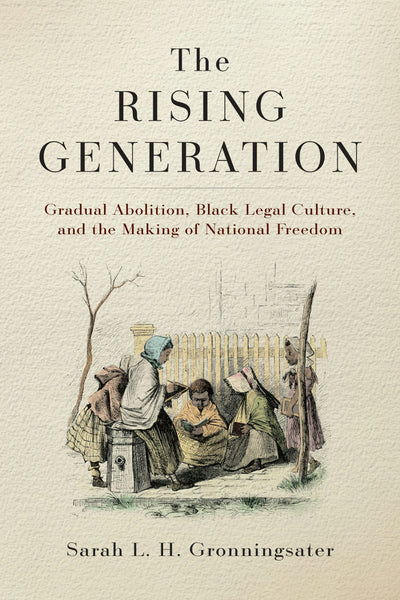
The Rising Generation
Regular price $69.95 Save $-69.95Chronicles the history of emancipation through the cradle-to-grave experiences of a remarkable generation of black northerners
The Rising Generation chronicles the long history of emancipation in the United States through the cradle-to-grave experiences of a generation of black New Yorkers. Born into precarious freedom after the American Revolution and reaching adulthood in the lead-up to the Civil War, this remarkable generation ultimately played an outsized role in political and legal conflicts over slavery’s future, influencing both the nation’s path to the Civil War and changes to the US Constitution.
Through exhaustive research in archives across New York State, where the largest enslaved population in the North resided at the time of the American Revolution, Sarah L. H. Gronningsater begins by exploring how English colonial laws shaped late eighteenth-century gradual abolition acts that freed children born to enslaved mothers. The boys and girls affected by these laws were born into a quasi-free legal status. They were technically not enslaved but were nonetheless required to labor as servants until they reached adulthood. Parents, teachers, and mentors of these “children of gradual abolition” found multiple ways to protect and nurture the boys and girls in their midst. They supported and founded schools, formed ties with white lawyers and abolitionists, petitioned local and state officials for better laws, guarded against kidnapping and cruelty, and shaped New York’s evolving identity as a free state. Black fathers used their votes during annual state elections in the early 1800s to influence legislative antislavery efforts. After many but not all black men in the state were disfranchised by a race-based property requirement in 1822, black citizens across New York organized to regain equal suffrage and to expand and protect other crucial, non-gendered features of state citizenship. Women and children were critical participants in these efforts.
Gronningsater shows how, as the children of gradual abolition reached adulthood, they took the lessons of their youth into midcentury campaigns for legal equality, political inclusion, equitable common school education, and the expansion of freedom across the nation.
Speculation Nation
Regular price $39.95 Save $-39.95During the first quarter-century after its founding, the United States was swept by a wave of land speculation so unprecedented in intensity and scale that contemporaries and historians alike have dubbed it a “mania.” In Speculation Nation, Michael A. Blaakman uncovers the revolutionary origins of this real-estate bonanza—a story of ambition, corruption, capitalism, and statecraft that stretched across millions of acres from Maine to the Mississippi and Georgia to the Great Lakes.
Patriot leaders staked the success of their revolution on the seizure and public sale of Native American territory. Initially, they hoped that fledgling state and national governments could pay the hefty costs of the War for Independence and extend a republican society of propertied citizens by selling expropriated land directly to white farmers. But those democratic plans quickly ran aground of a series of obstacles, including an economic depression and the ability of many Native nations to repel U.S. invasion. Wily merchants, lawyers, planters, and financiers rushed into the breach. Scrambling to profit off future expansion, they lobbied governments to convey massive tracts for pennies an acre, hounded revolutionary veterans to sell their land bounties for a pittance, and marketed the rustic ideal of a yeoman’s republic—the early American dream—while waiting for land values to rise.
When the land business crashed in the late 1790s, scores of “land mad” speculators found themselves imprisoned for debt or declaring bankruptcy. But through their visionary schemes and corrupt machinations, U.S. speculators and statesmen had spawned a distinctive and enduring form of settler colonialism: a financialized frontier, which transformed vast swaths of contested land into abstract commodities. Speculation Nation reveals how the era of land mania made Native dispossession a founding premise of the American republic and ultimately rooted the United States’ “empire of liberty” in speculative capitalism.
Belonging
Regular price $39.95 Save $-39.95Explores how Black New Englanders maintained a sense of belonging among their kin in the face of slavery
As winter turned to spring in the year 1699, Sebastian and Jane embarked on a campaign of persuasion. The two wished to marry, and they sought the backing of their community in Boston. Nothing, however, could induce Jane’s enslaver to consent. Only after her death did Sebastian and Jane manage to wed, forming a long-lasting union even though husband and wife were not always able to live in the same household.
New England is often considered a cradle of liberty in American history, but this snippet of Jane and Sebastian’s story reminds us that it was also a cradle of slavery. From the earliest years of colonization, New Englanders bought and sold people, most of whom were of African descent. In Belonging, Gloria McCahon Whiting tells the region’s early history from the perspective of the people, like Jane and Sebastian, who belonged to others and who struggled to maintain a sense of belonging among their kin. Through a series of meticulously reconstructed family narratives, Whiting traces the contours of enslaved people’s intimate lives in early New England, where they often lived with those who bound them but apart from kin. Enslaved spouses rarely were able to cohabit; fathers and their offspring routinely were separated by inheritance practices; children could be removed from their mothers at an enslaver’s whim; and people in bondage had only partial control of their movement through the region, which made more difficult the task of maintaining distant relationships.
But Belonging does more than lay bare the obstacles to family stability for those in bondage. Whiting also charts Afro-New Englanders’ persistent demands for intimacy throughout the century and a half stretching from New England’s founding to the American Revolution. And she shows how the work of making and maintaining relationships influenced the region’s law, religion, society, and politics. Ultimately, the actions taken by people in bondage to fortify their families played a pivotal role in bringing about the collapse of slavery in New England’s most populous state, Massachusetts.
Coffee Nation
Regular price $45.00 Save $-45.00A fascinating look at how coffee tied the economic future of the early United States to the wider Atlantic world
Coffee is among the most common goods traded and consumed worldwide, and so omnipresent its popularity is often taken for granted. But even everyday habits have a history. When and why coffee become part of North American daily life is at the center of Coffee Nation. Using a wide range of archival, quantitative, and material evidence, Michelle Craig McDonald follows coffee from the slavery-based plantations of the Caribbean and South America, through the balance sheets of Atlantic world merchants, into the coffeehouses, stores, and homes of colonial North Americans, and ultimately to the growing import/export businesses of the early nineteenth-century United States that rebranded this exotic good as an American staple. The result is a sweeping history that explores how coffee shaped the lives of enslaved laborers and farmers, merchants and retailers, consumers and advertisers.
Coffee Nation also challenges traditional interpretations of the American Revolution, as coffee’s spectacular profitability in US markets and popularity on the new nation’s tables by the mid-nineteenth century was the antithesis of independence. From its beginnings as a colonial commodity in the early eighteenth century, coffee’s popularity soared to become a leading global economy by the 1830s. The United States dominated this growth, by importing ever-increasing amounts of the commodity for drinkers at home and developing a lucrative re-export trade to buyers overseas. But while income generated from coffee sales made up an expanding portion of US trade revenue, the market always depended on reliable access to a commodity that the nation could not grow for itself. By any measure, the coffee industry was a financial success story, but one that runs counter to the dominant narrative of national autonomy. Distribution, not production, lay at the heart of North America’s coffee business, and its profitability and expansion relied on securing and maintaining ties first with the Caribbean and then Latin America.
Black Elders
Regular price $39.95 Save $-39.95Would there have been a Frederick Douglass if it were not for Betsy Bailey, the grandmother who raised him? Would Harriet Jacobs have written her renowned autobiography, Incidents in the Life of a Slave Girl, if her grandmother, a free black woman named Molly Horniblow, had not enabled Jacobs’ escape from slavery?
In Black Elders, Frederick C. Knight explores the experiences of African Americans with aging and in old age during the eras of slavery and emancipation. Though slavery put a premium on young labor, elders worked as caregivers, domestics, cooks, or midwives and performed other tasks in the margins of Southern and Northern economies. Looking at black families, churches, mutual aid societies, and homes for the aged, Knight demonstrates the pivotal role of elders in the history of African American community formation through Reconstruction.
Drawing on a wide array of printed and archival sources, including slave narratives, plantation records, letters, diaries, meeting minutes, and state and federal archives, Knight also examines how blacks and whites, men and women, the young and the old developed competing ideas about age and aging, differences that shaped social relations in coastal West and West Central Africa, the Atlantic and domestic slave trades, colonial and antebellum Southern slave societies, and emancipation in the North and South.
Black Elders offers a unique window into the individual and collective lives of African Americans, the day-to-day struggles they waged around their experiences of aging, and how they drew upon these resources to define the meaning of family, community, and freedom.
The Great Power of Small Nations
Regular price $79.95 Save $-79.95A fresh examination of the formidable and resilient Native nations who helped shape the modern Gulf South
In The Great Power of Small Nations, Elizabeth N. Ellis (Peoria) tells the stories of the many smaller Native American nations that shaped the development of the Gulf South. Based on extensive archival research and oral histories, Ellis’s narrative chronicles how diverse Indigenous peoples—including Biloxis, Choctaws, Chitimachas, Chickasaws, Houmas, Mobilians, and Tunicas—influenced and often challenged the growth of colonial Louisiana. The book centers on questions of Native nation-building and international diplomacy, and it argues that Native American migration and practices of offering refuge to migrants in crisis enabled Native nations to survive the violence of colonization.
Indeed, these practices also made them powerful. When European settlers began to arrive in Indigenous homelands at the turn of the eighteenth century, these small nations, or petites nations as the French called them, pulled colonists into their political and social systems, thereby steering the development of early Louisiana. In some cases, the same practices that helped Native peoples withstand colonization in the eighteenth century, including frequent migration, living alongside foreign nations, and welcoming outsiders into their lands, have made it difficult for their contemporary descendants to achieve federal acknowledgment and full rights as Native American peoples.
The Great Power of Small Nations tackles questions of Native power past and present and provides a fresh examination of the formidable and resilient Native nations who helped shape the modern Gulf South.
A Constitutional Culture
Regular price $45.00 Save $-45.00In A Constitutional Culture, Adrian Chastain Weimer uncovers the story of how, more than a hundred years before the American Revolution, colonists pledged their lives and livelihoods to the defense of local political institutions against arbitrary rule.
With the return of Charles II to the English throne in 1660, the puritan-led colonies faced enormous pressure to conform to the crown’s priorities. Charles demanded that puritans change voting practices, baptismal policies, and laws, and he also cast an eye on local resources such as forests, a valuable source of masts for the English navy. Moreover, to enforce these demands, the king sent four royal commissioners on warships, ostensibly headed for New Netherland but easily redirected toward Boston. In the face of this threat to local rule, colonists had to decide whether they would submit to the commissioners’ authority, which they viewed as arbitrary because it was not accountable to the people, or whether they would mobilize to defy the crown.
Those resisting the crown included not just freemen (voters) but also people often seen as excluded or marginalized such as non-freemen, indentured servants, and women. Together they crafted a potent regional constitutional culture in defiance of Charles II that was characterized by a skepticism of metropolitan ambition, a defense of civil and religious liberties, and a conviction that self-government was divinely sanctioned. Weimer shows how they expressed this constitutional culture through a set of well-rehearsed practices—including fast days, debates, committee work, and petitions. Equipped with a ready vocabulary for criticizing arbitrary rule, with a providentially informed capacity for risk-taking, and with a set of intellectual frameworks for divided sovereignty, the constitutional culture that New Englanders forged would not easily succumb to an imperial authority intent on consolidating its power.
Republic of Indians
Regular price $45.00 Save $-45.00A sweeping history of the Native Southerners who wrote their principles into Spanish and English law
A sweeping history of the Native Southerners who challenged European empires from the inside, Republic of Indians tells the story of Indigenous leaders who wrote their principles into Spanish and English law.
While in the Spanish Empire, Natives were a recognized part of “la república de indios,” the “republic of Indians,” other Natives across the early American South understood themselves to be joined with European colonists in larger polities, each jealously guarding their own bodies of liberties under royal sanction. Thus, rather than simply rejecting European pretensions to rule them as subjects and vassals, Native Southerners as diverse as the Apalachees, Pamunkeys, Powhatans, and Timucuas redefined their status to become political players in legislative assemblies and the courts of distant monarchs. They pushed for incorporation in larger political systems in which they had a say and were themselves instrumental in creating.
Adapting pre-invasion practices to the technology of writing and the challenges of colonialism, Indigenous petitioners sought exemptions from labor and protection for “the lands that God gave to them,” as well as the right to install preferred leaders, avoid enslavement, ally with the Crown against colonists, ease harsh colonial laws, and even amend the terms of treaties and compacts. Bradley J. Dixon shows how their petitions also stand as enduring contributions to American political thought and how it was these “vassals” and “subjects” who gave meaning to the modern idea of tribal sovereignty. In the South, the Spanish and English empires came to resemble one another precisely because they were both dependent to a remarkable degree on maintaining Indigenous political consent and were founded in large part on Indigenous conceptions of law.
The Driver’s Story
Regular price $39.95 Save $-39.95The story of the driver is the story of Atlantic slavery. Starting in the seventeenth-century Caribbean, enslavers developed the driving system to solve their fundamental problem: how to extract labor from captive workers who had every reason to resist. In this system, enslaved Black drivers were tasked with supervising and punishing other enslaved laborers. In The Driver’s Story, Randy M. Browne illuminates the predicament and harrowing struggles of these men—and sometimes women—at the heart of the plantation world. What, Browne asks, did it mean to be trapped between the insatiable labor demands of white plantation authorities and the constant resistance of one’s fellow enslaved laborers?
In this insightful and unsettling account of slavery and racial capitalism, Browne shows that on plantations across the Americas, drivers were at the center of enslaved people’s working lives, social relationships, and struggles against slavery. Drivers enforced labor discipline and confronted the resistance of their fellow enslaved laborers, aiming to maintain a position that helped them survive in a world where enslaved people were treated as disposable. Drivers also protected the people they supervised, negotiating workloads and customary rights to essentials like food and rest with white authorities. Within the slave community, drivers helped other enslaved people create a sense of belonging, as husbands and fathers, as Big Men, and as leaders of diasporic African “nations.” Sometimes, drivers even organized rebellions, sabotaging the very system they were appointed to support.
Compelling and original, The Driver’s Story enriches our understanding of the never-ending war between enslavers and enslaved laborers by focusing on its front line. It also brings us face-to-face with the horror of capitalist labor exploitation.
Women Healers
Regular price $39.95 Save $-39.95In her eighteenth-century medical recipe manuscript, the Philadelphia healer Elizabeth Coates Paschall asserted her ingenuity and authority with the bold strokes of her pen. Paschall developed an extensive healing practice, consulted medical texts, and conducted experiments based on personal observations. As British North America’s premier city of medicine and science, Philadelphia offered Paschall a nurturing environment enriched by diverse healing cultures and the Quaker values of gender equality and women’s education. She participated in transatlantic medical and scientific networks with her friend, Benjamin Franklin. Paschall was not unique, however. Women Healers recovers numerous women of European, African, and Native American descent who provided the bulk of health care in the greater Philadelphia area for centuries.
Although the history of women practitioners often begins with the 1850 founding of Philadelphia’s Female Medical College, the first women’s medical school in the United States, these students merely continued the legacies of women like Paschall. Remarkably, though, the lives and work of early American female practitioners have gone largely unexplored. While some sources depict these women as amateurs whose influence declined, Susan Brandt documents women’s authoritative medical work that continued well into the nineteenth century. Spanning a century and a half, Women Healers traces the transmission of European women’s medical remedies to the Delaware Valley where they blended with African and Indigenous women’s practices, forming hybrid healing cultures.
Drawing on extensive archival research, Brandt demonstrates that women healers were not inflexible traditional practitioners destined to fall victim to the onward march of Enlightenment science, capitalism, and medical professionalization. Instead, women of various classes and ethnicities found new sources of healing authority, engaged in the consumer medical marketplace, and resisted physicians’ attempts to marginalize them. Brandt reveals that women healers participated actively in medical and scientific knowledge production and the transition to market capitalism.
America Under the Hammer
Regular price $39.95 Save $-39.95Reveals how, through auctions, early Americans learned capitalism
As the first book-length study of auctions in early America, America Under the Hammer follows this ubiquitous but largely overlooked institution to reveal how, across the eighteenth and early nineteenth centuries, price became an accepted expression of value. From the earliest days of colonial conquest, auctions put Native land and human beings up for bidding alongside material goods, normalizing new economic practices that turned social relations into economic calculations and eventually became recognizable as nineteenth-century American capitalism.
Starting in the eighteenth century, neighbors collectively turned speculative value into economic “facts” in the form of concrete prices for specific items, thereby establishing ideas about fair exchange in their communities. This consensus soon fractured: during the Revolutionary War, state governments auctioned loyalist property, weaponizing local group participation in pricing and distribution to punish political enemies. By the early nineteenth century, suspicion that auction outcomes were determined by manipulative auctioneers prompted politicians and satirists to police the boundaries of what counted as economic exchange and for whose benefit the economy operated. Women at auctions—as commodities, bidders, or beneficiaries—became a focal point for gendering economic value itself. By the 1830s, as abolitionists attacked the public sale of enslaved men, women, and children, auctions had enshrined a set of economic ideas—that any entity could be coded as property and priced through competition—that have become commonsense understandings all too seldom challenged.
In contrast to histories focused on banks, currencies, or plantations, America Under the Hammer highlights an institution that integrated market, community, and household in ways that put gender, race, and social bonds at the center of ideas about economic worth. Women and men, enslaved and free, are active participants in this story rather than bystanders, and their labor, judgments, and bodies define the resulting contours of the American economy.
Philadelphia Stories
Regular price $34.95 Save $-34.95For the average tourist, the history of Philadelphia can be like a leisurely carriage ride through Old City. The Liberty Bell. Independence Hall. Benjamin Franklin. The grooves in the cobblestone are so familiar, one barely notices the ride. Yet there are other paths to travel, and the ride can be bumpy. Beyond the famed founders, other Americans walked the streets of Philadelphia whose lives were, in their own ways, just as emblematic of the promises and perils of the new nation.
Philadelphia Stories chronicles twelve of these lives to explore the city's people and places from the colonial era to the years before the Civil War. This collective portrait includes men and women, Black and white Americans, immigrants and native born. If mostly forgotten today, banker Stephen Girard was one of the wealthiest men ever to have lived, and his material legacy can be seen by visiting sites such as Girard College. In a different register, but equally impressive, were the accomplishments of Sarah Thorn Tyndale. In a few short years as a widow she made enough money on her porcelain business to retire to a life as a reformer. Others faced frustration. Take, for example, Grace Growden Galloway. Born to an important family, she saw her home invaded and her property confiscated by patriot forces. Or consider the life of Francis Johnson, a Black bandleader and composer who often performed at the Musical Fund Hall, which still stands today. And yet he was barred from joining its Society. Philadelphia Stories examines their rich lives, as well as those of others who shaped the city's past.
Many of the places inhabited by these people survive to this day. In the pages of this book and on the streets of the city, one can visit both the people and places of Philadelphia's rich history.
Undoing Slavery
Regular price $69.95 Save $-69.95Undoing Slavery excavates cultural, political, medical, and legal history to understand the abolitionist focus on the body on its own terms. Motivated by their conviction that the physical form of the human body was universal and faced with the growing racism of eighteenth- and nineteenth-century science, abolitionists in North America and Britain focused on undoing slavery’s harm to the bodies of the enslaved. Their pragmatic focus on restoring the bodily integrity and wellbeing of enslaved people threw up many unexpected challenges. This book explores those challenges.
Slavery exploited the bodies of men and women differently: enslaved women needed to be acknowledged as mothers rather than as reproducers of slave property, and enslaved men needed to claim full adult personhood without triggering white fears about their access to male privilege. Slavery’s undoing became more fraught by the 1850s, moreover, as federal Fugitive Slave Law and racist medicine converged. The reach of the federal government across the borders of free states and theories about innate racial difference collapsed the distinctions between enslaved and emancipated people of African descent, making militant action necessary.
Escaping to so-called “free” jurisdictions, refugees from slavery demonstrated that a person could leave the life of slavery behind. But leaving behind the enslaved body, the fleshy archive of trauma and injury, proved impossible. Bodies damaged by slavery needed urgent physical care as well as access to medical knowledge untainted by racist science. As the campaign to end slavery revealed, legal rights alone, while necessary, were not sufficient either to protect or heal the bodies of African-descended people from the consequences of slavery and racism.
Boundaries of Belonging
Regular price $45.00 Save $-45.00In the decades following England’s 1655 conquest of Spanish Jamaica, the western Caribbean became the site of overlapping and competing claims—to land, maritime spaces, and people. English Jamaica, located in the midst of Spanish American port towns and shipping lanes, was central to numerous projects of varying legality, aimed at acquiring Spanish American wealth. Those projects were backdrop to a wide-ranging movement of people who made their own claims to political membership in developing colonial societies, and by extension, in Atlantic empires.
Boundaries of Belonging follows the stories of these individuals—licensed traders, smugglers, freedom seekers, religious refugees, pirates, and interlopers—who moved through the contested spaces of the western Caribbean. Though some were English and Spanish, many others were Sephardic, Tule, French, Kalabari, Scottish, Dutch, or Brandenberg. They also included creole people who identified themselves by their local place of origin or residence--as Jamaican, Cuban, or Panamanian.
As they crossed into and out of rival imperial jurisdictions, many either sought or rejected Spanish or English subjecthood, citing their place of birth, their nation or ethnicity, their religion, their loyalty, or their economic or military contributions to colony or empire. Colonial and metropolitan officials weighed those claims as they tried to impose sovereignty over diverse and mobile people in a region of disputed and shifting jurisdictions. These contests over who belonged in what empire and why, and over what protections such belonging conferred, in turn helped to determine who would be included within a developing law of nations.
The Early Imperial Republic
Regular price $55.00 Save $-55.00Created in a world of empires, the United States was to be something new: an expansive republic proclaiming commitments to liberty and equality but eager to extend its territory and influence. Yet from the beginning, Native powers, free and enslaved Black people, and foreign subjects perceived, interacted with, and resisted the young republic as if it was merely another empire under the sun. Such perspectives have driven scholars to reevaluate the early United States, as the parameters of early American history have expanded in Atlantic, continental, and global directions. If the nation’s acquisition of Puerto Rico, Guam, and the Philippine Islands in 1898 traditionally marked its turn toward imperialism, new scholarship suggests the United States was an empire from the moment of its creation.
The essays gathered in The Early Imperial Republic move beyond the question of whether the new republic was an empire, investigating instead where, how, and why it was one. They use the category of empire to situate the early United States in the global context its contemporaries understood, drawing important connections between territorial conquests on the continent and American incursions around the globe. They reveal an early U.S. empire with many different faces, from merchants who sought to profit from the republic’s imperial expansion to Native Americans who opposed or leveraged it, from free Black colonizationists and globe-trotting missionaries to illegal slave traders and anti-imperial social reformers. In tracing these stories, the volume’s contributors bring the study of early U.S. imperialism down to earth, encouraging us to see the exertion of U.S. power on the ground as a process that both drew upon the example of its imperial predecessors and was forced to grapple with their legacies. Taken together, they argue that American empire was never confined to one era but is instead a thread throughout U.S. history.
Contributors:Brooke Bauer, Michael A. Blaakman, Eric Burin, Emily Conroy-Krutz, Kathleen DuVal, Susan Gaunt Stearns, Nicholas Guyatt, Amy S. Greenberg, M. Scott Heerman, Robert Lee, Julia Lewandoski, Margot Minardi, Ousmane Power-Greene, Nakia D. Parker, Tom Smith
Under the Skin
Regular price $39.95 Save $-39.95Under the Skin investigates the role of cross-cultural body modification in seventeenth-century and eighteenth-century North America, revealing that the practices of tattooing and scalping were crucial to interactions between Natives and newcomers. These permanent and painful marks could act as signs of alliance or signs of conflict, producing a complex bodily archive of cross-cultural entanglement.
Indigenous body modification practices were adopted and transformed by colonial powers, making tattooing and scalping key forms of cultural and political contestation in early America. Although these bodily practices were quite distinct—one a painful but generally voluntary sign of accomplishment and affiliation, the other a violent assault on life and identity—they were linked by growing colonial perceptions that both were crucial elements of “Nativeness.” Tracing the transformation of concepts of bodily integrity, personal and collective identities, and the sources of human difference, Under the Skin investigates both the lived physical experience and the contested metaphorical power of early American bodies.
Struggling for power on battlefields, in diplomatic gatherings, and in intellectual exchanges, Native Americans and Anglo-Americans found their physical appearances dramatically altered by their interactions with one another. Contested ideas about the nature of human and societal difference translated into altered appearances for many early Americans. In turn, scars and symbols on skin prompted an outpouring of stories as people debated the meaning of such marks. Perhaps paradoxically, individuals with culturally ambiguous or hybrid appearances prompted increasing efforts to insist on permanent bodily identity. By the late eighteenth century, ideas about the body, phenotype, and culture were increasingly articulated in concepts of race. Yet even as the interpretations assigned to inscribed flesh shifted, fascination with marked bodies remained.
Cultivating Empire
Regular price $45.00 Save $-45.00Cultivating Empire charts the connections between missionary work, capitalism, and Native politics to understand the making of the American empire in the late-eighteenth and early-nineteenth centuries. It presents American empire-building as a negotiated phenomenon that was built upon the foundations of earlier Atlantic empires, and it shows how U.S. territorial and economic development went hand-in-hand. Lori. J. Daggar explores how Native authority and diplomatic protocols encouraged the fledgling U.S. federal government to partner with missionaries in the realm of Indian affairs, and she charts how that partnership borrowed and deviated from earlier imperial-missionary partnerships.
Employing the terminology of speculative philanthropy to underscore the ways in which a desire to do good often coexisted with a desire to make profit, Cultivating Empire links eighteenth- and early-nineteenth-century U.S. Indian policy—often framed as benevolent by its crafters—with the emergence of racial capitalism in the United States. In the process, Daggar argues that Native peoples wielded ideas of philanthropy and civilization for their own purposes and that Indian Country played a critical role in the construction of the U.S. imperial state and its economy. Rather than understand civilizing missions simply as tools for assimilation, then, Cultivating Empire reveals that missions were hinges for U.S. economic and political development that could both devastate Indigenous communities and offer Native peoples additional means to negotiate for power and endure.
Rogue Revolutionaries
Regular price $45.00 Save $-45.00In 1822, the Mary departed Philadelphia and sailed in the direction of the Spanish colony of Puerto Rico. Like most vessels that navigated the Caribbean, the Mary brought together men who had served under a dozen different flags over the years. Unlike most crews, those aboard the Mary were in a different line of commerce: they exported revolution. In addition to rifles and pistols, the Mary transported a box filled with proclamations announcing the creation of the "Republic of Boricua." This imagined republic rested on one principle: equal rights for all, regardless of birthplace, race, or religion. The leaders of the expedition had never set foot in Puerto Rico. And they never would.
When we think of the Age of Revolutions, George Washington, Robespierre, Toussaint Louverture, or Simón Bolívar might come to mind. But Rogue Revolutionaries recovers the interconnected stories of now-forgotten "foreigners of desperate fortune" who dreamt of overthrowing colonial monarchy and creating their own countries. They were not members of the political and economic elite; rather, they were ship captains, military veterans, and enslaved soldiers. As a history of ideas and geopolitics grounded in the narratives of extraordinary lives, Rogue Revolutionaries shows how these men of different nationalities and ethnicities claimed revolution as a universal right and reimagined notions of sovereignty, liberty, and decolonization.
In the midst of wars and upheavals, the question of who had the legitimacy to launch a revolution and to start a new country was open to debate. Behind the growing power of nation-states, Mongey uncovers a lost world of radical cosmopolitanism grounded in the pursuit of material interests and personal prestige. In demonstrating that these would-be revolutionaries and their fleeting republics were critical to the creation of a new international order, Mongey reminds us of the importance of attending to failures, dead ends, and the unpredictable nature of history.
The World Colonization Made
Regular price $45.00 Save $-45.00According to accepted historical wisdom, the goal of the African Colonization Society (ACS), founded in 1816 to return freed slaves to Africa, was borne of desperation and illustrated just how intractable the problems of race and slavery had become in the nineteenth-century United States. But for Brandon Mills, the ACS was part of a much wider pattern of national and international expansion. Similar efforts on the part of the young nation to create, in Thomas Jefferson's words, an "empire of liberty," spanned Native removal, the annexation of Texas and California, filibustering campaigns in Latin America, and American missionary efforts in Hawaii, as well as the founding of Liberia in 1821. Mills contends that these diverse currents of U.S. expansionism were ideologically linked and together comprised a capacious colonization movement that both reflected and shaped a wide range of debates over race, settlement, citizenship, and empire in the early republic.
The World Colonization Made chronicles the rise and fall of the colonization movement as a political force within the United States—from its roots in the crises of the Revolutionary era, to its peak with the creation of the ACS, to its ultimate decline with emancipation and the Civil War. The book interrogates broader issues of U.S. expansion, including the progression of federal Indian policy, the foundations and effects of the Monroe Doctrine and Manifest Destiny, and the growth of U.S. commercial and military power throughout the Western hemisphere. By contextualizing the colonization movement in this way, Mills shows how it enabled Americans to envision a world of self-governing republics that harmonized with racial politics at home.
A Town In-Between
Regular price $59.95 Save $-59.95In A Town In-Between, Judith Ridner reveals the influential, turbulent past of a modest, quiet American community. Today Carlisle, Pennsylvania, nestled in the Susquehanna Valley, is far from the nation's political and financial centers. In the eighteenth century, however, Carlisle and its residents stood not only at a geographical crossroads but also at the fulcrum of early American controversies. Located between East Coast settlement and the western frontier, Carlisle quickly became a mid-Atlantic hub, serving as a migration gateway to the southern and western interiors, a commercial way station in the colonial fur trade, a military staging and supply ground during the Seven Years' War, American Revolution, and Whiskey Rebellion, and home to one of the first colleges in the United States, Dickinson.
A Town In-Between reconsiders the role early American towns and townspeople played in the development of the country's interior. Focusing on the lives of the ambitious group of Scots-Irish colonists who built Carlisle, Judith Ridner reasserts that the early American west was won by traders, merchants, artisans, and laborers—many of them Irish immigrants—and not just farmers. Founded by proprietor Thomas Penn, the rapidly growing town was the site of repeated uprisings, jailbreaks, and one of the most publicized Anti-Federalist riots during constitutional ratification. These conflicts had dramatic consequences for many Scots-Irish Presbyterian residents who found themselves a people in-between, mediating among the competing ethnoreligious, cultural, class, and political interests that separated them from their fellow Quaker and Anglican colonists of the Delaware Valley and their myriad Native American trading partners of the Ohio country.
In this thoroughly researched and highly readable study, Ridner argues that interior towns were not so much spearheads of a progressive and westward-moving Euro-American civilization, but volatile places situated in the middle of a culturally diverse, economically dynamic, and politically evolving early America.
The World That Fear Made
Regular price $50.00 Save $-50.00A thought-provoking history of slaveholders' fear of the people they enslaved and its consequences
From the Stono Rebellion in 1739 to the Haitian Revolution of 1791 to Nat Turner's Rebellion in 1831, slave insurrections have been understood as emblematic rejections of enslavement, the most powerful and, perhaps, the only way for slaves to successfully challenge the brutal system they endured. In The World That Fear Made, Jason T. Sharples orients the mirror to those in power who were preoccupied with their exposure to insurrection. Because enslavers in British North America and the Caribbean methodically terrorized slaves and anticipated just vengeance, colonial officials consolidated their regime around the dread of rebellion. As Sharples shows through a comprehensive data set, colonial officials launched investigations into dubious rumors of planned revolts twice as often as actual slave uprisings occurred. In most of these cases, magistrates believed they had discovered plans for insurrection, coordinated by a network of enslaved men, just in time to avert the uprising. Their crackdowns, known as conspiracy scares, could last for weeks and involve hundreds of suspects. They sometimes brought the execution or banishment of dozens of slaves at a time, and loss and heartbreak many times over.
Mining archival records, Sharples shows how colonists from New York to Barbados tortured slaves to solicit confessions of baroque plots that were strikingly consistent across places and periods. Informants claimed that conspirators took direction from foreign agents; timed alleged rebellions for a holiday such as Easter; planned to set fires that would make it easier to ambush white people in the confusion; and coordinated the uprising with European or Native American invasion forces. Yet, as Sharples demonstrates, these scripted accounts rarely resembled what enslaved rebels actually did when they took up arms. Ultimately, he argues, conspiracy scares locked colonists and slaves into a cycle of terror that bound American society together through shared racial fear.
Colonial Ecology, Atlantic Economy
Regular price $49.95 Save $-49.95Focusing on the Connecticut River Valley—New England's longest river and largest watershed— Strother Roberts traces the local, regional, and transatlantic markets in colonial commodities that shaped an ecological transformation in one corner of the rapidly globalizing early modern world. Reaching deep into the interior, the Connecticut provided a watery commercial highway for the furs, grain, timber, livestock, and various other commodities that the region exported. Colonial Ecology, Atlantic Economy shows how the extraction of each commodity had an impact on the New England landscape, creating a new colonial ecology inextricably tied to the broader transatlantic economy beyond its shores.
This history refutes two common misconceptions: first, that globalization is a relatively new phenomenon and its power to reshape economies and natural environments has only fully been realized in the modern era and, second, that the Puritan founders of New England were self-sufficient ascetics who sequestered themselves from the corrupting influence of the wider world. Roberts argues, instead, that colonial New England was an integral part of Britain's expanding imperialist commercial economy.
Imperial planners envisioned New England as a region able to provide resources to other, more profitable parts of the empire, such as the sugar islands of the Caribbean. Settlers embraced trade as a means to afford the tools they needed to conquer the landscape and to acquire the same luxury commodities popular among the consumer class of Europe. New England's native nations, meanwhile, utilized their access to European trade goods and weapons to secure power and prestige in a region shaken by invading newcomers and the diseases that followed in their wake. These networks of extraction and exchange fundamentally transformed the natural environment of the region, creating a landscape that, by the turn of the nineteenth century, would have been unrecognizable to those living there two centuries earlier.
Faith in Exposure
Regular price $55.00 Save $-55.00Recent legal history in the United States reveals a hardening tendency to treat religious freedom and sexual and reproductive freedom as competing, even opposing, claims on public life. They are united, though, by the fact that both are rooted in our culture’s understanding of privacy. Faith in Exposure shows how, over the course of the nineteenth century, privacy came to encompass such contradictions—both underpinning the right to sexual and reproductive rights but also undermining them in the name of religious freedom.
Drawing on the interdisciplinary field of secular studies, Faith in Exposure brings a postsecular orientation to the historical emergence of modern privacy. The book explains this emergence through two interlocking stories. The first examines the legal and cultural connection of religion with the private sphere, showing how privacy became a moral concept that informs how we debate the right to be shielded from state interference, as well as who will be afforded or denied this protection. This conflation of religion with privacy gave rise, the book argues, to a “secular sensibility” that was especially invested in authenticity and the exposure of hypocrisy in others.
The second story examines the development of this “secular sensibility” of privacy through nineteenth-century novels. The preoccupation of the novel form with private life, and especially its dependence on revelations of private desire and sexual secrets, made it the perfect vehicle for suggesting that exposure might be synonymous with morality itself. Each chapter places key authors into wider contexts of popular fiction and periodical press debates. From fears over religious infidelity to controversies over what constituted a modern marriage and conspiracy theories about abolitionists, these were the contests, Justine S. Murison argues, that helped privacy emerge as both a sensibility and a right in modern, secular America.
Historic Real Estate
Regular price $69.95 Save $-69.95A detailed study of early historical preservation efforts between the 1780s and the 1850s
In Historic Real Estate, Whitney Martinko shows how Americans in the fledgling United States pointed to evidence of the past in the world around them and debated whether, and how, to preserve historic structures as permanent features of the new nation's landscape. From Indigenous mounds in the Ohio Valley to Independence Hall in Philadelphia; from Benjamin Franklin's childhood home in Boston to St. Philip's Episcopal Church in Charleston, South Carolina; from Dutch colonial manors of the Hudson Valley to Henry Clay's Kentucky estate, early advocates of preservation strove not only to place boundaries on competitive real estate markets but also to determine what should not be for sale, how consumers should behave, and how certain types of labor should be valued.
Before historic preservation existed as we know it today, many Americans articulated eclectic and sometimes contradictory definitions of architectural preservation to work out practical strategies for defining the relationship between public good and private profit. In arguing for the preservation of houses of worship and Indigenous earthworks, for example, some invoked the "public interest" of their stewards to strengthen corporate control of these collective spaces. Meanwhile, businessmen and political partisans adopted preservation of commercial sites to create opportunities for, and limits on, individual profit in a growing marketplace of goods. And owners of old houses and ancestral estates developed methods of preservation to reconcile competing demands for the seclusion of, and access to, American homes to shape the ways that capitalism affected family economies. In these ways, individuals harnessed preservation to garner political, economic, and social profit from the performance of public service.
Ultimately, Martinko argues, by portraying the problems of the real estate market as social rather than economic, advocates of preservation affirmed a capitalist system of land development by promising to make it moral.
Capitalism by Gaslight
Regular price $65.00 Save $-65.00While elite merchants, financiers, shopkeepers, and customers were the most visible producers, consumers, and distributors of goods and capital in the nineteenth century, they were certainly not alone in shaping the economy. Lurking in the shadows of capitalism's past are those who made markets by navigating a range of new financial instruments, information systems, and modes of transactions: prostitutes, dealers in used goods, mock auctioneers, illegal slavers, traffickers in stolen horses, emigrant runners, pilfering dock workers, and other ordinary people who, through their transactions and lives, helped to make capitalism as much as it made them.
Capitalism by Gaslight illuminates American economic history by emphasizing the significance of these markets and the cultural debates they provoked. These essays reveal that the rules of economic engagement were still being established in the nineteenth century: delineations between legal and illegal, moral and immoral, acceptable and unsuitable were far from clear. The contributors examine the fluid mobility and unstable value of people and goods, the shifting geographies and structures of commercial institutions, the blurred boundaries between legitimate and illegitimate economic activity, and the daily lives of men and women who participated creatively—and often subversively—in American commerce.
With subjects ranging from women's studies and African American history to material and consumer culture, this compelling volume illustrates that when hidden forms of commerce are brought to light, they can become flashpoints revealing the tensions, fissures, and inequities inherent in capitalism itself.
Contributors: Paul Erickson, Robert J. Gamble, Ellen Gruber Garvey, Corey Goettsch, Joshua R. Greenberg, Katie M. Hemphill, Craig B. Hollander, Brian P. Luskey, Will B. Mackintosh, Adam Mendelsohn, Brendan P. O'Malley, Michael D. Thompson, Wendy A. Woloson.
A Democracy of Facts
Regular price $49.95 Save $-49.95A Democracy of Facts chronicles the fascinating story of American naturalists who came of age and stumbled toward a profession in the years after the American Revolution.
In a political climate mistrusting of elites and book knowledge, naturalists turned to the American populace, especially its farmers and artisans, for information to catalog and describe the fledgling nation's natural environment. From these ordinary Americans, naturalists gathered a vast wealth of fact and opinion about the natural world of North America. But in relying on those who daily lived in and worked with nature, naturalists were obliged to engage directly with people who disagreed with them, who were unafraid to challenge scientific expertise and ignore scientific authority. As experts and ordinary Americans argued about nature, they exposed larger fault lines in American society—over useful versus academic knowledge, empirical experience versus professional expertise, and the struggle for and against cultural authority. In the debate over the natural history of the new nation, citizens in the early republic were entitled to their own opinions as well as their own facts.
Drawing on examples from ornithology, botany, antiquities, theology, and geology, historian Andrew J. Lewis concludes that American naturalists could not control the whims and fancies of public opinion and were successful in establishing their authority only after they aligned their interests with the emerging bureaucratic state. Through this process, natural history became professional science.
The first historical overview of early American natural history in many years, A Democracy of Facts will interest readers eager to learn about the birth of science in America and those curious to witness early Americans interacting with the natural world and each other.
Laid Waste!
Regular price $49.95 Save $-49.95After humble beginnings as faltering British colonies, the United States acquired astonishing wealth and power as the result of what we now refer to as modernization. Originating in England and Western Europe, transplanted to the Americas, then copied around the world in the nineteenth and twentieth centuries, this process locked together science and technology, political democracy, economic freedom, and competitive capitalism. This has produced for some populations unimagined wealth and material comfort, yet it has also now brought the global environment to a tipping point beyond which life as we know it may not be sustainable. How did we come to endanger the very future of life on earth in our heedless pursuit of wealth and happiness?
In Laid Waste!, John Lauritz Larson answers that question with a 350-year review of the roots of an American "culture of exploitation" that has left us free, rich, and without an honest sense of how this crisis came to be. Larson undertakes an ambitious historical synthesis, seeking to illuminate how the culture of exploitation grew out of the earliest English settlements and has continually undergirded U.S. society and its cherished myths. Through a series of meditations on key concepts, the story moves from the starving times of early Jamestown through the rise of colonial prosperity, the liberation of the revolutionary generation, the launching of the American republic, and the emergence of a new global industrial power by the end of the nineteenth century. Through this story, the book explores the rise of an American sense of righteousness, entitlement, and destiny that has masked any recognition that our wealth and success has come at expense to anyone or anything. Part polemic, part jeremiad, and part historical overview, Laid Waste! is a provocative and bracing account of how the development of American culture itself has led us to today's crises.
Revolutions and Reconstructions
Regular price $55.00 Save $-55.00Revolutions and Reconstructions gathers historians of the early republic, the Civil War era, and African American and political history to consider not whether black people participated in the politics of the nineteenth century but how, when, and with what lasting effects. Collectively, its authors insist that historians go beyond questioning how revolutionary the American Revolution was, or whether Reconstruction failed, and focus, instead, on how political change initiated by African Americans and their allies constituted the rule in nineteenth-century American politics, not occasional and cataclysmic exceptions.
The essays in this groundbreaking collection cover the full range of political activity by black northerners after the Revolution, from cultural politics to widespread voting, within a political system shaped by the rising power of slaveholders. Conceptualizing a new black politics, contributors observe, requires reorienting American politics away from black/white and North/South polarities and toward a new focus on migration and local or state structures. Other essays focus on the middle decades of the nineteenth century and demonstrate that free black politics, not merely the politics of slavery, was a disruptive and consequential force in American political development.
From the perspective of the contributors to this volume, formal black politics did not begin in 1865, or with agitation by abolitionists like Frederick Douglass in the 1840s, but rather in the Revolutionary era's antislavery and citizenship activism. As these essays show, revolution, emancipation, and Reconstruction are not separate eras in U.S. history, but rather linked and ongoing processes that began in the 1770s and continued through the nineteenth century.
Contributors: Christopher James Bonner, Kellie Carter Jackson, Andrew Diemer, Laura F. Edwards, Van Gosse, Sarah L. H. Gronningsater, M. Scott Heerman, Dale Kretz, Padraig Riley, Samantha Seeley, James M. Shinn Jr., David Waldstreicher.
American Freethinker
Regular price $59.95 Save $-59.95The first comprehensive biography of Elihu Palmer, who was at the heart of the early United States' protracted contest over religious freedom and free speech
When the United States was new, a lapsed minister named Elihu Palmer shared with his fellow Americans the radical idea that virtue required no religious foundation. A better source for morality, he said, could be found in the natural world: the interconnected web of life that inspired compassion for all living things. Religions that deny these universal connections should be discarded, he insisted. For this, his Christian critics denounced him as a heretic whose ideas endangered the country.
Although his publications and speaking tours made him one of the most infamous American freethinkers in his day, Elihu Palmer has been largely forgotten. No cache of his personal papers exists and his book has been long out of print. Yet his story merits telling, Kirsten Fischer argues, and not only for the dramatic account of a man who lost his eyesight before the age of thirty and still became a book author, newspaper editor, and itinerant public speaker. Even more intriguing is his encounter with a cosmology that envisioned the universe as interconnected, alive with sensation, and everywhere infused with a divine life force.
Palmer's "heresy" tested the nation's recently proclaimed commitment to freedom of religion and of speech. In this he was not alone. Fischer reveals that Palmer engaged in person and in print with an array of freethinkers—some famous, others now obscure. The flourishing of diverse religious opinion struck some of his contemporaries as foundational to a healthy democracy while others believed that only a strong Christian faith could support democratic self-governance. This first comprehensive biography of Palmer draws on extensive archival research to tell the life story of a freethinker who was at the heart of the new nation's protracted contest over religious freedom and free speech—a debate that continues to resonate today.
Dangerous Neighbors
Regular price $54.95 Save $-54.95Dangerous Neighbors shows how the Haitian Revolution permeated early American print culture and had a profound impact on the young nation's domestic politics. Focusing on Philadelphia as both a representative and an influential vantage point, it follows contemporary American reactions to the events through which the French colony of Saint Domingue was destroyed and the independent nation of Haiti emerged. Philadelphians made sense of the news from Saint Domingue with local and national political developments in mind and with the French Revolution and British abolition debates ringing in their ears. In witnessing a French colony experience a revolution of African slaves, they made the colony serve as powerful and persuasive evidence in domestic discussions over the meaning of citizenship, equality of rights, and the fate of slavery.
Through extensive use of manuscript sources, newspapers, and printed literature, Dun uncovers the wide range of opinion and debate about events in Saint Domingue in the early republic. By focusing on both the meanings Americans gave to those events and the uses they put them to, he reveals a fluid understanding of the American Revolution and the polity it had produced, one in which various groups were making sense of their new nation in relation to both its own past and a revolution unfolding before them. Zeroing in on Philadelphia—a revolutionary center and an enclave of antislavery activity—Dun collapses the supposed geographic and political boundaries that separated the American republic from the West Indies and Europe.
The Disaffected
Regular price $59.95 Save $-59.95Elizabeth and Henry Drinker of Philadelphia were no friends of the American Revolution. Yet neither were they its enemies. The Drinkers were a merchant family who, being Quakers and pacifists, shunned commitments to both the Revolutionaries and the British. They strove to endure the war uninvolved and unscathed. They failed. In 1777, the war came to Philadelphia when the city was taken and occupied by the British army.
Aaron Sullivan explores the British occupation of Philadelphia, chronicling the experiences of a group of people who were pursued, pressured, and at times persecuted, not because they chose the wrong side of the Revolution but because they tried not to choose a side at all. For these people, the war was neither a glorious cause to be won nor an unnatural rebellion to be suppressed, but a dangerous and costly calamity to be navigated with care. Both the Patriots and the British referred to this group as "the disaffected," perceiving correctly that their defining feature was less loyalty to than a lack of support for either side in the dispute, and denounced them as opportunistic, apathetic, or even treasonous. Sullivan shows how Revolutionary authorities embraced desperate measures in their quest to secure their own legitimacy, suppressing speech, controlling commerce, and mandating military service. In 1778, without the Patriots firing a shot, the king's army abandoned Philadelphia and the perceived threat from neutrals began to decline—as did the coercive and intolerant practices of the Revolutionary regime.
By highlighting the perspectives of those wearied by and withdrawn from the conflict, The Disaffected reveals the consequences of a Revolutionary ideology that assumed the nation's people to be a united and homogenous front.
The Weaver's Craft
Regular price $59.95 Save $-59.95Cloth was one of the most important commodities in the early modern world, and colonial North Americans had to develop creative strategies to acquire it. Although early European settlers came from societies in which hand textile production was central to the economy, local conditions in North America interacted with traditional craft structures to create new patterns of production and consumption. The Weaver's Craft examines the development of cloth manufacture in early Pennsylvania from its roots in seventeenth-century Europe to the beginning of industrialization.
Adrienne D. Hood's focus on Pennsylvania and the long sweep of history yields a new understanding of the complexities of early American fabric production and the regional variations that led to distinct experiences of industrialization. Drawing on an extensive array of primary sources, combined with a quantitative approach, the author argues that in contrast to New England, rural Pennsylvania women spun the yarn that a small group of trained male artisans wove into cloth on a commercial basis throughout the eighteenth century. Their production was considerably augmented by consumers purchasing cheap cloth from Europe and Asia, making them active participants in a global marketplace. Hood's painstaking research and numerous illustrations of textile equipment, swatch books, and consumer goods will be of interest to both scholars and craftspeople.
Domestic Intimacies
Regular price $54.95 Save $-54.95Although it is commonly thought that incest has been taboo throughout history, nineteenth-century Americans evinced a great cultural anxiety that the prohibition was failing. Theologians debated the meaning and limits of biblical proscription, while jurists abandoned such injunctions and invented a new prohibition organized around the nuclear family. Novelists crafted fictional tales of accidental incest resulting from the severed ties between public and private life, while antislavery writers lamented the ramifications of breaking apart enslaved families. Phrenologists and physiologists established reproduction as the primary motivation of the incest prohibition while naturalizing the incestuous eroticism of sentimental family affection. Ethnographers imagined incest as the norm in so-called primitive societies in contrast to modern civilization. In the absence of clear biological or religious limitations, the young republic developed numerous, varied, and contradictory incest prohibitions.
Domestic Intimacies offers a wide-ranging, critical history of incest and its various prohibitions as they were defined throughout the nineteenth century. Historian Brian Connolly argues that at the center of these convergent anxieties and debates lay the idea of the liberal subject: an autonomous individual who acted on his own desires yet was tempered by reason, who enjoyed a life in public yet was expected to find his greatest satisfaction in family and home. Always lurking was the need to exercise personal freedom with restraint; indeed, the valorization of the affectionate family was rooted in its capacity to act as a bulwark against licentiousness. However it was defined, incest was thus not only perceived as a threat to social stability; it also functioned to regulate social relations—within families and between classes as well as among women and men, slaves and free citizens, strangers and friends. Domestic Intimacies overturns conventional histories of American liberalism by placing the fear of incest at the heart of nineteenth-century conflicts over public life and privacy, kinship and individualism, social contracts and personal freedom.
The Commerce of Vision
Regular price $55.00 Save $-55.00When Ralph Waldo Emerson wrote in 1837 that "Our Age is Ocular," he offered a succinct assessment of antebellum America's cultural, commercial, and physiological preoccupation with sight. In the early nineteenth century, the American city's visual culture was manifest in pamphlets, newspapers, painting exhibitions, and spectacular entertainments; businesses promoted their wares to consumers on the move with broadsides, posters, and signboards; and advances in ophthalmological sciences linked the mechanics of vision to the physiological functions of the human body. Within this crowded visual field, sight circulated as a metaphor, as a physiological process, and as a commercial commodity. Out of the intersection of these various discourses and practices emerged an entirely new understanding of vision.
The Commerce of Vision integrates cultural history, art history, and material culture studies to explore how vision was understood and experienced in the first half of the nineteenth century. Peter John Brownlee examines a wide selection of objects and practices that demonstrate the contemporary preoccupation with ocular culture and accurate vision: from the birth of ophthalmic surgery to the business of opticians, from the typography used by urban sign painters and job printers to the explosion of daguerreotypes and other visual forms, and from the novels of Edgar Allan Poe and Herman Melville to the genre paintings of Richard Caton Woodville and Francis Edmonds. In response to this expanding visual culture, antebellum Americans cultivated new perceptual practices, habits, and aptitudes. At the same time, however, new visual experiences became quickly integrated with the machinery of commodity production and highlighted the physical shortcomings of sight, as well as nascent ethical shortcomings of a surface-based culture. Through its theoretically acute and extensively researched analysis, The Commerce of Vision synthesizes the broad culturing of vision in antebellum America.
Poetry Wars
Regular price $69.95 Save $-69.95During America's founding period, poets and balladeers engaged in a series of literary "wars" against political leaders, journalists, and each other, all in the name of determining the political course of the new nation. Political poems and songs appeared regularly in newspapers (and as pamphlets and broadsides), commenting on political issues and controversies and satirizing leaders like Thomas Jefferson and Alexander Hamilton. Drawing on hundreds of individual poems—including many that are frequently overlooked—Poetry Wars reconstructs the world of literary-political struggle as it unfolded between the Stamp Act crisis and the War of 1812.
Colin Wells argues that political verse from this period was a unique literary form that derived its cultural importance from its capacity to respond to, and contest the meaning of, other printed texts—from official documents and political speeches to newspaper articles and rival political poems. First arising during the Revolution as a strategy for subverting the authority of royal proclamations and congressional declarations, poetic warfare became a ubiquitous part of early national print culture. Poets representing the emerging Federalist and Republican parties sought to wrest control of political narratives unfolding in the press by engaging in literary battles.
Tracing the parallel histories of the first party system and the rise and eventual decline of political verse, Poetry Wars shows how poetic warfare lent urgency to policy debates and contributed to a dynamic in which partisans came to regard each other as threats to the republic's survival. Breathing new life into this episode of literary-political history, Wells offers detailed interpretations of scores of individual poems, references hundreds of others, and identifies numerous terms and tactics of the period's verse warfare.
The American Revolution Reborn
Regular price $69.95 Save $-69.95The American Revolution conjures a series of iconographic images in the contemporary American imagination. In these imagined scenes, defiant Patriots fight against British Redcoats for freedom and democracy, while a unified citizenry rallies behind them and the American cause. But the lived experience of the Revolution was a more complex matter, filled with uncertainty, fear, and discord. In The American Revolution Reborn, editors Patrick Spero and Michael Zuckerman compile essays from a new generation of multidisciplinary scholars that render the American Revolution as a time of intense ambiguity and frightening contingency.
The American Revolution Reborn parts company with the Revolution of our popular imagination and diverges from the work done by historians of the era from the past half-century. In the first section, "Civil Wars," contributors rethink the heroic terms of Revolutionary-era allegiance and refute the idea of patriotic consensus. In the following section, "Wider Horizons," essayists destabilize the historiographical inevitability of America as a nation. The studies gathered in the third section, "New Directions," present new possibilities for scholarship on the American Revolution. And the last section, titled "Legacies," collects essays that deal with the long afterlife of the Revolution and its effects on immigration, geography, and international politics. With an introduction by Spero and a conclusion by Zuckerman, this volume heralds a substantial and revelatory rebirth in the study of the American Revolution.
Contributors: Zara Anishanslin, Mark Boonshoft, Denver Brunsman, Katherine Carté Engel, Aaron Spencer Fogleman, Travis Glasson, Edward G. Gray, David C. Hsiung, Ned C. Landsman, Michael A. McDonnell, Kimberly Nath, Bryan Rosenblithe, David S. Shields, Patrick Spero, Matthew Spooner, Aaron Sullivan, Michael Zuckerman.
Performing Patriotism
Regular price $69.95 Save $-69.95Selected by Choice magazine as an Outstanding Academic Title
During the eighteenth century, North American colonists began to display an increasing appetite for professional and amateur theatrical performances and a familiarity with the British dramatic canon ranging from the tragedies of Shakespeare, Addison, and Rowe to the comedies of Farquhar, Steele, and Gay. This interest sparked demand for both the latest hits of the London stage and a body of plays centered on patriotic (and often partisan) British themes. As relations between the crown and the colonies soured, the texts of these plays evolved into a common frame of reference for political arguments over colonial policy. Making the transition to print, these arguments deployed dramatic texts and theatrical metaphors for political advantage. Eventually, with the production of American propaganda plays during the Revolution, colonists began to develop a patriotic drama of their own, albeit one that still stressed the "British" character of American patriotism.
Performing Patriotism examines the role of theatrical performance and printed drama in the development of early American political culture. Building on the eighteenth-century commonplace that the theater could be a school for public virtue, Jason Shaffer illustrates the connections between the popularity of theatrical performances in eighteenth-century British North America and the British and American national identities that colonial and Revolutionary Americans espoused. The result is a wide-ranging survey of eighteenth-century American theater history and print culture.
Smugglers, Pirates, and Patriots
Regular price $50.00 Save $-50.00After emerging victorious from their revolution against the British Empire, many North Americans associated commercial freedom with independence and republicanism. Optimistic about the liberation movements sweeping Latin America, they were particularly eager to disrupt the Portuguese Empire. Anticipating the establishment of a Brazilian republic that they assumed would give them commercial preference, they aimed to aid Brazilian independence through contraband, plunder, and revolution. In contrast to the British Empire's reaction to the American Revolution, Lisbon officials liberalized imperial trade when revolutionary fervor threatened the Portuguese Empire in the 1780s and 1790s. In 1808, to save the empire from Napoleon's army, the Portuguese court relocated to Rio de Janeiro and opened Brazilian ports to foreign commerce. By 1822, the year Brazil declared independence, it had become the undisputed center of U.S. trade with the Portuguese Empire. However, by that point, Brazilians tended to associate freer trade with the consolidation of monarchical power and imperial strength, and, by the end of the 1820s, it was clear that Brazilians would retain a monarchy despite their independence.
Smugglers, Pirates, and Patriots delineates the differences between the British and Portuguese empires as they struggled with revolutionary tumult. It reveals how those differences led to turbulent transnational exchanges between the United States and Brazil as merchants, smugglers, rogue officials, slave traders, and pirates sought to trade outside legal confines. Tyson Reeder argues that although U.S. traders had forged their commerce with Brazil convinced that they could secure republican trade partners there, they were instead forced to reconcile their vision of the Americas as a haven for republics with the reality of a monarchy residing in the hemisphere. He shows that as twilight fell on the Age of Revolution, Brazil and the United States became fellow slave powers rather than fellow republics.
John Woolman's Path to the Peaceable Kingdom
Regular price $50.00 Save $-50.00The abolitionist John Woolman (1720-72) has been described as a "Quaker saint," an isolated mystic, singular even among a singular people. But as historian Geoffrey Plank recounts, this tailor, hog producer, shopkeeper, schoolteacher, and prominent Quaker minister was very much enmeshed in his local community in colonial New Jersey and was alert as well to events throughout the British Empire. Responding to the situation as he saw it, Woolman developed a comprehensive critique of his fellow Quakers and of the imperial economy, became one of the most emphatic opponents of slaveholding, and helped develop a new form of protest by striving never to spend money in ways that might encourage slavery or other forms of iniquity.
Drawing on the diaries of contemporaries, personal correspondence, the minutes of Quaker meetings, business and probate records, pamphlets, and other sources, John Woolman's Path to the Peaceable Kingdom shows that Woolman and his neighbors were far more engaged with the problems of inequality, trade, and warfare than anyone would know just from reading the Quaker's own writings. Although he is famous as an abolitionist, the end of slavery was only part of Woolman's project. Refusing to believe that the pursuit of self-interest could safely guide economic life, Woolman aimed for a miraculous global transformation: a universal disavowal of greed.
Empire by Collaboration
Regular price $54.95 Save $-54.95From the beginnings of colonial settlement in Illinois Country, the region was characterized by self-determination and collaboration that did not always align with imperial plans. The French in Quebec established a somewhat reluctant alliance with the Illinois Indians while Jesuits and fur traders planted defiant outposts in the Illinois River Valley beyond the Great Lakes. These autonomous early settlements were brought into the French empire only after the fact. As the colony grew, the authority that governed the region was often uncertain. Canada and Louisiana alternately claimed control over the Illinois throughout the eighteenth century. Later, British and Spanish authorities tried to divide the region along the Mississippi River. Yet Illinois settlers and Native people continued to welcome and partner with European governments, even if that meant playing the competing empires against one another in order to pursue local interests.
Empire by Collaboration explores the remarkable community and distinctive creole culture of colonial Illinois Country, characterized by compromise and flexibility rather than domination and resistance. Drawing on extensive archival research, Robert Michael Morrissey demonstrates how Natives, officials, traders, farmers, religious leaders, and slaves constantly negotiated local and imperial priorities and worked purposefully together to achieve their goals. Their pragmatic intercultural collaboration gave rise to new economies, new forms of social life, and new forms of political engagement. Empire by Collaboration shows that this rugged outpost on the fringe of empire bears central importance to the evolution of early America.
Imperial Entanglements
Regular price $55.00 Save $-55.00Imperial Entanglements chronicles the history of the Haudenosaunee Iroquois in the eighteenth century, a dramatic period during which they became further entangled in a burgeoning market economy, participated in imperial warfare, and encountered a waxing British Empire. Rescuing the Seven Years' War era from the shadows of the American Revolution and moving away from the political focus that dominates Iroquois studies, historian Gail D. MacLeitch offers a fresh examination of Iroquois experience in economic and cultural terms. As land sellers, fur hunters, paid laborers, consumers, and commercial farmers, the Iroquois helped to create a new economic culture that connected the New York hinterland to a transatlantic world of commerce. By doing so they exposed themselves to both opportunities and risks.
As their economic practices changed, so too did Iroquois ways of making sense of gender and ethnic differences. MacLeitch examines the formation of new cultural identities as men and women negotiated challenges to long-established gendered practices and confronted and cocreated a new racialized discourses of difference. On the frontiers of empire, Indians, as much as European settlers, colonial officials, and imperial soldiers, directed the course of events. However, as MacLeitch also demonstrates, imperial entanglements with a rising British power intent on securing native land, labor, and resources ultimately worked to diminish Iroquois economic and political sovereignty.
Political Gastronomy
Regular price $49.95 Save $-49.95"The table constitutes a kind of tie between the bargainer and the bargained-with, and makes the diners more willing to receive certain impressions, to submit to certain influences: from this is born political gastronomy. Meals have become a means of governing, and the fate of whole peoples is decided at a banquet."—Jean Anthèlme Brillat-Savarin, The Physiology of Taste, or, Meditations on Transcendental Gastronomy
The first Thanksgiving at Plymouth in 1621 was a powerfully symbolic event and not merely the pageant of abundance that we still reenact today. In these early encounters between Indians and English in North America, food was also symbolic of power: the venison brought to Plymouth by the Indians, for example, was resonant of both masculine skill with weapons and the status of the men who offered it. These meanings were clearly understood by Plymouth's leaders, however weak they appeared in comparison.
Political Gastronomy examines the meaning of food in its many facets: planting, gathering, hunting, cooking, shared meals, and the daily labor that sustained ordinary households. Public occasions such as the first Thanksgiving could be used to reinforce claims to status and precedence, but even seemingly trivial gestures could dramatize the tense negotiations of status and authority: an offer of roast squirrel or a spoonful of beer, a guest's refusal to accept his place at the table, the presence and type of utensils, whether hands should be washed or napkins used. Historian Michael A. LaCombe places Anglo-Indian encounters at the center of his study, and his wide-ranging research shows that despite their many differences in language, culture, and beliefs, English settlers and American Indians were able to communicate reciprocally in the symbolic language of food.
Unsettling the West
Regular price $49.95 Save $-49.95The revolutionary Ohio Valley is often depicted as a chaotic Hobbesian dystopia, in which Indians and colonists slaughtered each other at every turn. In Unsettling the West, Rob Harper overturns this familiar story. Rather than flailing in a morass, the peoples of the revolutionary Ohio Valley actively and persistently sought to establish a new political order that would affirm their land claims, protect them against attack, and promote trade. According to Harper, their efforts repeatedly failed less because of racial antipathy or inexorable competition for land than because of specific state policies that demanded Indian dispossession, encouraged rapid colonization, and mobilized men for war.
Unsettling the West demonstrates that government policies profoundly unsettled the Ohio Valley, even as effective authority remained elusive. Far from indifferent to states, both Indians and colonists sought government allies to aid them in both intra- and intercultural conflicts. Rather than spreading uncontrollably across the landscape, colonists occupied new areas when changing policies, often unintentionally, gave them added incentives to do so. Sporadic killings escalated into massacre and war only when militants gained access to government resources. Amid the resulting upheaval, Indians and colonists sought to preserve local autonomy by forging relationships with eastern governments. Ironically, these local pursuits of order ultimately bolstered state power.
Following scholars of European and Latin American history, Harper extends the study of mass violence beyond immediate motives to the structural and institutional factors that make large-scale killing possible. The Ohio Valley's transformation, he shows, echoed the experience of early modern and colonial state formation around the world. His attention to the relationships between violence, colonization, and state building connects the study of revolutionary America to a vibrant literature on settler colonialism.
Anglicizing America
Regular price $69.95 Save $-69.95The thirteen mainland colonies of early America were arguably never more British than on the eve of their War of Independence from Britain. Though home to settlers of diverse national and cultural backgrounds, colonial America gradually became more like Britain in its political and judicial systems, material culture, economies, religious systems, and engagements with the empire. At the same time and by the same process, these politically distinct and geographically distant colonies forged a shared cultural identity—one that would bind them together as a nation during the Revolution.
Anglicizing America revisits the theory of Anglicization, considering its application to the history of the Atlantic world, from Britain to the Caribbean to the western wildernesses, at key moments before, during, and after the American Revolution. Ten essays by senior historians trace the complex processes by which global forces, local economies, and individual motives interacted to reinforce a more centralized and unified social movement. They examine the ways English ideas about labor influenced plantation slavery, how Great Britain's imperial aspirations shaped American militarization, the influence of religious tolerance on political unity, and how Americans' relationship to Great Britain after the war impacted the early republic's naval and taxation policies. As a whole, Anglicizing America offers a compelling framework for explaining the complex processes at work in the western hemisphere during the age of revolutions.
Contributors: Denver Brunsman, William Howard Carter, Ignacio Gallup-Diaz, Anthony M. Joseph, Simon P. Newman, Geoffrey Plank, Nancy L. Rhoden, Andrew Shankman, David J. Silverman, Jeremy A. Stern.
The Haitian Revolution and the Early United States
Regular price $85.00 Save $-85.00When Jean-Jacques Dessalines proclaimed Haitian independence on January 1, 1804, Haiti became the second independent republic, after the United States, in the Americas; the Haitian Revolution was the first successful antislavery and anticolonial revolution in the western hemisphere. The histories of Haiti and the early United States were intimately linked in terms of politics, economics, and geography, but unlike Haiti, the United States would remain a slaveholding republic until 1865. While the Haitian Revolution was a beacon for African Americans and abolitionists in the United States, it was a terrifying specter for proslavery forces there, and its effects were profound. In the wake of Haiti's liberation, the United States saw reconfigurations of its geography, literature, politics, and racial and economic structures.
The Haitian Revolution and the Early United States explores the relationship between the dramatic events of the Haitian Revolution and the development of the early United States. The first section, "Histories," addresses understandings of the Haitian Revolution in the developing public sphere of the early United States, from theories of state sovereignty to events in the street; from the economic interests of U.S. merchants to disputes in the chambers of diplomats; and from the flow of rumor and second-hand news of refugees to the informal communication networks of the enslaved. The second section, "Geographies," explores the seismic shifts in the ways the physical territories of the two nations and the connections between them were imagined, described, inhabited, and policed as a result of the revolution. The final section, "Textualities," explores the wide-ranging consequences that reading and writing about slavery, rebellion, emancipation, and Haiti in particular had on literary culture in both the United States and Haiti.
With essays from leading and emerging scholars of Haitian and U.S. history, literature, and cultural studies, The Haitian Revolution and the Early United States traces the rich terrain of Haitian-U.S. culture and history in the long nineteenth century.
Contributors: Anthony Bogues, Marlene Daut, Elizabeth Maddock Dillon, Michael Drexler, Laurent Dubois, James Alexander Dun, Duncan Faherty, Carolyn Fick, David Geggus, Kieran Murphy, Colleen O'Brien, Peter P. Reed, Siân Silyn Roberts, Cristobal Silva, Ed White, Ivy Wilson, Gretchen Woertendyke, Edlie Wong.

Tea Sets and Tyranny
Regular price $54.95 Save $-54.95Even as eighteenth-century thinkers from John Locke to Thomas Jefferson struggled to find effective means to restrain power, contemporary discussions of society gave increasing attention to ideals of refinement, moderation, and polished self-presentation. These two sets of ideas have long seemed separate, one dignified as political theory, the other primarily concerned with manners and material culture. Tea Sets and Tyranny challenges that division. In its original context, Steven C. Bullock suggests, politeness also raised important issues of power, leadership, and human relationships. This politics of politeness helped make opposition to overbearing power central to early American thought and practice.
Although these views spanned the English Atlantic world, they were particularly significant in America, most notably in helping shape its Revolution. By the end of the eighteenth century, the politics of politeness was already breaking apart, however its ideals continued to be important. Opposition to arbitrary governing became central to American political culture; self-control became a major part of nineteenth-century values, but these ideals increasingly seemed to belong in separate spheres. This division between public power and personal life continues to shape thinking about liberty so fully that it has been difficult to recognize its origins in the eighteenth-century politics of politeness.
Tea Sets and Tyranny follows the experiences of six extraordinary individuals, each seeking to establish public authority and personal standing: a cast of characters that includes a Virginia governor consumed by fits of towering rage; a Carolina woman who befriended a British princess; and a former Harvard student who became America's first confidence man.
Louisiana
Regular price $70.00 Save $-70.00Located at the junction of North America and the Caribbean, the vast territory of colonial Louisiana provides a paradigmatic case study for an Atlantic studies approach. One of the largest North American colonies and one of the last to be founded, Louisiana was governed by a succession of sovereignties, with parts ruled at various times by France, Spain, Britain, and finally the United States. But just as these shifting imperial connections shaped the territory's culture, Louisiana's peculiar geography and history also yielded a distinctive colonization pattern that reflected a synthesis of continent and island societies.
Louisiana: Crossroads of the Atlantic World offers an exceptional collaboration among American, Canadian, and European historians who explore colonial and antebellum Louisiana's relations with the rest of the Atlantic world. Studying the legacy of each period of Louisiana history over the longue durée, the essays create a larger picture of the ways early settlements influenced Louisiana society and how the changes in sovereignty and other circulations gave rise to a multiethnic society. Contributors examine the workings of empire through the examples of slave laws, administrative careers or on-the-ground political negotiations, cultural exchanges among landowners, slave holders, and slaves, and the construction of race through sexuality, marriage, and household formation. As a whole, the volume makes the compelling argument that one cannot write Louisiana history without adopting an Atlantic perspective, or Atlantic history without referring to Louisiana.
Contributors: Guillaume Aubert, Emily Clark, Alexandre Dubé, Sylvia R. Frey, Sylvia L. Hilton, Jean-Pierre Le Glaunec, Cécile Vidal, Sophie White, Mary Williams.
The Threshold of Manifest Destiny
Regular price $59.95 Save $-59.95In The Threshold of Manifest Destiny, Laurel Clark Shire illuminates the vital role women played in national expansion and shows how gender ideology was a key mechanism in U.S. settler colonialism.
Among the many contentious frontier zones in nineteenth-century North America, Florida was an early and important borderland where the United States worked out how it would colonize new territories. From 1821, when it acquired Florida from Spain, through the Second Seminole War, and into the 1850s, the federal government relied on women's physical labor to create homes, farms, families, and communities. It also capitalized on the symbolism of white women's presence on the frontier; images of imperiled women presented settlement as the spread of domesticity and civilization and rationalized the violence of territorial expansion as the protection of women and families.
Through careful parsing of previously unexplored military, court, and land records, as well as popular culture sources and native oral tradition, Shire tracks the diverse effects of settler colonialism on free and enslaved blacks and Seminole families. She demonstrates that land-grant policies and innovations in women's property law implemented in Florida had long-lasting effects on American expansion. Ideologically, the frontier in Florida laid the groundwork for Manifest Destiny, while, practically, the Armed Occupation Act of 1842 presaged the Homestead Act.
Making Houses, Crafting Capitalism
Regular price $64.95 Save $-64.95In the decades after the American Revolution, as Philadelphia became a center of political and economic power, the city experienced extraordinary population growth, increasing from 60,000 to 400,000 inhabitants between 1790 and 1850. By tracing the business strategies of several hundred housebuilders during this period—a medley of traditional craft workers, emerging entrepreneurs, and hustling speculators—Making Houses, Crafting Capitalism uncovers the complex process by which thousands of row houses were constructed and sold, and shows how craftsmen were at the center of this dramatic physical and economic expansion.
Simultaneously assuming the roles of craftsmen, entrepreneurs, supervisors, and demiarchitects, the master builders of Philadelphia survived much longer as independent business owners and were more influential than their peers in other cities of Jacksonian America. Facing an ever-changing economic and urban landscape, and encouraged by wealthy Philadelphia families to undertake the financial risks associated with construction, small capitalists exercised great flexibility in their business practices.
Early-nineteenth century Philadelphia house artisans also formulated an important new strategy: they acquired credit and built on speculation. Such practices drew them deeply into a competitive and volatile economy, and artisans in the Philadelphia construction trades responded as spirited, innovative entrepreneurs who plunged wholeheartedly into the dangers and rewards of capitalism. When credit flowed, they competed for contracts to build ten, twenty, even forty houses at a time. When business slowed during the economic depressions of the period, they ferreted out small jobs, repairs, renovations, and custom work.
In Making Houses, Crafting Capitalism, Donna J. Rilling follows the work of entrepreneurial builders, from the procurement of bricks and mortar to the eventual marketing and sale of a finished house. By tracing these activities, Rilling demonstrates the diverse ways capital markets, worksites, raw materials, and the real estate business changed over six decades. She opens the world of artisans to reveal their creative impact on the Philadelphia economy and the ways they exploited the shifting organization of work and capital to secure their financial independence. The aggressive craftsmen profiled in Making Houses, Crafting Capitalism will enrich and complicate how historians think about small producers and their role in the nineteenth-century economy.
Slavery and the Democratic Conscience
Regular price $55.00 Save $-55.00Democracy and slavery collided in the early American republic, nowhere more so than in the Democratic-Republican party, the political coalition that elected Thomas Jefferson president in 1800 and governed the United States into the 1820s. Joining southern slaveholders and northern advocates of democracy, the coalition facilitated a dramatic expansion of American slavery and generated ideological conflict over slaveholder power in national politics. Slavery was not an exception to the rise of American democracy, Padraig Riley argues, but was instead central to the formation of democratic institutions and ideals.
Slavery and the Democratic Conscience explains how northern men both confronted and accommodated slavery as they joined the Democratic-Republican cause. Although many northern Jeffersonians opposed slavery, they helped build a complex political movement that defended the rights of white men to self-government, American citizenship, and equality and protected the master's right to enslave. Dissenters challenged this consensus, but they faced significant obstacles. Slaveholders resisted interference with slavery, while committed Jeffersonians built an aggressive American nationalism, consolidating an ideological accord between white freedom and slaveholder power.
By the onset of the Missouri Crisis in 1819, democracy itself had become an obstacle to antislavery politics, insofar as it bound together northern aspirations for freedom and the institutional power of slavery. That fundamental compromise had a deep influence on democratic political culture in the United States for decades to come.
Rebellion and Savagery
Regular price $64.95 Save $-64.95In the summer of 1745, Charles Edward Stuart, the grandson of England's King James II, landed on the western coast of Scotland intending to overthrow George II and restore the Stuart family to the throne. He gathered thousands of supporters, and the insurrection he led—the Jacobite Rising of 1745—was a crisis not only for Britain but for the entire British Empire. Rebellion and Savagery examines the 1745 rising and its aftermath on an imperial scale.
Charles Edward gained support from the clans of the Scottish Highlands, communities that had long been derided as primitive. In 1745 the Jacobite Highlanders were denigrated both as rebels and as savages, and this double stigma helped provoke and legitimate the violence of the government's anti-Jacobite campaigns. Though the colonies stayed relatively peaceful in 1745, the rising inspired fear of a global conspiracy among Jacobites and other suspect groups, including North America's purported savages.
The defeat of the rising transformed the leader of the army, the Duke of Cumberland, into a popular hero on both sides of the Atlantic. With unprecedented support for the maintenance of peacetime forces, Cumberland deployed new garrisons in the Scottish Highlands and also in the Mediterranean and North America. In all these places his troops were engaged in similar missions: demanding loyalty from all local inhabitants and advancing the cause of British civilization. The recent crisis gave a sense of urgency to their efforts. Confident that "a free people cannot oppress," the leaders of the army became Britain's most powerful and uncompromising imperialists.
Geoffrey Plank argues that the events of 1745 marked a turning point in the fortunes of the British Empire by creating a new political interest in favor of aggressive imperialism, and also by sparking discussion of how the British should promote market-based economic relations in order to integrate indigenous peoples within their empire. The spread of these new political ideas was facilitated by a large-scale migration of people involved in the rising from Britain to the colonies, beginning with hundreds of prisoners seized on the field of battle and continuing in subsequent years to include thousands of men, women and children. Some of the migrants were former Jacobites and others had stood against the insurrection. The event affected all the British domains.
Professional Indian
Regular price $44.95 Save $-44.95Born in 1788, Eleazer Williams was raised in the Catholic Iroquois settlement of Kahnawake along the St. Lawrence River. According to some sources, he was the descendant of a Puritan minister whose daughter was taken by French and Mohawk raiders; in other tales he was the Lost Dauphin, second son to Louis XVI of France. Williams achieved regional renown as a missionary to the Oneida Indians in central New York; he was also instrumental in their removal, allying with white federal officials and the Ogden Land Company to persuade Oneidas to relocate to Wisconsin. Williams accompanied them himself, making plans to minister to the transplanted Oneidas, but he left the community and his young family for long stretches of time. A fabulist and sometime confidence man, Eleazer Williams is notoriously difficult to comprehend: his own record is complicated with stories he created for different audiences. But for author Michael Leroy Oberg, he is an icon of the self-fashioning and protean identity practiced by native peoples who lived or worked close to the centers of Anglo-American power.
Professional Indian follows Eleazer Williams on this odyssey across the early American republic and through the shifting spheres of the Iroquois in an era of dispossession. Oberg describes Williams as a "professional Indian," who cultivated many political interests and personas in order to survive during a time of shrinking options for native peoples. He was not alone: as Oberg shows, many Indians became missionaries and settlers and played a vital role in westward expansion. Through the larger-than-life biography of Eleazer Williams, Professional Indian uncovers how Indians fought for place and agency in a world that was rapidly trying to erase them.
Liquid Landscape
Regular price $59.95 Save $-59.95In Florida, land and water frequently change places with little warning, dissolving homes and communities along with the very concepts of boundaries themselves. While Florida's landscape of saturated swamps, shifting shorelines, coral reefs, and tiny keys initially impeded familiar strategies of early U.S. settlement, such as the establishment of fixed dwellings, sturdy fences, and cultivated fields, over the course of the eighteenth and nineteenth centuries, Americans learned to inhabit Florida's liquid landscape in unconventional but no less transformative ways.
In Liquid Landscape, Michele Currie Navakas analyzes the history of Florida's incorporation alongside the development of new ideas of personhood, possession, and political identity within American letters. From early American novels, travel accounts, and geography textbooks, to settlers' guides, maps, natural histories, and land surveys, early American culture turned repeatedly to Florida's shifting lands and waters, as well as to its itinerant enclaves of Native Americans, Spaniards, pirates, and runaway slaves.
This preoccupation with Floridian terrain and populations, argues Navakas, reveals a deep American concern with the challenges of settling a region so exceptional in topography, geography, and demography. Navakas reads a vast archive of popular, literary, and reference texts spanning Revolution to Reconstruction, including works by William Bartram, James Fenimore Cooper, and Harriet Beecher Stowe, to uncover an alternative history of American possession, one that did not descend exclusively, or even primarily, from the more familiar legal, political, and philosophical conceptions of American land as enduring, solid, and divisible. The shifting southern edge of early America produced a new language of settlement, belonging, territory, and sovereignty, and that language would ultimately transform how people all across the rapidly changing continent imagined the making of U.S. nation and empire.
Warner Mifflin
Regular price $44.95 Save $-44.95Warner Mifflin—energetic, uncompromising, and reviled—was the key figure connecting the abolitionist movements before and after the American Revolution. A descendant of one of the pioneering families of William Penn's "Holy Experiment," Mifflin upheld the Quaker pacifist doctrine, carrying the peace testimony to Generals Howe and Washington across the blood-soaked Germantown battlefield and traveling several thousand miles by horse up and down the Atlantic seaboard to stiffen the spines of the beleaguered Quakers, harried and exiled for their neutrality during the war for independence. Mifflin was also a pioneer of slave reparations, championing the radical idea that after their liberation, Africans in America were entitled to cash payments and land or shared crop arrangements. Preaching "restitution," Mifflin led the way in making Kent County, Delaware, a center of reparationist doctrine.
After the war, Mifflin became the premier legislative lobbyist of his generation, introducing methods of reaching state and national legislators to promote antislavery action. Detesting his repeated exercise of the right of petition and hating his argument that an all-seeing and affronted God would punish Americans for "national sins," many Southerners believed Mifflin was the most dangerous man in America—"a meddling fanatic" who stirred the embers of sectionalism after the ratification of the Constitution of 1787. Yet he inspired those who believed that the United States had betrayed its founding principles of natural and inalienable rights by allowing the cancer of slavery and the dispossession of Indian lands to continue in the 1790s.
Writing in beautiful prose and marshaling fascinating evidence, Gary B. Nash constructs a convincing case that Mifflin belongs in the Quaker antislavery pantheon with William Southeby, Benjamin Lay, John Woolman, and Anthony Benezet.
Cast Down
Regular price $65.00 Save $-65.00Derived from the Latin abiectus, literally meaning "thrown or cast down," "abjection" names the condition of being servile, wretched, or contemptible. In Western religious tradition, to be abject is to submit to bodily suffering or psychological mortification for the good of the soul. In Cast Down: Abjection in America, 1700-1850, Mark J. Miller argues that transatlantic Protestant discourses of abjection engaged with, and furthered the development of, concepts of race and sexuality in the creation of public subjects and public spheres.
Miller traces the connection between sentiment, suffering, and publication and the role it played in the movement away from church-based social reform and toward nonsectarian radical rhetoric in the public sphere. He focuses on two periods of rapid transformation: first, the 1730s and 1740s, when new models of publication and transportation enabled transatlantic Protestant religious populism, and, second, the 1830s and 1840s, when liberal reform movements emerged from nonsectarian religious organizations. Analyzing eighteenth- and nineteenth-century conversion narratives, personal narratives, sectarian magazines, poems, and novels, Miller shows how church and social reformers used sensational accounts of abjection in their attempts to make the public sphere sacred as a vehicle for political change, especially the abolition of slavery.
From Privileges to Rights
Regular price $69.95 Save $-69.95From Privileges to Rights connects the changing fortunes of tradesmen in early New York to the emergence of a conception of subjective rights that accompanied the transition to a republican and liberal order in eighteenth-century America.
Tradesmen in New Amsterdam occupied a distinct social position and, with varying levels of success, secured privileges such as a reasonable reward and the exclusion of strangers from their commerce. The struggle to maintain these privileges figured in the transition to English rule as well as Leisler's Rebellion. Using hitherto unexamined records from the New York City Mayor's Court, Simon Middleton also demonstrates that, rather than merely mastering skilled crafts in workshops, artisans participated in whatever enterprises and markets promised profits with a minimum of risk. Bakers, butchers, and carpenters competed in a bustling urban economy knit together by credit that connected their fortunes to the Atlantic trade.
In the early eighteenth century, political and legal changes diminished earlier social distinctions and the grounds for privileges, while an increasing reliance on slave labor stigmatized menial toil. When an economic and a constitutional crisis prompted the importation of radical English republican ideas, artisans were recast artisans as virtuous male property owners whose consent was essential for legitimate government. In this way, an artisanal subject emerged that provided a constituency for the development of a populist and egalitarian republican political culture in New York City.
Stuyvesant Bound
Regular price $69.95 Save $-69.95Stuyvesant Bound is an innovative and compelling evaluation of the last director general of New Netherland. Donna Merwick examines the layers of culture in which Peter Stuyvesant forged his career and performed his responsibilities, ultimately reappraising the view of Stuyvesant long held by the majority of U.S. historians and commentators.
Borrowing its form from the genre of eighteenth- and nineteenth-century learned essays, Stuyvesant Bound invites the reader to step into a premodern worldview as Merwick considers Stuyvesant's role in history from the perspectives of duty, belief, and loss. Stuyvesant is presented as a mid-seventeenth-century magistrate obliged by his official oath to manage New Netherland, including installing Calvinist politics and belief practices under the fragile conditions of early modern spirituality after the Protestant Reformation. Merwick meticulously reconstructs the process by which Stuyvesant became his own archivist and historian when, recalled to The Hague to answer for his surrender of New Netherland in 1664, he gathered together papers amounting to almost 50,000 words and offered them to the States General. Though Merwick weaves the theme of loss throughout this meditation on Stuyvesant's career, the association culminates in New Netherland's fall to the English in 1664 and Stuyvesant's immediate recall to Holland to defend his surrender. Rigorously researched and unabashedly interpretive, Stuyvesant Bound makes a major contribution to recovery of the cultural and religious diversity that marked colonial America.
Troubled Experiment
Regular price $79.95 Save $-79.95Eighteenth-century Pennsylvanians killed and abused each other at a pace that outstripped most of their English and American contemporaries and rivaled some of the worst crime rates in the following 200 years. They victimized their kin and neighbors as well as their enemies and rivals, and the powerful as well as the weak. And yet the land they populated was captioned the "Holy Experiment," renowned as the "best poor man's country on earth," and memorialized as the "Peaceable Kingdom." Troubled Experiment chronicles the extravagant crime in this unlikely place and explains how the disparity between reputation and reality arose.
This work attaches numbers and faces to the criminals and their victims and to the magistrates, judges, and others seeking to maintain a civil society in the face of violence and licentiousness. To provide such detail, the authors assembled an impressive array of archival materials, including all the extant public court records. No previous history has looked so closely at the volume and variety of crime in the Quaker province, the identity of the perpetrators of crime, their victims, and their prosecutors. The authors also examine the historical record of women, children, African Americans, and ethnic groups in their behavior as criminals, victims, and other actors in the criminal justice system.
Pennsylvanians exalted the freedom and toleration of their province, but Troubled Experiment explains that they confronted abuses of freedom that made them reexamine their tolerance and rethink their idealism. It lends a new perspective to the conventional characterization of Pennsylvania by adding the momentous dimensions of crime and punishment. The authors conclude by depicting Pennsylvania—vaunted as an enlightened, free society—as a community suffering from the problems of crime that plague America today.
Discerning Characters
Regular price $70.00 Save $-70.00In this path-breaking study of the intersections between visual and literary culture, Christopher J. Lukasik explores how early Americans grappled with the relationship between appearance and social distinction in the decades between the American Revolution and the Civil War.
Through a wide range of evidence, including canonical and obscure novels, newspapers, periodicals, scientific and medical treatises, and plays as well as conduct manuals, portraits, silhouettes, and engravings, Discerning Characters charts the transition from the eighteenth century's emphasis on performance and manners to the search for a more reliable form of corporeal legibility in the wake of the Revolution. The emergence of physiognomy, which sought to understand a person's character based on apparently unchanging facial features, facilitated a larger shift in perception about the meanings of physical appearance and its relationship to social distinction.
The ensuing struggle between the face as a pliable medium of cultural performance and as rigid evidence of social standing, Lukasik argues, was at the center of the post-Revolutionary novel, which imagined physiognomic distinction as providing stability during a time of cultural division and political turmoil. As Lukasik shows, this tension between a model of character grounded in the fluid performances of the self and one grounded in the permanent features of the face would continue to shape not only the representation of social distinction within the novel but, more broadly, the practices of literary production and reception in nineteenth-century America across a wide range of media.
The result is a new interdisciplinary interpretation of the rise of the novel in America that reconsiders the political and social aims of the genre during the fifty years following the Revolution. In so doing, Discerning Characters powerfully rethinks how we have read—and continue to read—both novels and each other.
One Family Under God
Regular price $59.95 Save $-59.95Originally a sect within the Anglican church, Methodism blossomed into a dominant mainstream religion in America during the nineteenth century. At the beginning, though, Methodists constituted a dissenting religious group whose ideas about sexuality, marriage, and family were very different from those of their contemporaries.
Focusing on the Methodist notion of family that cut across biological ties, One Family Under God speaks to historical debates over the meaning of family and how the nuclear family model developed over the eighteenth century. Historian Anna M. Lawrence demonstrates that Methodists adopted flexible definitions of affection and allegiance and emphasized extended communal associations that enabled them to incorporate people outside the traditional boundaries of family. They used the language of romantic, ecstatic love to describe their religious feelings and the language of the nuclear family to describe their bonds to one another. In this way, early Methodism provides a useful lens for exploring eighteenth-century modes of family, love, and authority, as Methodists grappled with the limits of familial and social authority in their extended religious family.
Methodists also married and formed conjugal families within this larger spiritual framework. Evangelical modes of marriage called for careful, slow courtships, and often marriages happened later in life and produced fewer children. Religious views of the family offered alternatives to traditional coupling and marriage—through celibacy, spiritual service, and the idea of finding one's true spiritual match, which both challenged the role of parental authority within marriage-making and accelerated the turn within the larger society toward romantic marriage.
By examining the language and practice of evangelical sexuality and family, One Family Under God highlights how the Methodist movement in the eighteenth century was central to the rise of romantic marriage and the formation of the modern family.
Against Self-Reliance
Regular price $64.95 Save $-64.95Individualism is arguably the most vital tenet of American national identity: American cultural heroes tend to be mavericks and nonconformists, and independence is the fulcrum of the American origin story. But in the late eighteenth and early nineteenth centuries, a number of American artists, writers, and educational philosophers cast imitation and emulation as central to the linked projects of imagining the self and consolidating the nation. Tracing continuities between literature, material culture, and pedagogical theory, William Huntting Howell uncovers an America that celebrated the virtues of humility, contingency, and connection to a complex whole over ambition and distinction.
Against Self-Reliance revalues and rethinks what it meant to be repetitive, derivative or pointedly generic in the early republic and beyond. Howell draws on such varied sources as Benjamin Franklin's programs for moral reform, Phillis Wheatley's devotional poetry, David Rittenhouse's coins and astronomical machines, Benjamin Rush's psychological and political theory, Susanna Rowson's schoolbooks, and the novels of Charles Brockden Brown and Herman Melville to tease out patterns of dependence in early America. With its incisive critique of America's storied heroic individualism, Against Self-Reliance argues that the arts of dependence were—and are—critical to the project of American independence.
Seduced, Abandoned, and Reborn
Regular price $64.95 Save $-64.95Seduced, Abandoned, and Reborn exposes the fears expressed by elders about young people in the early American republic. Those authors, educators, and moral reformers who aspired to guide youth into respectable stations perceived new dangers in the decades following independence. Battling a range of seducers in the burgeoning marketplace of early America, from corrupt peers to licentious prostitutes, from pornographic authors to firebrand preachers, these self-proclaimed moral guardians crafted advice and institutions for youth, hoping to guide them safely away from harm and toward success. By penning didactic novels and advice books while building reform institutions and colleges, they sought to lead youth into dutiful behavior. But, thrust into the market themselves, these moral guides were forced to compromise their messages to find a popular audience. Nonetheless, their calls for order did have lasting impact. In urban centers in the Northeast, middle-class Americans became increasingly committed to their notions of chastity, piety, and hard work.
Focusing on popular publications and large urban centers, Hessinger draws a portrait of deeply troubled reformers, men and women, who worried incessantly about the vulnerability of youth to the perils of prostitution, promiscuity, misbehavior, and revolt.
Benefiting from new insights in cultural history, Seduced, Abandoned, and Reborn looks at the way the categories of gender, age, and class took rhetorical shape in the early republic. In trying to steer young adults away from danger, these advisors created values that came to define the emerging middle class of urban America.