Drawing upon the most current methodologies, the essays in this book pursue the multifarious functions of end-times in medieval German texts.
The contemporary fascination with the end of the world and of life as we know it would not have surprised our counterparts a millennium ago; only the fact that such an end has not yet occurred. Current visions of the apocalypse encompass climate change, terrorism, antibiotic-resistant bacteria, and war. Popular culture expresses the fear associated with these global crises, obsessively portraying zombies, alien attacks, pandemics, and self-destructive technology. This book explores how end-times were envisioned in medieval Germany. The essays, written by well-established scholars, examine the period's fascination with the apocalypse by applying the most current methodological approaches to a wide range of literary genres. Drawing upon methodologies such as adaptation theory, gender analysis, space and place studies, reception studies, and memory studies, this book uncovers the rhetorical, didactic, narratological, mnemonic, thematic, cultural, and political functions of end-times in medieval German texts.
Contributors: Tina Boyer, Albrecht Classen, Winfried Frey, Will Hasty, Ernst Ralf Hintz, Winder McConnell, Evelyn Meyer, Scott E. Pincikowski, Marian E. Polhill, Alexander Sager, Alexandra Sterling-Hellenbrand, Joseph M. Sullivan.
Ernst Ralf Hintz is Professor of German and Medieval Studies at Truman State University. Scott E. Pincikowski is Professor of German at Hood College.
Music into Fiction
Regular price
$75.00
Save $-75.00
Illuminates unexplored dimensions of the music-literature relationship and the sometimes unrecognized talents of certain famous writers and composers.
This book deals with three aspects that have been neglected in the burgeoning field of music and literature. The "First Movement" of the book considers writers from German Romanticism to the present who, like Robert Schumann, first saw themselves as writers before they turned to composition, or, like E. T. A. Hoffmann and Anthony Burgess, sought careers in music before becoming writers. It also considers the few operatic composers, such as Richard Wagner and Arnold Schoenberg, who wrote their own libretti. The "Second Movement" turns to literary works based specifically on musical compositions. This group includes, first and more generally, prose works whose author chose a specific musical form such as sonata or fugue as an organizational model. And second, it includes novels based structurally or thematically on specific compositions, such as Bach's Goldberg Variations. The "Finale" concludes with a unique case: efforts by modern composers to render musically the compositions described in detail by Thomas Mann in his novel Doktor Faustus. This book, which addresses itself to readers interested generally in music and literature and is written in a reader-friendly style, draws attention to unexplored dimensions of the music-literature relationship and to the sometimes unrecognized talents of certain writers and composers.
Theodore Ziolkowski is Professor Emeritus of German and Comparative Literature, Princeton University.
Historians and Ideologues
Regular price
$130.00
Save $-130.00
The influence of historiography on aspects of political thought in France, Italy and Germany.
In recent years the overlap between political thought and historiography has changed the boundaries of intellectual history. Donald Kelley, the longtime editor of The Journal of the History of Ideas has played a leading part in this process. These essays by his friends and former students follow in his footsteps. The collection is divided into three parts: France, England [six essays], and Italy and Germany [four essays]. Anthony Grafton and John Salmon provide an introduction, and the volume concludes with a bibliography of Donald Kelley's many works. Historians and Ideologues is designed for those with an interest in the contribution of historiography to political thought, and will be a timely addition to the growing reaction against the postmodern scepticism in historiographical research in this field.
Contributors include Ann Blair, Julian Franklin, Kathleen Parrow, David Harris Sacks, Sarah Hanley, Daniel Woolf, Gordon Schochet, Joseph Levine, John Pocock, Perez Zagorin, William Connell, Donald Phillip Verene, and Michael Carhart.
Anthony Grafton is a Professor in the Department of History at Princeton University. John Salmon is the Marjorie Walter Goodheart Emeritus Professor of History at Bryn Mawr College.
Berlioz: Past, Present, Future
Regular price
$120.00
Save $-120.00
A collection of essays commemorating Hector Berlioz's life and work on the 200th anniversary of his birth.
This far-reaching collection of heretofore unpublished studies ushers in the two-hundredth anniversary of the birth of Hector Berlioz [1803-1869]. The contributors include leading music historians and two prominent historians of culture, Peter Gay and Jacques Barzun. The essays discuss Berlioz's views of the music of the "past," Berlioz's interactions with music and musicians of his "present," and views of Berlioz during the several generations after his death [the "future"]. A long-awaited piece by Richard Macnutt meticulously inventories and investigates more than two hundred letters and documents that are now known to have been forged but that have sometimes been accepted as authentic. Further contributions, from David Charlton, Heather Hadlock, Sylvia L'Ecuyer, Katherine Kolb, Catherine Massip, Kerry Murphy, Jean-Michel Nectoux, Cecile Reynaud, and Lesley Wright, consider specific aspects of Berlioz's creative work and critical reception.
The editor, Peter Bloom, is Grace Jarcho Ross 1933 Professor of Humanities in the Department of Music at Smith College. His scholarly work has focused primarily on the life and workof Berlioz. He is a member of the Panel of Advisors of the New Berlioz Edition and the author of The Life of Berlioz.
Virtual Walls?
Regular price
$120.00
Save $-120.00
A reassessment of the journey Germans in East and West have taken during the past two and a half decades: even today, an open-ended, unfinished journey.
On October 3, 1990, just a year after the Berlin Wall fell, the German Democratic Republic was absorbed into the Federal Republic of Germany, officially ceasing to exist. What was the GDR and how do we remember it? According to the dominant Western narrative, it was a country that brought neither unity nor justice nor freedom to its citizens. But if so, why does a virtual wall still seem to exist in Germany today between the erstwhile citizens of the GDR and FRG? The GDR very much remains in the public debate, and while political integration is well on its way, the cultural integration of the two former states has proven much more challenging. This volume analyzes the culturaltransformation - or lack thereof - that has followed political unification. The contributions are interdisciplinary: essays on history and politics provide a framework and others on art, film, literature, museums, music, and education provide specific examples. These case studies allow us to examine the state of unification beyond statistics, opinion polls, and glib generalizations. The volume, then, is a reassessment of the journey Germans in East and West have taken during the past two and a half decades. Even today, it is an open-ended, unfinished journey. But such journeys tend to be the most interesting.
Contributors: Kerstin Barndt, Stephen Brockmann, Michael Dreyer, Andreas Eis, April A. Eisman, Peter Hayes, Franziska Lys, Charles S. Maier, Andreas Niederberger, Mary-Elizabeth O'Brien, Daniel Ortuno-Stühring.
Franziska Lys is Professor of German at Northwestern University. Michael Dreyer is Professor in the Institute for Political Science at the University of Jena.
The Chansons of Orlando di Lasso and Their Protestant Listeners
Regular price
$130.00
Save $-130.00
A study of how the secular lyrics of the French composer Orlando di Lasso were reworked by Protestant printers in the sixteenth century to convey new spiritual meanings.
This book aims to enrich our understanding of the French secular music of Orlando di Lasso, using those songs as a means of understanding a particular community of Renaissance readers and the music books they created. Lasso's secular songs figured quite prominently in a number of collections of devotional songs issued by Protestant printers in the late sixteenth century. Lasso's profane lyrics were changed to convey spiritual meanings. This study uses theexample of such reworkings as a means of discovering how such a repertory was heard and understood by a particular community of listeners, and in so doing, it explores the history of these chansons in print, and the history of thespiritual attitudes that shaped their reception among the Huguenots.
Richard Freedman is Associate Professor of Music at Haverford College.
Edinburgh German Yearbook 10
Regular price
$120.00
Save $-120.00
Contributions exploring the representation and reality of LGBTQ+ individuals and issues in historical and contemporary German-speaking culture.
The German-speaking lands have a long history of engagement, ranging from celebratory to horrific, with non-normative genders and sexualities, including through cultural output, language, and politics. Queering German Culture, volume 10 of the Edinburgh German Yearbook, foregrounds this via new analyses of a variety of LGBTQ+ cultural artifacts - archives both physical and digital, literature in the form of novels and periodicals, and film both narrative and documentary - to consider a spectrum of gender and sexual identities. Individual chapters employ a range of lenses, including psychoanalysis, feminism, and postcolonial and queer theory, to analyze work by ThomasMann, Thomas Brussig, Jenny Erpenbeck, Terézia Mora, Rainer Werner Fassbinder, and Fatih Akin, among others.
Contributors: Nicholas Courtman, Leanne Dawson, Kyle Frackman, Sarra Kassem, Lauren Pilcher, John L. Plews, Gary Schmidt, Cyd Sturgess.
Leanne Dawson is Lecturer in German and Film Studies at the University of Edinburgh.
The Politics of Vaccination
Regular price
$36.95
Save $-36.95
A detailed examination of the political forces and events that shaped smallpox vaccination policy in England, Wales, Ireland, and Scotland during the nineteenth century.
The introduction of public vaccination was among the greatest of public health triumphs. By the end of the nineteenth century, legislation framed and implemented by medical experts in Britain's government brought smallpox under control for the first time. The Politics of Vaccination: Practice and Policy in England, Wales, Ireland, and Scotland, 1800-1874, by historian Deborah Brunton, reveals the conflict that accompanied this success, and highlights how power differentials among government officials, medical experts, and general practitioners influenced vaccination policy across Great Britain. Brunton challenges the assumption that expert supervision was crucial, showing instead that local organization was pivotal to successful public vaccination. Throughout Britain, ordinary practitioners -- eager to enhance their professional status -- demanded the right to shape and supervise public vaccination. But their achievement depended on wider political considerations, and varied from country to country. In England and Wales, for instance, practitioners were defeated by a new band of medical experts who had established apower base within government. In Scotland, medical professionals contrived to keep most vaccination within the private sector, but local enthusiasm ensured very high levels of participation. Public vaccination was most successfulin Ireland, where practitioners had limited influence over dispensary provision and smallpox was nearly eradicated, if briefly, in the 1860s. In The Politics of Vaccination, Brunton demonstrates that public vaccination was not simply a medical matter: it was a divisive political issue, with outcomes strongly influenced by competing partisan interests.
Deborah Brunton is senior lecturer in History of Medicine at the Open University.
Colonial Rule and Crisis in Equatorial Africa
Regular price
$130.00
Save $-130.00
A look at the encounter between the French and the peoples of Southern Gabon in terms of their differing conceptions of boundaries.
In the second half of the nineteenth century, two very different practices of territoriality confronted each other in Southern Gabon. Clan and lineage relationships were most important in the local practice, while the French practice was informed by a territorial definition of society that had emerged with the rise of the modern nation-state and industrial capitalism. This modern territoriality used an array of bureaucratic instruments -- such as maps andcensuses -- previously unknown in equatorial Africa. Such instruments denied the existence of locally created territories and were fundamental to the exercise of colonial power. Thus modern territoriality imposed categories and institutions foreign to the peoples to whom they were applied. As colonial power became more effective from the 1920s on, those institutions started to be appropriated by Gabonese cultural elites who negotiated their meanings in reference to their own traditions. The result was a strongly ambiguous condition that left its imprint on the new colonial territories and subsequently the postcolonial Gabonese state.
Christopher Gray was Assistant Professor of History, Florida International University.
Plato's Erotic Thought
Regular price
$120.00
Save $-120.00
An attempt, by a close reading of three Platonic dialogues, the Symposium, Lysis, and the Phaedrus, to discover the true nature of the object of Eros and especially to understand the mystery of its birth.
This work is an attempt to understand the nature of the object of Eros in Plato's writings. In the first chapter certain considerations based on a passage in Plato's Symposium lead to a discovery and characterization of thenature of that object and several of its features. Then it is realized that the chief problem or mystery about the nature of the object of Eros is how it arises. The book then explores the Lysis and the Phaedrus, which both address how the object arises, in two different ways, the Socratic and the Platonic.
Alfred Geier is associate professor of religious and classical studies, University of Rochester.
Civilizing Thoreau
Regular price
$120.00
Save $-120.00
Proposes an interdisciplinary solution to the "Thoreau problem" through the connection between his ecological study of nature and his intense interest in the emerging social sciences.
Recent book-length studies of Thoreau have focused either on his place in the history of the natural sciences or have applied political principles to his works. None, however, has fully addressed what ecocritic Rebecca Solnit calls "the Thoreau problem," the compartmentalizing of Thoreau's mind into either that of a hermit of nature or that of a champion of social reform. This book proposes an interdisciplinary solution to this problem through the connection between Thoreau's ecological study of nature and his intense interest in the emerging social sciences, especially the history of civilization and ethnology. The book first establishes Thoreau's "human ecology," the relation between the natural sciences and the social sciences in his thinking, exploring how his reading in contemporary books about the history of humanity and racial science shaped his thinking and connecting these emerging anthropological texts to his late nature writings. It then discusses these connections in his major works, including Walden and his "reform papers" such as "Civil Disobedience," the travel narrative A Week on the Concord and Merrimack Rivers, The Maine Woods, and Cape Cod. The concluding chapter focuses on Thoreau's attitude toward Manifest Destiny, arguing, against conventional views, that considering both his life and his writing, especially the essay "Walking," we must conclude that he both accepted and endorsed Manifest Destiny as an inevitable result of cultural succession.
Richard J. Schneider is Professor Emeritus from Wartburg College. He has authored a monograph and many articles as well as edited three collections on Thoreau.
Life without End
Regular price
$120.00
Save $-120.00
A groundbreaking study examining major literary treatments of the idea of earthly immortality, throwing into relief fascinating instances of human self-awareness over the past three hundred years.
The idea of earthly immortality has a tradition in literature dating to the Gilgamesh epic. But what would it mean to attain such immortality? Answers are suggested in novels and plays that explore the theme using varieties of Borges's "rational imagination," often in connection with projections of biology or cybernetics. In this groundbreaking study, Karl S. Guthke examines key works in this vein, throwing into relief fascinating instances of human self-awareness across the last three hundred years. Authors discussed in detail include J. M. Barrie, Calvino, Shaw, Adolfo Bioy Casares, Swift, Aldous Huxley, Walter Besant, Arthur C. Clarke, Wilde, Borges, William Godwin, P. B. and Mary Shelley, Capek, Machado de Assis, Simone de Beauvoir, Martin Amis, Dino Buzzati, Houellebecq, Iris Barry, Saramago, Rushdie, Gabi Gleichmann, and Pascal Mercier. Guthke finds that the fictional triumph over death is only rarely viewed positively, and mostly as a "curse" - for a variety of reasons. Almost always, however, literary experiments with immortality suggest an alternative: the chance to take our limited lifetime into our own hands, shapingit meaningfully and thereby experiencing "a new way of being in the world" (Mercier). The fictional immortals reject this challenge, thus depriving themselves of what makes humans human and life worth living. And what that mightbe is also at least hinted at in the works Guthke analyzes. As a result, an aspect of cultural history comes into view that is revealing and stimulating at a time that is, as Der Spiegel put it in 2014, "obsessed by the invention of immortality."
Karl S. Guthke is the Kuno Francke Professor of Germanic Art and Culture, Emeritus, of Harvard University.
Carl W. Peters
Regular price
$55.00
Save $-55.00
An account of the life and work of the American Scene painter Carl W. Peters, and the place of his work within the genre.
This extensive and lavishly produced book provides, for the first time, a detailed analysis of the history of American Scene painting and Regionalism with an emphasis on artists active during the period between the two World Wars.Though little known until recently, Carl W. Peters embodied the essence of American Scene painting throughout his extremely productive life. His works are considered here within the broad panorama of cultural and intellectual history during these exciting decades, when modernism and indigenous American realism were in constant conflict.
Transformation and Education in the Literature of the GDR
Regular price
$130.00
Save $-130.00
This book explores how writers adhered to, played with, and subverted the formulaic precepts of educational transformation in the German Democratic Republic.
Perhaps never before has a state emphasized education to citizenship more than in the new nation founded in 1949 as the German Democratic Republic. For forty years, educational and cultural policy played a pivotal role in effortsto build and sustain a socialist state on German soil. Party and state held teachers and writers responsible for demonstrating the superiority of socialism, infusing pupils and readers with a commitment to the emerging state, andproviding persuasive role models of der neue Mensch each was challenged to become. Utilizing an innovative triangular framework, this book demonstrates how mentor-protegé(e) rubrics, traditionally associated with the socialist Bildungsroman, came to characterize text-external and text-internal relations within diverse narrative forms. Thus, leading writers such as Hermann Kant, Christa Wolf, Brigitte Reimann, and Christoph Hein played with the genre's patterns of transformation as they engaged with the intellectual, societal, and aesthetic dilemmas of GDR life. This book shows that understanding representations of educational transformation in GDR literature, a topic largely overlooked by critics, is central to an aesthetic appreciation of that literature more broadly.
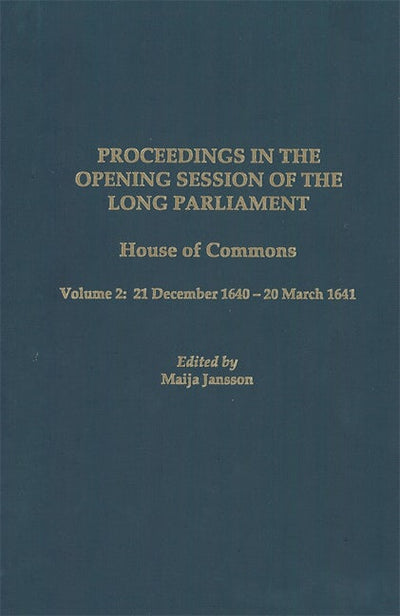
Proceedings in the Opening Session of the Long Parliament
Regular price
$150.00
Save $-150.00
The volumes of Proceedings in the Opening Session of the Long Parliament present the records of proceedings in the House of Commons [5 volumes] and the House of Lords [3 volumes] beginning in November 1640. Volume 1 of theproceedings in the House of Commons is the first of two volumes leading up to the beginning of the impeachment trial of the Earl of Strafford for High Treason.
For those interested in the causes of the breakdown that led to civil war and revolution in mid-seventeenth-century England, the volumes of Proceedings in the Opening Session of the Long Parliament are a good place to begin. The debates in this session focus on the accumulated problems -- political, social, economic, and religious -- that were the legacy of Charles I's years of personal rule. During the almost seven months between the dissolution of the Short Parliament in April 1640 and the first session of what came to be called the Long Parliament in November 1640, the King, his advisors, and army commanders were absorbed with the financial and military problems of the Scottisharmy camped in the north of England. In the Irish parliament in Dublin, reaction against the King's close friend the Earl of Strafford, the Deputy Lieutenant of Ireland, was beginning to crystalize. Throughout the kingdom, religious unrest continued. All of these elements came to play in the Long Parliament. Volume 1 of the House of Commons debate covers the opening session from 3 November through 19 December 1640. This volume plus Volume 2 [December 21,1640 through March 20, 1641] provide the debates leading up to the beginning of the impeachment trial of the Earl of Strafford for High Treason.
Contested Power in Angola, 1840s to the Present
Regular price
$130.00
Save $-130.00
A detailed historiographical examination of the role the Ovimbundu people have played in Angolan politics from Portuguese colonization to the present.
Contested Power in Angola, 1840s to the Present argues that the Ovimbundu of central Angola have been key players in the history of modern Angola. The work focuses on the tensions between the centralising forces of the state and the pull of local, regional and ethnic tendencies which have characterised the modern history of Angola. The study begins with a chapter which highlights the relationship between relatively weak pre-colonial Ovimbundu state systems and the autonomous local economic, political and social institutions that functioned in the villages. The chapter also looks at how both state and local systems adapted to the commercial, political and cultural imperatives of industrializing Europe and America. The subsequent chapters explore the emergence and transformation of the Portuguese colonial state in central Angola, including issues of pacification and colonialization, the Estado Novo and the politics of subjugation. They illustrate the contradictions between the rhetoric of racial democracy of the apologists of the colonial state and the reality of rising ethnic and regional tension. The study concludes with the evolution of Ovimbundu nationalism during the colonial and post-colonial periods. It argues that the divisions of the Cold War and continuing ethnic and regional divisions frustrated the Ovimbundu leadership in its efforts to make the state more inclusive. This quest to reshape the state remains a salient feature in the relationship between the Ovimbundu and the state.
Linda Heywood is Associate Professor of History, Howard University.
Edgar Julius Jung, Right-Wing Enemy of the Nazis
Regular price
$130.00
Save $-130.00
Fills a serious gap in German historical literature by providing the first political biography of Jung, a leading figure of the anti-Nazi Right.
By the time of his death, Edgar Julius Jung (1894-1934) was well known in Germany and Europe as one of the foremost ideologues of the political movement that called itself the Conservative Revolution and as a right-wing opponent of the Nazis. He was speechwriter for and confidant of Franz von Papen (first Hitler's predecessor as chancellor, then Hitler's vice-chancellor), which put him at the center of political events right up until the Nazi seizure of power. Considered by Baldur von Schirach and Goebbels to be one of the worst enemies of the Nazis, Jung was assassinated by the Nazi regime in June 1934. The eleven years of Nazi rule that followed contributed to Jung's neglect by historians, as did distaste, since the war's end and the founding of the Federal Republic on democratic principles, for his strongly antidemocratic stance. Although there have been several studies on Jung's political thought,there has been until now no biography in German or English. Roshan Magub's book therefore fills a serious gap in German historical literature. It shows that Jung's opposition to National Socialism dates from the earliest days andthat he had a very close relationship with the Ruhr industry, which supported him financially and enabled him to reach a nationwide audience. Magub uses, for the first time, all the available material from the archives in Munich,Koblenz, Cologne, and Berlin, and the whole of Jung's Nachlass. Her book sheds new light on Jung and demonstrates his importance in Germany's political history.
Roshan Magub holds a PhD from Birkbeck College, University of London.
Violence in Nigeria
Regular price
$45.95
Save $-45.95
A comprehensive study of religious violence and aggression in Nigeria, notably its causes, consequences, and the options for conflict resolution.
Violence in Nigeria is the most comprehensive study of religious violence and aggression in Nigeria, notably its causes, consequences, and the options for conflict resolution. After an analysis of the links between religionand politics, the book elaborates on all the major cases of violence in the 1980s and 90s, including the Maitatsine, Kano, Bauchi, Kaduna, and Katsina riots. Zones of religious tensions are identified, as well as general characteristics of violence in Nigeria; and issues in inter and intra-religious relations, relious organizations, and the states, and the main actors in the conflicts are explored in great detail. A product of extensive primary research,Violence in Nigeria makes a contribution to contemporary social and political history that no previous study has attempted, and it is written to appeal to specialists and non-specialists alike. Toyin Falola is the Jacob and Frances Sanger Mossiker Chair in the Humanities and University Distinguished Teaching Professor at the University of Texas at Austin. He is the author or editor of over a dozen books dealing with the history of Nigeria, its people, their religion and politics.
Elliott Carter: Collected Essays and Lectures, 1937-1995
Regular price
$45.95
Save $-45.95
Elliott Carter [b.1908] is now generally acknowledged as America's most eminent living composer. This definitive volume of his essays and lectures -- many previously unpublished or uncollected -- shows his thinking and writing onmusic and associated issues developing in parallel with his career as a composer; his reputation became established in the 1950s, and the material in this book offers an important and knowledgeable commentary on the course of American and European music in the succeeding decades. Carter's articles on his own music have become classic texts for students of his oeuvre; he also writes on the state of new music in Europe and the United States and the relations between music and the other arts. Other pieces range from a consideration of aspects of music to the work of individual composers. As a whole, the collection is the expression of Carter's musical philosophy, and a valuablerecord for historians of modern music.
Future-Founding Poetry
Regular price
$170.00
Save $-170.00
An investigation of how American poetry since Whitman makes its beginnings, with what means and to which political and aesthetic ends, and how it addresses fundamental questions about what the future is and how it may be affectednow.
Although issues of futurity have become more and more central to literary and cultural studies in recent years, especially in environmental criticism, no scholarly work has yet addressed the topic of beginnings in American poetryin sufficient scope or detail or with adequate theoretical background. This book is a study of how beginnings are made in American poetry, and to what ends. It borrows Walt Whitman's term "future-founding" to establish a theory ofpoetic beginnings that asks how poetry relates to notions of the future and how it imagines, constructs, and influences this future in the present. Furthermore, it seeks to change the way literary scholars think about futurity with regard to American poetry: they most often conceive of it in terms of newness alone, yet a deeper theorization of beginnings must open up new ways of understanding the complexities of this relation. With chapters on Whitman, William Carlos Williams, Langston Hughes, Muriel Rukeyser, Allen Ginsberg, and future-founding poetry after 9/11, this book explains how American poetry makes its beginnings, with what means and to which political and aesthetic ends, and how it addresses fundamental questions about what the future is and how it may be affected now.
Sascha Pöhlmann is Associate Professor of American Literary History at Ludwig-Maximilians-University, Munich.
Serving a Great and Noble Art
Regular price
$30.00
Save $-30.00
Serving a Great and Noble Art is the second volume of the history of the Eastman School of Music, beginning in 1932 after George Eastman's death, and ending in 1972 with the resignation of the school's third director, Walter Hendl. This book is very much about Howard Hanson, director of the school from 1924 until his retirement in 1964. After forty years under Hanson's guidance, the Eastman School of Music was a near-perfect reflection of the valuesand ideals of its long-term director. Under Hanson's leadership, the school became widely known as an institution that welcomed the performer and the scholar, the composer and the educator. It was a school committed to the development of musical leadership, and above all an institution that was thoroughly American in its outlook, method, and goals. In 1945 Howard Hanson spoke of the school as "serving a great and noble art." These words provide a vivid picture of Hanson and also accurately describe his vision for the institution which, to this day, bears the unmistakable influence of his forty-year tenure as director. Hanson's successor as director, Walter Hendl, had a far less happy tenure at Eastman. A musician of great talent, his time at the Eastman School of Music ended in considerable controversy amid personal struggle. His eight years as director nonetheless witnessed many new initiatives, positivechanges, and important faculty appointments. The record of his leadership, therefore, deserving of attention and gratitude, is recounted in this volume.
Vincent A. Lenti is Eastman School of Music historian, a graduateof the school (BM '60, MA '63), member of the faculty since 1963, and author of For the Enrichment of Community Life: George Eastman and the Founding of the Eastman School of Music
Persistent Legacy
Regular price
$130.00
Save $-130.00
New essays by prominent scholars in German and Holocaust Studies exploring the boundaries and confluences between the fields and examining new transnational approaches to the Holocaust.
In studies of Holocaust representation and memory, scholars of literature and culture traditionally have focused on particular national contexts. At the same time, recent work has brought the Holocaust into the arena of the transnational, leading to a crossroads between localized and global understandings of Holocaust memory. Further complicating the issue are generational shifts that occur with the passage of time, and which render memory and representations of the Holocaust ever more mediated, commodified, and departicularized. Nowhere is the inquiry into Holocaust memory more fraught or potentially more productive than in German Studies, where scholars have struggled to addressGerman guilt and responsibility while doing justice to the global impact of the Holocaust, and are increasingly facing the challenge of engaging with the broader, interdisciplinary, transnational field.
Persistent Legacy connects the present, critical scholarly moment with this long disciplinary tradition, probing the relationship between German Studies and Holocaust Studies today. Fifteen prominent scholars explore how German Studies engages with Holocaust memory and representation, pursuing critical questions concerning the borders between the two fields and how they are impacted by emerging scholarly methods, new areas of inquiry, and the changing place of Holocaust memory in contemporary Germany.
Contributors: David Bathrick, Stephan Braese, William Collins Donahue, Tobias Ebbrecht-Hartmann, Katja Garloff, Andreas Huyssen, Irene Kacandes, Jennifer M. Kapczynski, Sven Kramer,Erin McGlothlin, Leslie Morris, Brad Prager, Karen Remmler, Michael D. Richardson, Liliane Weissberg.
Erin McGlothlin and Jennifer M. Kapczynski are both Associate Professors in the Department of Germanic Languages andLiteratures at Washington University in St. Louis.
Tzvetan Todorov
Regular price
$130.00
Save $-130.00
The first-ever comprehensive examination of Tzvetan Todorov's cultural theory and his place in European thought.
Originally known for his groundbreaking work in literary studies, the Bulgarian-born French scholar Tzvetan Todorov (1939-2017) was one of the world's foremost cultural theorists. His interventions cover an astounding range of topics, from narratology to ethics, from painting to politics, and from the Enlightenment to current affairs. This collection of essays is the first-ever comprehensive examination of Todorov as a cultural critic. It offers in-depth discussions of the crucial elements of his thought since his historical and cultural turn in the early 1980s: his "marginal centricity" within the French intellectual field, and his relations with other French thinkers; his philosophical precursors and influences, notably Jean-Jacques Rousseau and Mikhail Bakhtin; his conception of the Enlightenment; his views on historiography, and on the possibility and limitations of passing historical judgments; his defense of a European identity; and his political philosophy, including his critique of totalitarianism, neoconservativism, and neoliberalism. Written by international experts in the fields of Enlightenment studies, literary and cultural studies, critical theory, and intellectual history, this volume offers both an introduction to one of the most important postwar European thinkers and discussions of some of the most hotly debated topics in cultural studies today.
Uncle Sam's Orchestra
Regular price
$120.00
Save $-120.00
A humorous look at the accomplishments of America's Seventh Army Symphony during its 10-year, European tour-of-duty from 1952-1962.
The United States once maintained a symphony orchestra, the Seventh Army Symphony, based in Stuttgart, Germany. Formed in 1952 as a public relations measure, it was intended to demonstrate to the Europeans, and the Germans in particular, that American soldiers were young men of culture capable of appreciating and performing the music of Beethoven, Brahms, and other great composers with feeling and understanding. In this the orchestra was extremely successful, touring repeatedly throughout (West) Germany, Denmark, France, Greece, Italy, and the United Kingdom.
In spite of the great acclaim and enthusiasm with which it was received throughout Europe, the orchestra encountered difficulty and some outright hostility from the U.S. Army itself, which did not quite know what to do with a symphony orchestra in its midst. Therefore, in addition to paying tribute to the important work the orchestra did inthe field of cultural relations, this book chronicles the many humorous incidents that arose out of the perennial friction between the rather unmilitary orchestra and the "regular Army" personnel with whom it came in direct contact.
West Indians in West Africa, 1808-1880
Regular price
$130.00
Save $-130.00
A history of the West Indians who migrated to Sierra Leone from the Caribbean after the abolition of slavery in 1807.
An examination of the trans-oceanic migration of West Indians from the Caribbean to Sierra Leone in the decades following the abolition of slavery in the British colonies in 1807. The West Indians who immigrated to Sierra Leone during this period came to occupy many positions in the colonial government of the colony, and, in time, they were an important [although not always liked] minority. Nemata Blyden is a Professor in the School of Arts and Humanities, University of Texas at Dallas.
The Critical Reception of Flannery O'Connor, 1952-2017
Regular price
$130.00
Save $-130.00
The first chronological overview of O'Connor criticism from the publication of her first novel, Wise Blood, in 1952 to the present.
Flannery O'Connor is one of the most widely read, discussed, and taught of all American authors. She is immensely popular with students, general readers, and literary critics. Her work, often characterized as "Southern Gothic," betrays in its focus on morality her devout Roman Catholic faith even as it displays a wicked sense of humor. She has been the subject of numerous articles and books, and indeed an entire journal devoted to her writings has existedfor decades. There is not, however, any chronological overview of the history of O'Connor criticism. The present volume fills that very conspicuous gap. It is the sort of book that practically every college and university library,as well as many public libraries, will need to own, and it will appeal not only to scholars and students but to non-academic readers of O'Connor, whose numbers are legion. A particular value of the book is that it synthesizes criticism and commentary that is now only available in individual essays that are widely scattered.
Robert C. Evans is Professor of English at Auburn University Montgomery. Among his many books is Critical Insights: ShortFiction of Flannery O'Connor (2016).
The Communicative Event in the Works of Günter Grass
Regular price
$130.00
Save $-130.00
A major contribution to Grass scholarship that looks at his career as a whole and identifies four phases or stages of his writing in terms of communicative strategy and style.
Nobel-laureate novelist and public intellectual Günter Grass was a towering figure among German writers and social critics from the 1950s until his death in 2015. After rising to prominence with the novel The Tin Drum (1959), he assumed the role of the conscience of the German nation. He sustained that position throughout his life despite multiple controversies, particularly the revelation, in his 2006 autobiography Peeling the Onion, of hisbrief service in the Waffen SS, and the 2012 publication of his poem "What Must Be Said," which sharply criticized Israel. This monograph argues that the ethos of "speaking out" is fundamental to Grass's life and work. His approach to the dynamics and manifestations of speech acts has been marginalized in Grass criticism, but is crucial to understanding his fiction. Looking back at Grass's career, this book identifies four phases in terms of communicative strategy and style. Whereas the Danzig trilogy abounds in judgmental and oppressive speech acts, the mid-career novels express the writer's hopes of using dialogue in support of democracy. In turn, the fall of the Berlin Wallinspired novels that feature critical conversations on memory culture amid German unification and the upheaval of the 1990s. Finally, the late autobiographies reveal a search for the private and political self in meditative, internalized monologues about a life lived in language.
Nicole A. Thesz is Associate Professor of German at Miami University, Ohio.
Herder's Essay on Being
Regular price
$120.00
Save $-120.00
Presents the first English translation of Herder's foundational essay along with critical responses to it by today's leading Herder scholars.
In recent years, Johann Gottfried Herder has been the focus of much interest in the English-speaking world. While he was long disregarded, current scholarship in both German and English is revisiting his importance as an early theorist of the limits of Enlightenment. Increasingly, scholarship is remembering that in the closing decades of the eighteenth century Herder was one of the most important alternative voices to Kant. Herder's Versuch über das Sein (Essay on Being, ca. 1764) was likely composed in reaction to Kant's lectures on metaphysics. In it, Herder unfolds his philosophical project, setting the terms that remained the foundation of his work throughout his life and influenced Hegel, Nietzsche, Heidegger, and others. Given the central importance of the essay and Herder's increasing recognition in the English-speaking world, it is striking that it has not been translated into English until now. This volume presents a facsimile of the manuscript along with a German transcription, an annotated translation, and critical essays by the most important Herder scholars writing in German and English today.
Contributors: Manfred Baum, Arnd Bohm, Nigel DeSouza, Ulrich Gaier, Alexander J. B. Hampton, Marion Heinz, John K. Noyes, Wolfgang Pross, Sonia Sikka.
John K. Noyes is Professor of Germanic Languages and Literatures at theUniversity of Toronto and Extraordinary Professor at Stellenbosch University, South Africa. He is the author of Herder: Aesthetics against Imperialism.
The Art of Musical Phrasing in the Eighteenth Century
Regular price
$170.00
Save $-170.00
Practical suggestions, and documentary evidence, for performers wishing to understand the gestures and nuances embedded in eighteenth-century musical notation.
There are, of course, no commas, periods, or question marks in music of the Baroque and Classic eras. Nonetheless, the concept of "punctuating" music into longer and shorter units of expression was richly explored by many of the era's leading composers, theorists, and performers. The Art of Musical Phrasing in the Eighteenth Century gathers and discusses, for the first time, an extensive collection of quotations and musical illustrations relevant tophrase articulation and written and unwritten rests. Among the notable authors cited and discussed are Muffat, Telemann, C. P. E. Bach, Mattheson, Marpurg, Tartini, and Mozart's father Leopold (author of the most important eighteenth-century treatise on string playing). On a larger scale, The Art of Musical Phrasing demonstrates the role of punctuation within the history of rhetoric during the Age of Enlightenment. From this, the performer of todaycan gain a greater appreciation for both the strengths and shortcomings of the analogy that writers of the day drew between punctuation in written language and in music. Modern performers, argues Vial, have the challenge andresponsibility of understanding and conveying the nuances, inflections, and rhythmic gestures deeply embedded in eighteenth-century musical notation. The Art of Musical Phrasing, the fruit of Vial's rich experience as a cellist performing on both period and modern instruments, lays out long-needed practical suggestions for achieving this goal.
Stephanie D. Vial performs and records widely as a cellist and has taught at the University ofNorth Carolina at Chapel Hill and Duke University.
Willa Cather
Regular price
$120.00
Save $-120.00
A contextualizing overview of the polarized critical reception of Willa Cather, one of the pre-eminent US authors of the twentieth-century.
The ever-growing body of criticism on Willa Cather and her fiction is indicative of her enduring position as a pre-eminent figure of twentieth-century American literature. It has been spurred by the challenge of situating Cather in relation to established critical approaches. Since the 1920s, Cather's work has been praised by critics for its realism, innovative form, and diversity; simultaneously, it has been derided as nostalgic, anti-modern, and narrow. Drawing on monographs, edited collections, journal articles, and society publications, Willa Cather: The Critical Conversation provides Cather scholars and students at the graduate and undergraduate levels with an accessible overview of Cather's critical reception through the first two decades of the twenty-first century. In addition to providing a valuable resource for research and teaching on Cather, the book also speaks to broader issues such as canon formation and historical trends in literary criticism that are relevant to American literature and culture as a whole. This book provides a solid understanding of the major issues in Cather criticism over time, with an eye toward how the conversation may continue for decades to come.
The Blue Stain
Regular price
$120.00
Save $-120.00
A European novel of racial mixing and "passing" in early twentieth-century America that serves as a unique account of transnational and transcultural racial attitudes that continue to reverberate today.
Hugo Bettauer's The Blue Stain, a novel of racial mixing and "passing," starts and ends in Georgia but also takes the reader to Vienna and New York. First published in 1922, the novel tells the story of Carletto, son of a white European academic and an African American daughter of former slaves, who, having passed as white in Europe and fled to America after losing his fortune, resists being seen as "black" before ultimately accepting that identityand joining the early movement for civil rights. Never before translated into English, this is the first novel in which a German-speaking European author addresses early twentieth-century racial politics in the United States - notonly in the South but also in the North. There is an irony, however: while Bettauer's narrative aims to sanction a white/European egalitarianism with respect to race, it nevertheless exhibits its own brand of racism by assertingthat African Americans need extensive enculturation before they are to be valued as human beings. The novel therefore serves as a unique historical account of transnational and transcultural racial attitudes of the period that continue to reverberate in our present globalized world.
Hugo Bettauer (1872-1925) was a prolific Austrian writer and journalist, a very early victim of the Nazis. Peter Höyng is Associate Professor of German Studies at Emory University. Chauncey J. Mellor is Emeritus Professor of German at the University of Tennessee, Knoxville. Kenneth R. Janken is Professor of African American and Diaspora Studies at the University of North Carolina, Chapel Hill.
Pluralist Desires
Regular price
$120.00
Save $-120.00
Excavates the contemporary revival of 19th-century cultural pluralism, revealing how American novelists since the 1990s have appropriated the historical novel in the pursuit of selfhood rather than truth, fundamentally repositioning the genre in American culture.
In Pluralist Desires, Philipp Löffler explores the contemporary historical novel in conjunction with three cultural shifts that have crucially affected political and intellectual life in the United States during the 1990s and 2000s: the end of the Cold War, the decline of postmodernism, and the re-emergence of cultural pluralism. Contemporary historical fiction -- from Don DeLillo's Underworld and Philip Roth's American trilogy to Richard Powers's Plowing the Dark and Toni Morrison's A Mercy -- relates and authorizes these developments by imagining the writing of history as a powerful form of world-making. Rather than asking whether history can ever be true, contemporary historical fiction investigates the uses of history for our individual lives. How can we use history to make our individual lives meaningful and worthy in the face of an unknown future? Pluralist Desires approaches these issues by excavating the origins of 19th-century pluralism and its revival in the late 20th and early 21st centuries, revealing how major American novelists have appropriated the genre of the historical novelin the pursuit of selfhood rather than truth. Löffler complements standard accounts of the end of history with a selection of careful close readings that fundamentally reposition the form and the function of the historical novel in contemporary American culture.
Philipp Löffler is Assistant Professor of American Literature at the University of Heidelberg, Germany.
Red Vienna, White Socialism, and the Blues
Regular price
$120.00
Save $-120.00
Reveals Ann Tizia Leitich, American correspondent for Austrian newspapers in the 1920s and 1930s, as an important cultural mediator between the two countries.
After the First World War, Vienna was overrun by jazz, Hollywood movies, and Fordism; its citizens were both fascinated and appalled by the waves of American ideas and products. To make sense of the American phenomenon, readers turned to Ann Tizia Leitich, the New York-based correspondent for Vienna's prominent daily Neue Freie Presse and other newspapers. Rob McFarland tells the story of Leitich's escape, occasioned by a personal crisis, from Austria to America in 1921, and of her rise as a journalist, cultural historian, and novelist. By the early 1930s, she had met President Coolidge, Senator Sol Bloom, the writer Upton Sinclair, and the critic H. L. Mencken. Her devotedreaders - including the novelist Stefan Zweig and the Austrian chancellor Ignatz Seipl - sought in her witty, insightful descriptions of the United States some American vitality to invigorate their own moribund culture and economy. Chronicling Leitich's career as a journalist, cultural historian, and novelist and providing close readings of her writings about America, this book reveals her as an important cultural mediator between Austria and America.
Rob McFarland is Associate Professor of German at Brigham Young University.
Analyzing Wagner's Operas
Regular price
$130.00
Save $-130.00
An examination of work by the German music theorist, Alfred Lorenz, to explain Wagner's operas and how they fit with German nationalist ideology.
The work of the Wagnerian theorist and analyst Alfred Lorenz (1869-1939) has had a profound influence upon both Wagnerian scholarship and music analysis in the twentieth century, and yet it has never been properly evaluated. Analyzing Wagner's Operas outlines the origins and development of the expressive aesthetic in writings by Wagner and others, as well as in early-twentieth-century theories of musical form, and it considers Lorenz's work and contributions in this light. The book also hopes to show, to the extent possible, where Lorenz's work acted as a sort of "musical metaphor" for German nationalist ideology during the Nazi era.
Gender and Sexuality in East German Film
Regular price
$130.00
Save $-130.00
The first scholarly collection in English or German to fully address the treatment of gender and sexuality in the productions of DEFA across genres and in social, political, and cultural context.
The cinema of the German Democratic Republic, that is, the cinema of its state-run studio DEFA, portrayed gender and sexuality in complex and contradictory ways. In doing so, it reflected the contradictions in GDR society in respect to such questions. This is the first scholarly collection in English or German to fully address the treatment of gender and sexuality in the productions of DEFA across genres (from shorts and feature films to educational videos, television productions, and documentaries) and in light of social, political, and cultural contexts. It is also unique in its investigation of previously unresearched subjects, including films and directors that have received little scholarly attention and nonconformist representations of gender and sexual embodiments, identifications, and practices. The volume presents the work of leading scholars on the GDR and allows students and scholars to examine East German film with respect to the acceptance, rejection, or nuanced negotiation of ideas of proper male and female behavior espoused by the country's brand of socialism.
Contributors: Muriel Cormican, Jennifer L. Creech, Heidi Denzel de Tirado, Kyle Frackman, Sebastian Heiduschke, Sonja E. Klocke, John Lessard, Larson Powell, Victoria I. Rizo Lenshyn, Reinhild Steingröver, Faye Stewart, Evan Torner, Henning Wrage.
Kyle Frackman is Assistant Professor of Germanic Studies at the University of British Columbia. Faye Stewart is Associate Professor of German at Georgia State University.
Goethe Yearbook 24
Regular price
$90.00
Save $-90.00
Cutting-edge scholarly articles on diverse aspects of Goethe and his age, featuring in this volume a special section on the poetics of space in the Goethezeit.
The Goethe Yearbook is a publication of the Goethe Society of North America, encouraging North American Goethe scholarship by publishing original English-language contributions to the understanding of Goethe and other authors of the Goethezeit while also welcoming contributions from scholars around the world. Volume 24 features a special section titled "The Poetics of Space in the Goethezeit," co-edited by John Lyon and Elliott Schreiber, with contributions on blind spots in Goethe's Elective Affinities; on the topography and topoi of Goethe's autobiographical childhood; on disorientation and the subterranean in Novalis; on selfhood, sovereignty, and public space in Die italienische Reise and Dichtung und Wahrheit; on Goethe's theater of anamnesis in Wilhelm Meisters Lehrjahre; and on spatial mobilization in Kleist's Berliner Abendblätter. There are also articles on the horror of coming home in Caroline de la Motte Fouqué's "Der Abtrünnige" and on Friedrich Heinrich Jacobi's Eduard Allwills Papiere.
Contributors: Colin Benert, Stephanie Galasso, Tove Holmes, Edgar Landgraf, Sara Luly, John B. Lyon, Anthony Mahler, Monika Nenon, Joseph O'Neil, Elliott Schreiber, Inge Stephan, Gabriel Trop, Christian P. Weber.
Adrian Daub is Associate Professor of German at Stanford. Elisabeth Krimmer is Professor of German at the University of California Davis. Book review editor Birgit Tautz is Associate Professor of German at Bowdoin College.
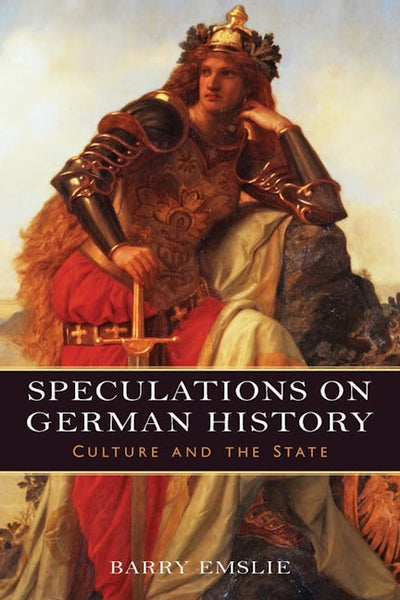
Speculations on German History
Regular price
$120.00
Save $-120.00
Provocative and spiced with humor, this book uses a cultural studies approach to examine the fraught relationship in German history between material reality and ideology.
German history never loses its fascination. It is exceptionally varied, contradictory, and raises difficult problems for the historian. In a material sense, there have been a great many Germanies, so that it was long unclear what"Germany" would amount to geopolitically, while German intellectuals fought constantly over the idea(s) of Germany. Provocative and spiced with humor, Speculations tackles Germany's successes and catastrophes in view of this fraught relationship between material reality and ideology. Concentrating on the period from Friedrich the Great until today, the book is less a conventional history than an extended essay. It moves freely within the chosenperiod, and because of its cultural studies disposition, devotes a great deal of attention to German writers, artists, and intellectuals. It looks at the ways in which German historians have attempted to come to terms with theirown varying notions of nation, culture, and race. An underlying philosophical assumption is that history is not one dominant narrative but a struggle between competing, simultaneous narratives: like all those Germanies of thepast and of the mind, history is plural. Barry Emslie pursues this agenda into the present, arguing that there has been an unprecedented qualitative change in the Federal Republic in the quarter-century since unification.
Barry Emslie lives and teaches in Berlin. He is the author of Richard Wagner and the Centrality of Love (Boydell Press, 2010) and Narrative and Truth: An Ethical and Dynamic Paradigm for the Humanities (PalgraveMacmillan, 2012).
The Critical Writings of Ingeborg Bachmann
Regular price
$170.00
Save $-170.00
The first English translation of the essays, lectures, and other critical writings of the celebrated Austrian poet, novelist, and public intellectual, one of the most influential postwar writers in German.
The Austrian Ingeborg Bachmann (1926-1973) is one of the most important postwar writers in German. Her work is enmeshed with the intellectual and cultural developments of the period: she was influenced by European modernism in the early 1950s, experienced the sweeping changes of the 60s, and worked until her death in 1973 on her celebrated and sprawling "Todesarten" (Ways of Death) project, on the decades following National Socialism. Her poetry and prose confront what she called "the sickness of our time": the subtle connection between patriarchal society, catastrophic history in the form of National Socialism, and the subjugation of the Other. Even during her lifetime, Bachmann achieved a prominent position in postwar German-language literature. Interest in her literary output increased sharply in the early 1980s with the publication of the first edition of her works, and has been growing steadily ever since. Bachmann's impact on German literature is comparable to that of Virginia Woolf on English literature. Just as an appreciation of Woolf's poetic oeuvre, and that of other women writers, is impossible without reference to "A Room of One's Own," the critical writings of Bachmann enhance our awareness of not only her own works, but also those of many other writers, philosophers, and artists. As the only translation of Bachmann's essays, lectures, speeches, and theoretical texts into English, The Critical Writings will be a valuable tool for students of Comparative Literature and German literature and cultural studies.
Science and Power in Colonial Mauritius
Regular price
$120.00
Save $-120.00
An analysis of the historical and scientific effects of technology transfer from an imperial to colonial setting.
Science and Power in Colonial Mauritius examines, within the context of the history of sugarcane production in Mauritius, the cross-cultural debates about the production and dissemination of science and technology from "developed" to "less-developed" countries and from elites to peasants within these countries. The book also shows in great detail that the history of science, technology, and colonialism can shed light on contemporary problems in natural resource management and global policy making.
The Blue Stain
Regular price
$29.99
Save $-29.99
A European novel of racial mixing and "passing" in early twentieth-century America that serves as a unique account of transnational and transcultural racial attitudes that continue to reverberate today.
Hugo Bettauer's The Blue Stain, a novel of racial mixing and "passing," starts and ends in Georgia but also takes the reader to Vienna and New York. First published in 1922, the novel tells the story of Carletto, son of a white European academic and an African-American daughter of former slaves, who, having passed as white in Europe and fled to America after losing his fortune, resists being seen as "black" before ultimately accepting that identityand joining the early movement for civil rights. Never before translated into English, this is the first novel in which a German-speaking European author addresses early twentieth-century racial politics in the United States - notonly in the South but also in the North. There is an irony, however: while Bettauer's narrative aims to sanction a white/European egalitarianism with respect to race, it nevertheless exhibits its own brand of racism by assertingthat African Americans need extensive enculturation before they are to be valued as human beings. The novel therefore serves as a unique historical account of transnational and transcultural racial attitudes of the period that continue to reverberate in our present globalized world.
Hugo Bettauer (1872-1925) was a prolific Austrian writer and journalist, a very early victim of the Nazis. Peter Höyng is Associate Professor of German at Emory University. Chauncey J. Mellor is Emeritus Professor of German at the University of Tennessee. Kenneth R. Janken is Professor in the Department of African, African American, and Diaspora Studies at the University of North Carolina.
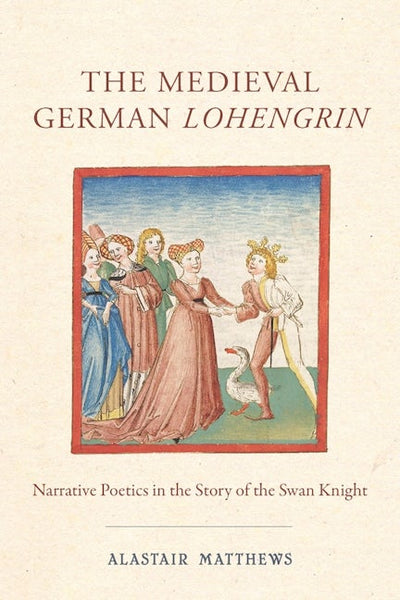
The Medieval German Lohengrin
Regular price
$120.00
Save $-120.00
The first monograph in English on the German Lohengrin, offering a new response to the challenges posed by the text.
The tale of the mysterious knight carried across the water by a swan to the woman he saves and marries is one of the great narrative traditions of the Middle Ages. The version in the German Lohengrin (ca.1300) is perhaps the most striking. It captures the imagination with the appearance of the epic poet Wolfram von Eschenbach as narrator, the changing forms of the swan, and Lohengrin's appearance as a warrior alongside Saints Peter and Paul. In thepast, however, Lohengrin has been dismissed as an awkward amalgamation of earlier sources - partly due to more recent retellings of the material, such as Wagner's opera. This first monograph on Lohengrin in English presents a new response to the challenges the text poses. It is a study of how we read narrative across temporal distance, and at its heart lies the question: if a story is not held together by the chronological and causal links characteristic of modern narratives, how does it cohere? Alastair Matthews analyzes both the invocations of Wolfram that frame the text and the story of the Swan Knight that they enclose, arguing that Lohengrin is defined by a web of connections in which questions of identity and recognition are crucial, and thus that the themes at the core of the tale govern how it is told.
Alastair Matthews, DPhil Oxford, is a Marie Curie ResearchFellow at the Centre for Medieval Literature, University of Southern Denmark.
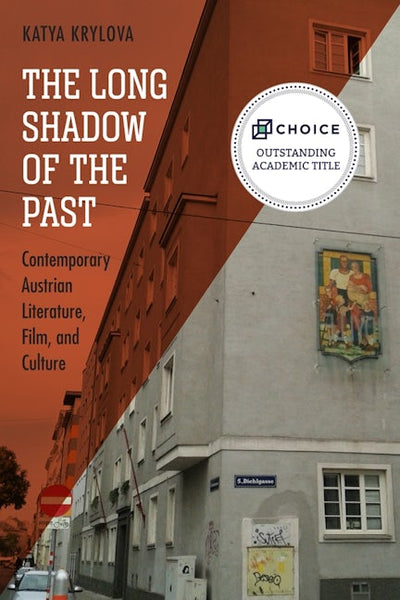
The Long Shadow of the Past
Regular price
$120.00
Save $-120.00
Examines key contemporary Austrian literary texts, films, and memorials that treat Nazism and the Holocaust for what they reveal about the country's contemporary politics of memory.
2018 CHOICE Outstanding Academic Title
The process of coming to terms with its National Socialist past has been a long and difficult one in Austria. It is only over the past thirty years that the country's view of its role during the Third Reich has shifted decisively from that of victimhood to complicity, prompted by the Waldheim affair of 1986-1988. Austria's writers, filmmakers, and artists have been at the center of this process, holding upa mirror to the country's present and drawing attention to a still disturbing past. Katya Krylova's book undertakes close readings of key contemporary Austrian literary texts, films, and memorials that treat the legacy of Nazism and the Holocaust. The analysis focuses on texts by Robert Schindel, Elfriede Jelinek, and Anna Mitgutsch, documentary films by Ruth Beckermann and by Margareta Heinrich and Eduard Erne, as well as recent memorial projects inVienna, examining what these reveal about the evolving memory culture in contemporary Austria. Aimed at a broad readership, the book will be a key reference point for university teachers, undergraduates, and postgraduates engagedin scholarship on contemporary Austrian literature, film, and visual culture, and for general readers interested in confrontations with the National Socialist past in the Austrian context.
KATYA KRYLOVA is Lecturer in German, Film and Visual Culture at the University of Aberdeen, UK. The Long Shadow of the Past is her second book.
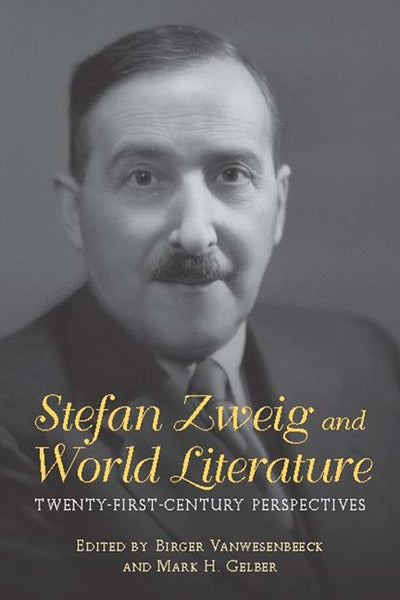
Stefan Zweig and World Literature
Regular price
$130.00
Save $-130.00
A new critical assessment of the works of the Austrian-Jewish author, in whom there has been a recent resurgence of interest, from the perspective of world literature.
The twenty-first century has seen a renewed surge of cultural and critical interest in the works of the Austrian-Jewish author Stefan Zweig (1881-1942), who was among the most-read and -acclaimed authors worldwide in the 1920s and1930s but after 1945 fell into critical disfavor and relative obscurity. The resurgence in interest in Zweig and his works is attested to by, among other things, new English translations and editions of his works; a Brazilian motion picture and a best-selling French novel about his final days; and a renewed debate surrounding the literary quality of his work in the London Review of Books. This global return to Zweig calls for a critical reassessment of his legacy and works, which the current collection of essays provides by approaching them from a global perspective as opposed to the narrow European focus through which they have been traditionally approached. Together, theintroduction and twelve essays engage the totality of Zweig's published and unpublished works from his drama and his fiction to his letters and his biographies, and from his literary and art criticism to his autobiography.
Contributors: Richard V. Benson, Jeffrey B. Berlin, Darién J. Davis, Marlen Eckl, Mark H. Gelber, Robert Kelz, Klemens Renoldner, Birger Vanwesenbeeck, John Warren, Klaus Weissenberger, Robert Weldon Whalen, Geoffrey Winthrop-Young.
Birger Vanwesenbeeck is Associate Professor of English at the State University of New York at Fredonia. Mark H. Gelber is Senior Professor of Comparative Literature and German-Jewish Studies at Ben-Gurion University of the Negev, Israel.
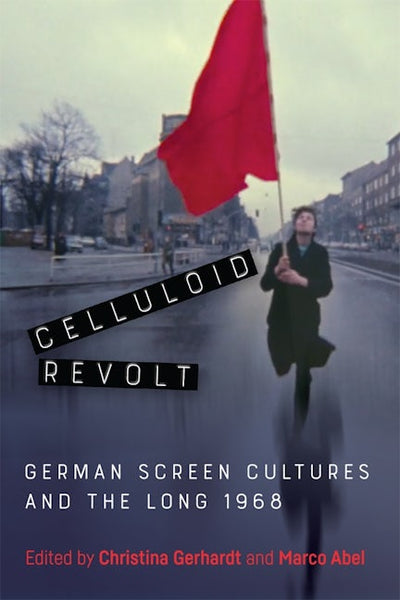
Celluloid Revolt
Regular price
$130.00
Save $-130.00
Provides new insights into German-language cinema around 1968 and its relationship to the period's epoch-making cultural and political happenings.
The epoch-making revolutionary period universally known in Germany as '68 can be argued to have predated that year and to have extended well into the 1970s. It continues to affect German and Austrian society and culture to this day. Yet while scholars have written extensively about 1968 and the cinema of other countries, relatively little sustained scholarly attention has thus far been paid to 1968 and West German, East German, and Austrian cinemas. Now, five decades later, Celluloid Revolt sets out to redress that situation, generating new insights into what constituted German-language cinema around 1968 and beyond. Contributors engage a range of cinemas, spanning experimental and avant-garde cinema, installations and exhibits; short films, animated films, and crime films; collectively produced cinemas, feminist films, and Arbeiterfilme (workers' films); as well as their relationship to cinemas of other countries, such as French cinéma vérité and US direct cinema.
Contributors: Marco Abel, Tilman Baumgärtel, Madeleine Bernstorff, Timothy Scott Brown, Michael Dobstadt, Sean Eedy, Thomas Elsaesser, IanFleishman, Christina Gerhardt, Lisa Haegele, Randall Halle, Priscilla Layne, Ervin Malakaj, Kalani Michell, Evelyn Preuss, Patricia Anne Simpson, Fabian Tietke, Andrew Stefan Weiner.
Christina Gerhardt is Associate Professor of German and Film Studies at the University of Hawai'i at Manoa. Marco Abel is Professor of English and Film Studies at the University of Nebraska-Lincoln.
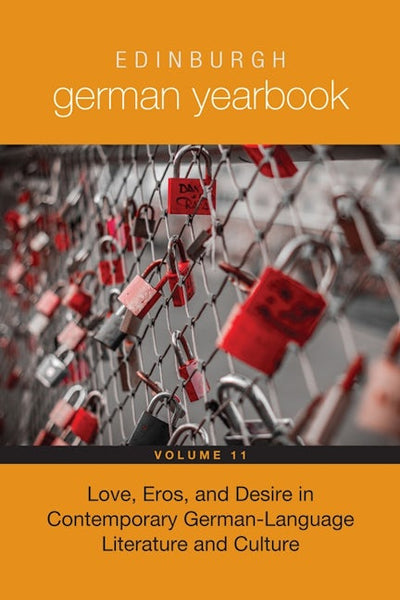
Edinburgh German Yearbook 11
Regular price
$80.00
Save $-80.00
New essays exploring the resurgence of the theme of romantic relationships and love in German literature since around the turn of the millennium.
While sociologists have long agreed that the problems of modern and contemporary subjectivity crystallize in the issue of romantic relationships and love (e.g., Luhmann, Illouz, Beck, etc.), the theme of love, so crucial to the foundational text of modern German literature, Goethe's Werther, all but disappeared from German prose literature in the second half of the twentieth century. Yet over the past fifteen years German-language literature has witnessed an explosion of novels with "Liebe" in their titles as well as novels that centrally focus on intersubjective erotic and emotional relationships. A number of major contemporary writers (Treichel, Walser, Kermani, Ortheil, Maron, Zaimoglu, Genazino) have written Liebesromane or novels in which significant sociohistorical questions are refracted through the love relationships of their protagonists. German film likewise has increasingly thematized love relationships under postromantic conditions, e.g. in the films of the Berlin school. Simultaneously, the development of both feminist and LGBTQ politics over the past decades has exploded the heteronormative discourses ofdesire in a way that has both expanded and enriched the lovers' discourse, while recent developments of urban (hetero)sexuality have expanded the previously available models of expressing erotic relationships in ways that are reminiscent of the utopian ending of Goethe's first version of Stella. The present collection offers a wide-ranging set of essays on these developments.
Contributors: Esther K. Bauer, Sven Glawion, Silke Horstkotte,Sarra Kassem, Maria Roca Lizarazu, Helmut Schmitz, Angelika Vybiral.
Helmut Schmitz is Reader in German at the University of Warwick. Peter Davies is Professor and Head of German at the University of Edinburgh.
Nexus 3
Regular price
$120.00
Save $-120.00
Biennial volume of new and innovative essays on German Jewish Studies, featuring forum sections on Heinrich Heine and Karl Kraus.
Nexus is the official publication of the biennial German Jewish Studies Workshop, which was inaugurated at Duke University in 2009 and is now held at the University of Notre Dame. Together, Nexus and the Workshop constitute the first ongoing forum in North America for German Jewish Studies. Nexus publishes innovative research in German Jewish Studies, introducing new directions, analyzing the development and definition of the field, and considering its place vis-à-vis both German Studies and Jewish Studies. Additionally, it examines issues of pedagogy and programming at the undergraduate, graduate, and community levels. Nexus 3 features special forum sections on Heinrich Heine and Karl Kraus. Renowned Heine scholar Jeffrey Sammons offers a magisterial critical retrospective on this towering "German Jewish" author, followed by a response from Ritchie Robertson, while the deanof Kraus scholarship, Edward Timms, reflects on the challenges and rewards of translating German Jewish dialect into English. Paul Reitter provides a thoughtful response.
Contributors: Angela Botelho, Jay Geller, Abigail Gillman, Jeffrey A. Grossman, Leo Lensing, Georg Mein, Paul Reitter, Ritchie Robertson, Jeffrey L. Sammons, Egon Schwarz, Edward Timms, Liliane Weissberg, Emma Woelk.
William Collins Donahue is the John J. CavanaughProfessor of the Humanities at the University of Notre Dame, where he chairs the Department of German and Russian. Martha B. Helfer is Professor of German and an affiliate member of the Department of Jewish Studies at Rutgers, TheState University of New Jersey.
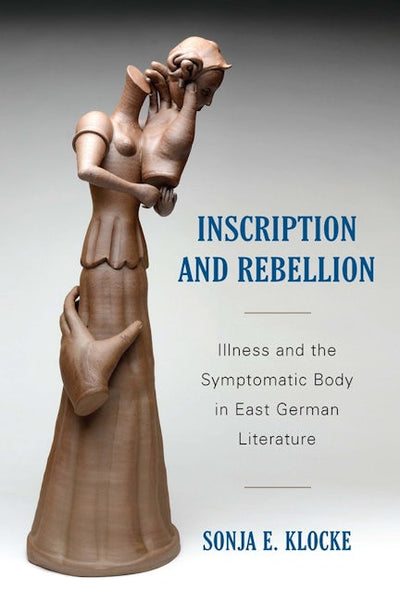
Inscription and Rebellion
Regular price
$36.95
Save $-36.95
Employs research on the GDR's healthcare system along with feminist and queer theory to get at socialism's legacy, revealing a specifically East German literary convention: employment of "symptomatic female bodies" to either enforce or rebel against political and social norms.
The healthcare system of the German Democratic Republic, based on Soviet models, reflected the importance the socialist state assigned the health both of its citizens and of the metaphorical national body meant to represent and promulgate the nation's political vitality. Yet many East German literary writers depicted characters ailing and under medical care, and even after the country's dissolution in 1990, writers who had lived there continued to portraysickness and the GDR healthcare system prominently in their fiction. This book offers an innovative reading of such texts - both by the GDR's most prominent writer, Christa Wolf, and by younger writers raised in the GDR but active mainly after 1989 - employing historical research on the healthcare system and feminist and queer theory to get at socialism's legacy. It develops a new approach to East German literature that underscores the impact of fortyyears of Marxist-Leninist thought on post-GDR poetics. Intertwining aesthetics with politics, the book employs the Foucauldian concept of the "symptomatic body," in this case a female character's body on which historical and political events inscribe physical or psychological illness, in so doing revealing a specifically East German literary convention: employment of such "symptomatic bodies" to either enforce or rebel against political and social norms.
SONJA E. KLOCKE is Associate Professor of German Studies and Affiliated Faculty in Gender and Women's Studies at the University of Wisconsin-Madison.
Approaches to Kurban Said's Ali and Nino
Regular price
$130.00
Save $-130.00
Essays showcasing Ali and Nino as particularly topical for today's readers both in and out of the classroom, and providing a number of diverse approaches to it.
Ali and Nino is a novel published in German in 1937 under the alias "Kurban Said," a love story between a Muslim man and a Christian woman set in Baku, Azerbaijan, during World War I and the country's brief independence. Itwas a major success, translated into several other languages, but was forgotten by the end of World War II. Recent research by the journalist Tom Reiss has revealed the identity of the author as Lev/Leo Nussimbaum (1905-1942), aJewish man born in Baku who converted to Islam, worked as a journalist in Berlin, and died forgotten in exile. Reiss's discovery has spurred new interest in the novel, as has the fact that the book prefigures today's perceived conflicts between East and West or Islam and Christianity, but also suggests a more peaceful model of intercultural living in multiethnic Baku's melting pot of Islam, Judaism, and Christianity. The present volume collects twelve newessays on different aspects of the text by scholars from a variety of disciplines and cultural backgrounds. It is intended to showcase the suitability of Ali and Nino for inclusion in a curriculum focused on German, world literature, or area studies, and to suggest a variety of approaches to the novel while also appealing to its fans.
Contributors: Sara Abdoullah-Zadeh, Cori Crane, Chase Dimock, Christine Rapp Dombrowski, Elizabeth WeberEdwards, Anja Haensch, Kamaal Haque, Lisabeth Hock, Ruchama Johnston-Bloom, Carl Niekerk, Elke Pfitzinger, Soraya Saatchi, Daniel Schreiner, Azade Seyhan.
Carl Niekerk is Professor of German with affiliate appointmentsin French, Comparative and World Literature, and Jewish Studies at the University of Illinois at Urbana-Champaign. Cori Crane is Associate Professor of the Practice and Director of the Language Program in the Department of Germanic Languages and Literature at Duke University.
Into the Groove
Regular price
$130.00
Save $-130.00
A new and wide-ranging view of the confluence, since the 1990s, of the fields of contemporary literature and popular music in Germany.
In Germany the decade beginning in the mid-1990s brought an unprecedented "confusion of the spheres" of literature and popular music. Popular musicians "crossed over" into the literary field, editors and writers called for contemporary German literature to become more like popular music, writers attempted to borrow structural aspects from music or paid new attention to popular music at the thematic level. Others sought to raise their profiles by means of performance models taken from the popular music field. This book sets out to make sense of this situation. It argues for more inclusive and detailed attention to what it calls "musico-centric fiction," for which it discerns intellectual precursors going back to the 1960s and also identifies examples written since the turn of the millennium, after the would-be death of "pop literature." In doing so, it focuses on fiction and paratextual interventions by authors including Peter Handke, Rolf Dieter Brinkmann, Rainald Goetz, Andreas Neumeister, Thomas Meinecke, Matthias Politycki, Frank Goosen, Benjamin von Stuckrad-Barre, Thomas Brussig, Karen Duve, and Kerstin Grether.
Andrew Wright Hurley is Senior Lecturer in German and Cultural Studies at the University of Technology, Sydney, Australia.
Mountain of Destiny
Regular price
$130.00
Save $-130.00
A study of how Nanga Parbat, the ninth-highest peak on earth, became the German "mountain of the mind."
Never has a mountain occupied the German imagination longer and more thoroughly than Nanga Parbat (8,125m), the world's ninth-highest peak, located in the extreme western part of the Himalaya chain in present-day Pakistan. Repeatedly referred to in the 1930s as the German "mountain of destiny," over a period of roughly two decades from 1932 to 1953 Nanga Parbat became not only the destination of six German mountaineering expeditions, but also the quintessential German "mountain of the mind" onto whose slopes German mountaineers, mountaineering officials, politicians, writers, and filmmakers projected some of the most pressing social, political, and cultural concerns of their times.This book is a detailed study of that process: of the initial motivations of post-First World War mountaineers for attempting to scale one of the tallest mountains in the world, of the appropriation of this epic mountaineering challenge by National Socialism, of the reappropriation of the Nanga Parbat project during the early years of the German Federal Republic. And most important - since to date such an approach is almost completely absent from existingstudies of Himalaya mountaineering of this era - it is a study of the means and mechanisms, the texts and contexts employed for communicating these high-altitude mountaineering exploits to the German public and thereby inscribingNanga Parbat into the German imagination.
Harald Höbusch is Associate Professor of German and Associate Chair of the Department of Modern and Classical Languages, Literatures and Cultures at the University of Kentucky.
European Perspectives on John Updike
Regular price
$120.00
Save $-120.00
A collection of essays that perceive Updike's America through the eyes of Western and Eastern European readers and scholars, contributing to Updike scholarship while demonstrating his resonance across the Atlantic.
From the publication in 1958 of his first book, The Carpentered Hen and Other Tame Creatures, the American writer John Updike attracted an international readership. His books have been translated into twenty-three languages. He had a strong following in the United Kingdom, where his books were routinely reviewed in all the leading national newspapers. In Germany, France, Italy, and other countries too, his books were discussed in major publications. Although Updike died in 2009, interest in his writing remains strong among European scholars. They are active in the John Updike Society and on the John Updike Review (which began publishing in 2011). During the past four decades, several Europeans have influenced the study of Updike worldwide. No recent volume, however, collects diverse European views on his oeuvre. The current book fills that void, presenting essays that perceive Updike's renditions of America through the eyes of scholar-readers from both Western and Eastern Europe.
Contributors: Kasia Boddy, Teresa Botelho, Biljana Dojcinovic, Brian Duffy, Karin Ikas, Ulla Kriebernegg, Sylvie Mathé, Judie Newman, Sue Norton, Andrew Tate, Aristi Trendel, Eva-Sabine Zehelein.
Laurence W. Mazzeno is President Emeritus of Alvernia University. Sue Norton is a Lecturer in English at the Dublin Institute of Technology.
Transnationalism in Contemporary German-Language Literature
Regular price
$130.00
Save $-130.00
Investigates the concept of transnationalism and its significance in and for German-language literature and culture.
Transnationalism has become a key term in debates in the social sciences and humanities, reflecting concern with today's unprecedented flows of commodities, fashions, ideas, and people across national borders. Forced and unforced mobility, intensified cross-border economic activity due to globalization, and the rise of trans- and supranational organizations are just some of the ways in which we now live both within, across, and beyond national borders. Literature has always been a means of border crossing and transgression-whether by tracing physical movement, reflecting processes of cultural transfer, traveling through space and time, or mapping imaginary realms. It is alsobecoming more and more a "moving medium" that creates a transnational space by circulating around the world, both reflecting on the reality of transnationalism and participating in it. This volume refines our understanding of transnationalism both as a contemporary reality and as a concept and an analytical tool. Engaging with the work of such writers as Christian Kracht, Ilija Trojanow, Julya Rabinowich, Charlotte Roche, Helene Hegemann, Antje Rávic Strubel, Juli Zeh, Friedrich Dürrenmatt, and Wolfgang Herrndorf, it builds on the excellent work that has been done in recent years on "minority" writers; German-language literature, globalization, and "world literature"; and gender and sexuality in relation to the "nation."
Contributors: Hester Baer, Anke S. Biendarra, Claudia Breger, Katharina Gerstenberger, Elisabeth Herrmann, Christina Kraenzle, Maria Mayr, Tanja Nusser, Lars Richter, Carrie Smith-Prei, Faye Stewart, Stuart Taberner.
Elisabeth Herrmann is Associate Professor of German at Stockholm University. Carrie Smith-Prei is Associate Professor of German at the University of Alberta. Stuart Taberner is Professor of Contemporary German Literature, Culture and Society at the University of Leeds and is a Research Associate in the Department of Afrikaans and Dutch; German and French at the University of the Free State, South Africa.
Kafka after Kafka
Regular price
$120.00
Save $-120.00
New essays providing an up-to-date picture of the engagement of artists, philosophers, and critics with Kafka's work.
The topic of "Kafka after Kafka" is a fascinating one: the engagement of artists, philosophers, and critics in dialogical exchange with Kafka's works. The present collection of new essays highlights the engagement of lesser knownartists and commentators with Kafka, and represents those who are well known, such as Arendt, Blanchot, Nabokov, and Coetzee, from new perspectives. The eleven essays contained here represent the most recent scholarly engagements with this topic. An essay on major trends in current Kafka criticism provides background for several essays on novelists, philosophers, and critics whose relationship to Kafka is not very well known. A section devoted to Kafka from an Israeli perspective includes artists not commonly known in the US or Europe (Ya'acov Shteinberg, Hezi Leskly, Sayed Kashua), as well as an essay on the recent trial in Israel regarding the fate of Kafka's literary legacy. A final section addresses important contemporary approaches to Kafka in film studies, animal studies, the graphic novel, and in postmodern culture and counterculture.
Contributors: Iris Bruce, Stanley Corngold, AmirEngel, Mark H. Gelber, Sander L. Gilman, Caroline Jessen, Tali Latowicki, Michael G. Levine, Ido Lewit, Vivian Liska, Alana Sobelman.
Iris Bruce is Associate Professor of German at McMaster University. Mark H. Gelber is Senior Professor and Director of the Center for Austrian and German Studies at Ben-Gurion University.
Writing the Revolution
Regular price
$130.00
Save $-130.00
An extensive look at historical, literary, and media representations of '68 in Germany, challenging the way it has been instrumentalized.
In Germany, the concept of "1968" is enduring and synonymous with the German Student Movement, and is viewed, variously, as a fundamental liberalization, a myth, a second foundation, or an irritation. The movement's aims - radicalre-imagination of the political and economic order and social hierarchy - have been understood as requiring a "long march." While the movement has been judged at best a "successful failure," cultural elites continue to engage inthe construction of 1968. Ingo Cornils's book argues that writing about 1968 in Germany is no longer about the historical events or the specific objectives of a bygone counterculture, but is instead a moral touchstone, a marker ofsocial group identity meant to keep alive (or at bay) a utopian agenda that continues to fire the imagination. The book demonstrates that the representation of 1968 as a "foundational myth" suits the needs of a number of surprisingly heterogeneous groups, and that even attempts to deconstruct the myth strengthen it. Cornils brings together for the first time the historical, literary, and media representations of the movement, showing the motivation behindand effect of almost five decades of writing about 1968. In so doing, Cornils challenges the way 1968 has been instrumentalized: as a powerful imaginary that has colonized every aspect of life in Germany, and as symbolic capitalin cultural and political debates.

Ingo Cornils is Professor of German Studies at the University of Leeds.
The Eulenburg Affair
Regular price
$190.00
Save $-190.00
The first monograph to treat comprehensively the epoch-making though now too often forgotten scandal that rocked German political culture from 1906 to 1909, now in English translation.
When it broke out in 1906, the scandal surrounding Prince Philipp Eulenburg, closest confidant of Emperor Wilhelm II, shook the Hohenzollern monarchy and all of Europe to the core. Sparked by accusations by the journalist and publicist Maximilian Harden, the scandal dominated European headlines until 1909; it was the first modern scandal in which homosexuality was openly discussed. Particularly shocking was Harden's claim that Wilhelm had long been under the influence of a homosexual camarilla led by Eulenburg. Allegedly, this clique had brought about Bismarck's dismissal, cut off the emperor from his people, and, with its undue pacifism, maneuvered Germany not only into isolation,but to the brink of war during the Morocco Crisis of 1905-6. The scandal came to be a forum for the German public to debate diverse political, social, and cultural issues: honor, friendship, marriage, privacy, sexual mores,anti-Semitism, spiritualism, class struggle, submission to authority, and enthusiasm for the military. Norman Domeier's book, now in English translation, is the first scholarly monograph on the scandal. It draws on a wealth of primary material, including ca. 5,000 newspaper articles as well as minutes of court trials, private correspondence, government files, pamphlets, diaries, memoirs, and images. Domeier's historical analysis offers fascinating insightsinto the cultural history of German politics in the fateful years of transition from the Belle Époque to the "Iron Age" of the world wars.
Norman Domeier is Assistant Professor at the University of Stuttgart's Historical Institute.
Writing in Red
Regular price
$170.00
Save $-170.00
This book explores how the East German Writers Union became a site for the contestation of writers' roles in GDR society with consequences well beyond the literary community.
In the German Democratic Republic words and ideas mattered, both for legitimizing and criticizing the regime. No wonder, then, that the ruling SED party created a Writers Union to mold what writers publicly wrote and said. Its chief task was ideological: creating a socialist and antifascist culture. But it was also supposed to advance its members' professional interests and enable them to act as public intellectuals with a say in the direction of socialism. Many writers demanded that it pursue this second function as well, which brought it into conflict with the SED. This book explores how the union became a site for the contestation of writers' roles in GDR society with consequences well beyond the literary community. Union leaders, pressured by the SED or the secret police, usually acquiesced in enforcing regime demands, but by the 1980s many authors had adapted to the rules of the game, exploiting theirunion membership to insulate themselves from reprisal for their carefully worded critiques and in so doing beginning to break down limitations on public speech. The book explores how and why in the 1970s the Writers Union helped normalize relations between writers and state, yet over the course of the 1980s inadvertently aided the expansion of permissible speech, ultimately helping destabilize the East German system.
Thomas W. Goldstein is Assistant Professor of History at the University of Central Missouri.
Renaissance Papers 2015
Regular price
$120.00
Save $-120.00
Annual volume of the best essays submitted to the Southeastern Renaissance Conference, this year with an emphasis on English drama and the cultural anxieties it expresses.
Renaissance Papers collects the best scholarly essays submitted each year to the Southeastern Renaissance Conference. The 2015 volume features essays from the conference held at the University of North Carolina at Chapel Hill, as well as essays submitted directly to the journal. The volume opens with a trio of reconsiderations of the impact of patronage on theater under the Stuarts, the role of the audience in Hamlet, and the role of King Arthur in The Faerie Queene. The heart of this year's journal is English drama, featuring essays on anxieties about nationhood in The Spanish Tragedy, generic anomalies and Chaucerian echoes in All's Well That Ends Well, the inversion of the hagiographical tradition in Shakespeare's Richard III, and the complexities coalescing around authorial identity under the Stuarts. In the penultimate essay, the focus shifts to the non-dramatic with a reconsideration of Milton's Paradise Regained and its relationship to the court masque. The last offering is a historical essay on the intersection of the personal and the political in John Wray's The Pilgrim'sJournal. The volume concludes with four book reviews.
Contributors: David M. Bergeron, William A. Coulter, Timothy D. Crowley, Melissa Geil, Lainie Pomerleau, Robert Lanier Reid, Emily Stockard, Lewis Walker, John N. Wall.
The journal is edited by Jim Pearce of North Carolina Central University and Ward Risvold of the University of Georgia.
The Intellectual Landscape in the Works of J. M. Coetzee
Regular price
$130.00
Save $-130.00
New essays examining the intellectual allegiances of Coetzee, arguably the most decorated and critically acclaimed writer of fiction in English today and a deeply intellectual and philosophical writer.
Arguably the most decorated and critically acclaimed writer of today, J. M. Coetzee is a deeply intellectual writer. Yet while just about everyone who comes to Coetzee's writing is aware that the visible superstructure of his works is moved from below by a vast substructure of ideas, we are still far from grasping Coetzee's intellectual allegiances as a whole. This book sets out to examine these allegiances in ways not attempted before, by bringing leadingfigures in the philosophy of literary fiction and ethics together with leading Coetzee scholars. The book is organized into three parts: the first part evaluates Coetzee with respect to notions of truth and justification. At issue is how the reader is to understand the ground on which Coetzee builds his ethical commitments. The second part considers the problem of language, in which ethics is rooted and on which it depends. The chapters of the third partposition Coetzee's writing with respect to notions of social and moral solidarity, where, in regard to literature as such or experience as such, philosophy and literature together exercise an unrivaled right to be heard.
Contributors: Elisa Aaltola, Derek Attridge, David Attwell, Maria Boletsi, Carrol Clarkson, Simon During, Patrick Hayes, Alexander Honold, Anton Leist, Tim Mehigan, Christian Moser, Robert B. Pippin, Robert Stockhammer, Markus Winkler, Martin Woessner.
Tim Mehigan is Deputy Director of the Institute for Advanced Studies in the Humanities at the University of Queensland. Christian Moser is Professor of Comparative Literature at the University of Bonn.
Nonconformist Writing in Nazi Germany
Regular price
$54.95
Save $-54.95
An innovative, critical, historically informed, yet accessible reassessment of writers who remained in Nazi Germany and Austria yet expressed nonconformity - even dissent - through their fiction.
2016 CHOICE Outstanding Academic Title
Studies of literary responses to National Socialism between 1933 and 1945 have largely focused on exiled writers; opposition within Germany and Austria is less well understood. Yetin both countries there were writers who continued to publish imaginative literature that did not conform to Nazi precepts: the authors of the so-called Inner Emigration. They withdrew from the regime and sought to express theirnonconformity through camouflaged texts designed to offer sensitized readers encouragement, reassurance, and consolation. This book provides a critical, historically informed reassessment of these writers. It is innovative inscope, in its use of little-known sources, in placing authors and texts in a detailed social and political context, and in analyzing seminal topoi and tropes of oppositional discourse. One of the most extensive studies of the topic in German or English, it provides a state-of-the-art text for literary historians, scholars, and students of German literature, but also, thanks to its accessibility and translation of all material, serves as an introduction for English-speaking readers to this poorly understood group of writers. Two contextualizing chapters are followed by chapters devoted to Werner Bergengruen, Stefan Andres, Friedrich Reck-Malleczewen, Gertrud von le Fort, Reinhold Schneider, Ernst Jünger, Ernst Wiechert, and Erika Mitterer.
JOHN KLAPPER is Professor in the Department of Modern Languages at the University of Birmingham, UK.
A Companion to the Works of Kim Scott
Regular price
$120.00
Save $-120.00
New essays on the acclaimed Australian Indigenous author's entire body of work, including his novels, short stories, poetry, and his work with Indigenous language and health.
Since the mid-1980s there has been a sharp rise in the number of literary publications by Indigenous Australians and in the readership and impact of those works. One contemporary Aboriginal Australian author who continues to makea contribution to both the Australian and the global canon is Kim Scott (1957-). Scott has won many awards, including Australia's highest, the prestigious Miles Franklin Award, for his novels Benang (in 2000) and That Deadman Dance (in 2011). Scott has also published in other literary genres, including poetry, the short story, and children's literature, and he has written and worked professionally on Indigenous health issues. Despite Scott'snational and international acclaim, there is currently no comprehensive critical companion that contextualizes his work for scholars, students, and general readers. A Companion to the Works of Kim Scott fills this void by providing a collection of eleven original essays focusing on Scott's novels, short stories, poetry, and his work with the Wirlomin Noongar Language and Stories Project and Indigenous health. The companion also includes an originalinterview with the author.
Contributors: Christine Choo, Arindam Das, Per Henningsgaard, Tony Hughes-d'Aeth, Jeanine Leane, Brenda Machosky, Nathanael Pree, Natalie Quinlivan, Lydia Saleh Rofail, Lisa Slater, Rosalie Thackrah and Sandra Thompson, Belinda Wheeler, Gillian Whitlock and Roger Osborne.
Belinda Wheeler is Associate Professor of English at Claflin University, Orangeburg, South Carolina.
Taking Stock of German Studies in the United States
Regular price
$130.00
Save $-130.00
Examines the challenges facing German-language study in the new millennium and highlights how creative, innovative, inspired approaches have allowed it to weather many of them.
In the last decade, cuts have been made to foreign-language programs in the United States across all levels of education, German programs among them. Despite this, enrollments in German programs have increased modestly. The importance of Germany and its language on the world stage is undeniable: it has demonstrated its strength as a major world economic power, and Germany continues to invest heavily throughout the world. Inspired by the leadership of Helene Zimmer-Loew, longtime Executive Director of the American Association of Teachers of German, the contributors to this volume examine the factors shaping German-language study in the new millennium. They highlight how innovative curricular design, creative applied research, inspirational leadership, inventive professional development, and entrepreneurial approaches have allowed German to weather many of its challenges. This volume will be of interest to scholars, teachers, and students of German who are committed to invigorating its study in the United States.
Contributors: Teresa R. Bell, Regina Braker, Kurt Buhanan and Glenn S. Levine, Albrecht Classen, Kathleen Condray, Rachel J. Halverson, Martin Kagel and William Collins Donahue, Lynn Marie Kutch, Aleidine J. Moeller and Sheri Hurlbut, Traci S. O'Brien, Lynne Tatlock, Frank Trommler, Gregory H. Wolf.
Rachel J. Halverson is Marianna Merritt and Donald S. Matteson Distinguished Professor in Foreign Languages and Cultures at Washington State University. Carol Anne Costabile-Heming is Professor of German in the Department of World Languages, Literatures, and Cultures at the University of North Texas.
Novel Affinities
Regular price
$120.00
Save $-120.00
Challenges traditional novel scholarship that emphasizes the individual and the Bildungsroman, broadening the focus to the family and both canonical and non-canonical novels, reading them together with biological, legal and pedagogical texts.
The novel, according to standard scholarly narratives, depicts an individual's path to maturity. Scholarship on the rise of the novel in Germany and in Europe more broadly, from Watt to Moretti, has essentially collapsed the genreinto the individualist Bildungsroman, exemplified by a narrow canon. This study challenges and nuances these narratives, first by expanding the focus from the individual to the family, second by broadening the field of novels treated to include not only canonical works but also so-called trivial literature, and third, by reading novels alongside contemporary biological, legal, and pedagogical texts. This perspective reveals that the novel and the family around 1800 were mutually constitutive and that the two together were instrumental in the development of conceptions of individuality, kinship, and society that are still relevant today. Sarah Vandegrift Eldridge reads novels by Goethe, Wolzogen, Engel, Karoline Fischer, August Lafontaine, and Brentano, showing that they exhibit varying degrees of "imaginative didacticism": suggestions not of what to think and feel, but that thinking and feeling in reaction to literature are central to cultural practices of self-reflection and development. The family is a crucial locus for this practice, and reading novels together with nonliterary texts illuminates how they experiment productively with the infinite possibilities presented by the relationships they portray.
Sarah Vandegrift Eldridge is Associate Professor of German at the University of Tennessee, Knoxville.
Collecting in the Twenty-First Century
Regular price
$120.00
Save $-120.00
An interdisciplinary volume of essays identifying the impact of technology on the age-old cultural practice of collecting as well as the opportunities and pitfalls of collecting in the digital era.
Seminal to the rise of human cultures, the practice of collecting is an expression of individual and societal self-understanding. Through collections, cultures learn and grow. The introduction of digital technology has accelerated this process and at the same time changed how, what, and why we collect. Ever-expanding storage capacities and the accumulation of unprecedented amounts of data are part of a highly complex information economy in which collecting has become even more important for the formation of the past, present, and future. Museums, libraries, and archives have adapted to the requirements of a digital environment, as has anyone who browses the internet and stores information on hard drives or cloud servers. In turn, companies follow the digital footprint we leave behind. Today, collecting includes not only physical objects but also the binary code that allows for their virtual representation on screen. Collecting in the Twenty-First Century identifies the impact of technology, both new and old, on the cultural practice of collecting as well as the challenges and opportunities of collecting in the digital era. Scholars from German Studies, Media Studies, Museum Studies, Sound Studies, Information Technology, and Art History as well as librarians and preservationists offer insights into the most recent developments in collecting practices.
Romantic Rapports
Regular price
$120.00
Save $-120.00
New essays offering fresh glimpses of Romanticism as interdisciplinary and cross-linguistic, illuminating the discursive features and the pan-European nature of the movement.
Romanticism bubbled up as lava from such historical eruptions as the Napoleonic Wars. The power of its flow across disciplines and linguistic borders reminds us that the use of the term in a context limited to one linguistic, national, or political tradition, or to one discipline or area of human development, shows an essential ignorance of the ideational configurations elaborated and lived out by the movement. Among its consistent norms are the notion ofreality as a transcendent self-unfolding Geist, everything existing in a dialectical relationship with all else; the position that art reveals mythic understructures of reality; and that all kinds of kinship are more normalthan isolation. This book brings together essays that highlight the inclusivity of Romanticism. A team of eleven scholars offers fresh glimpses of Romanticism as it manifests itself in a number of disciplines, including most prominently literature, but also music, painting, and the sciences. In so doing, the contributors treat Romanticism as interdisciplinary and cross-linguistic, providing data and interpretive viewpoints that illuminate the discursive features and the pan-European nature of the movement.
Contributors: Lloyd Davies, Ellis Dye, Stacey Hahn, Hollie Markland Harder, Jennifer Law-Sullivan, Sarah Lippert, Marjean D. Purinton, Ashley Shams, Kaitlin Gowan Southerly.
Larry H. Peer is Professor of Comparative Literature at Brigham Young University. Christopher R. Clason is Professor of German at Oakland University.
Nonconformist Writing in Nazi Germany
Regular price
$190.00
Save $-190.00
An innovative, critical, historically informed, yet accessible reassessment of writers who remained in Nazi Germany and Austria yet expressed nonconformity - even dissent - through their fiction.
2016 CHOICE Outstanding Academic Title
Studies of literary responses to National Socialism between 1933 and 1945 have largely focused on exiled writers; opposition within Germany and Austria is less well understood. Yetin both countries there were writers who continued to publish imaginative literature that did not conform to Nazi precepts: the authors of the so-called Inner Emigration. They withdrew from the regime and sought to express theirnonconformity through camouflaged texts designed to offer sensitized readers encouragement, reassurance, and consolation. This book provides a critical, historically informed reassessment of these writers. It is innovative inscope, in its use of little-known sources, in placing authors and texts in a detailed social and political context, and in analyzing seminal topoi and tropes of oppositional discourse. One of the most extensive studies of the topic in German or English, it provides a state-of-the-art text for literary historians, scholars, and students of German literature, but also, thanks to its accessibility and translation of all material, serves as an introduction for English-speaking readers to this poorly understood group of writers. Two contextualizing chapters are followed by chapters devoted to Werner Bergengruen, Stefan Andres, Friedrich Reck-Malleczewen, Gertrud von le Fort, Reinhold Schneider, Ernst Jünger, Ernst Wiechert, and Erika Mitterer.
John Klapper is Professor in the Department of Modern Languages at the University of Birmingham, UK.
Returning Memories
Regular price
$170.00
Save $-170.00
Provides the first comprehensive analysis of the history of returning German POWs after the Second World War, explored as a history of memory both during Germany's division and after unification.
Millions of former German soldiers (known as Heimkehrer, literally "homecomers," or returnees) returned from captivity as prisoners of war at the end of the Second World War, an experience that had profound effects on German society and touched almost every German family. Based on extensive archival research and oral history interviews, this book provides the first comprehensive analysis of the history of the German returnees, explored as a historyof memory, both during Germany's division and after unification. At its core lies the question of how the experiences of war captivity were transformed into individual and collective memories. The book argues that memory of the experience of captivity and return is complex and multilayered and has been shaped by postwar political and social frameworks.
Christiane Wienand is a historian and works in Heidelberg, Germany. She holds a PhD in Historyfrom University College London.
Writing the Revolution
Regular price
$36.95
Save $-36.95
An extensive look at historical, literary, and media representations of '68 in Germany, challenging the way it has been instrumentalized.
In Germany, the concept of "1968" is enduring and synonymous with the German Student Movement, and is viewed, variously, as a fundamental liberalization, a myth, a second foundation, or an irritation. The movement's aims - radicalre-imagination of the political and economic order and social hierarchy - have been understood as requiring a "long march." While the movement has been judged at best a "successful failure," cultural elites continue to engage inthe construction of 1968. Ingo Cornils's book argues that writing about 1968 in Germany is no longer about the historical events or the specific objectives of a bygone counterculture, but is instead a moral touchstone, a marker ofsocial group identity meant to keep alive (or at bay) a utopian agenda that continues to fire the imagination. The book demonstrates that the representation of 1968 as a "foundational myth" suits the needs of a number of surprisingly heterogeneous groups, and that even attempts to deconstruct the myth strengthen it. Cornils brings together for the first time the historical, literary, and media representations of the movement, showing the motivation behindand effect of almost five decades of writing about 1968. In so doing, Cornils challenges the way 1968 has been instrumentalized: as a powerful imaginary that has colonized every aspect of life in Germany, and as symbolic capitalin cultural and political debates.
Ingo Cornils is Professor of German Studies at the University of Leeds.
The Otherworlds of Liz Jensen
Regular price
$99.00
Save $-99.00
The first study of one of the most innovative of contemporary novelists, Liz Jensen, and of the "otherworlds" in her fiction.
Liz Jensen, a British author of eight novels, is among today's most innovative writers. Her literary thrillers occupy the terrain between realism and science fiction. This first study of Jensen centers on the very diverse "otherworlds" she creates in each of her novels, which can consist of an indeterminate space of ontological instability, a zone in which real and unreal converge to destabilize the realist text, as in Egg Dancing (1995) and TheNinth Life of Louis Drax (2004). In other novels the otherworld relies on defamiliarization: thus in War Crimes for the Home (2002) the experience of war is transformed by being seen from a woman's perspective. In stillother cases, the otherworld spans the novel's entire topos, as in The Paper Eater (2000), the full-blown utopia at the center of Jensen's oeuvre. Jensen's work approaches contemporary social issues such as religious fundamentalism, ecological disaster, and assisted procreation. Simultaneously, it displays a number of characteristics of erudite fiction, including self-reflexivity, inter- and intratextual reference, parody, pastiche, and burlesque. Notwithstanding the "popular" elements of Jensen's work, Helen E. Mundler's study adopts a rigorously academic approach to it, referencing canonical works but also more innovative texts, particularly by contemporary women writers, as points of comparison.
Helen E. Mundler is Senior Lecturer in English Studies at UPEC (Université Paris-Est Créteil) with a research affiliation at the Université Paris-X Nanterre-La Défense.
The Nazi Past in Contemporary German Film
Regular price
$120.00
Save $-120.00
From intimate portrayals of ordinary Germans and Nazi leaders to immersive spectacles of war and defeat, this study argues that, since 1990, German film has focused on portraying the Nazi past from within.
How has the German image of the Nazi past changed since the reunification of East and West Germany? And what role have cinema and television played in this process? This intriguing study argues that since 1990, the two media haveturned toward inner German experiences of the Third Reich. From intimate portrayals of ordinary Germans and Nazi leaders to immersive spectacles of war and defeat, German film has focused on portraying the Nazi past from within. Stimulating and accessible, combining close readings with broad contextualization, this monograph shows how profoundly cinema and television have transformed collective remembrance of the Third Reich. The first publication on the topic to embrace the two decades since 1990, it provides a comprehensive account of cinema and television productions, presenting case studies of national film events such as Stalingrad (1993) and Downfall (2004), andassessing the influence of international blockbusters from Schindler's List (1993) to The Reader (2008). Targeted at a wide readership, the book will be a central reference point for university teachers offering courses on German film or cultural memory, will give guidance to both undergraduate and postgraduate students, and will make a lasting impact on research in the field of German screen cultures.
Axel Bangert holds a doctorate from the Faculty of Modern and Medieval Languages, University of Cambridge. Previously a Junior Research Fellow at Homerton College, Cambridge, he is an Adjunct Professor at New York University Berlin where he teaches German Cinema Studies.
The Critical Life of Toni Morrison
Regular price
$130.00
Save $-130.00
The first book to trace the critical reception of the great African American woman writer, attending not only to her fiction but to her nonfiction and critical writings.
Winner of the Toni Morrison Society Book Prize for Best Single-Authored Book, 2019-2022
Toni Morrison (1931-2019) is the most important American novelist since Faulkner, the most significant American woman writer since Dickinson, and the most widely read African American public intellectual of the last half century. Her influence as a writer, critic, editor, teacher, and scholar is profound: she changed the face of literature and literary criticism in the US, if not worldwide. Yet despite the ever-expanding field of Morrison scholarship, no book tracing her critical reception has existed, until now. The book is as much a cultural history of America as a reception history of an American writer. Morrison worked brilliantly in many genres - fiction, of course (novels and short stories); drama/staged performance; poetry; non-fiction on historical, social, and political issues; and critical writings on the work of others and on her own work. She generated a literary-critical methodology that recognizes and embraces rather than ignores the African American presence in US literature, and thus transformed American academics' attitude toward American letters. The story of Morrison's achievement in making a home for herself - and for other women and people of color - in the stony bedrock of "white male" American literature is the subject of this book.
Edinburgh German Yearbook 8
Regular price
$120.00
Save $-120.00
New perspectives on the relationship - or the perceived relationship - between the German language and the causes, nature, and legacy of National Socialism and the Shoah.
There is seemingly no escaping the association of the language of Goethe with the language of Hitler: the two leaden clichés seem to be inseparable, suggesting a Sonderweg between enlightened sophistication and subtle beauty on the one hand and linguistic barbarism on the other. Victor Klemperer suggested that the Lingua Tertii Imperii was a perversion of German that needed to be purged from the language, but does the notion of "Nazi language" as an identifiably separate entity really hold water, or does it only reflect a desire to construct a clear demarcation line between "Germans" and "Nazis"? What new linguistic, literary, or historical perspectives are availableon the functioning of language during and after the Third Reich? Must German always be the "language of the perpetrators," entailing a constant state of heightened self-awareness or vigilance against contamination, or is neutral,objective speech about National Socialism possible in German? This collection provides new perspectives on the relationship - or the perceived relationship - between the German language in all its manifestations and the causes, nature, and legacy of National Socialism and the Shoah.
Contributors: Ian Biddle and Beate Müller, Mary Cosgrove, Peter Davies, Sylvia Degen, Andrea Hammel, Geraldine Horan, Teresa Ludden, Dora Osborne, Marko Pajevic, James Parsons, Simone Schroth, Arvi Sepp, Simon Ward, Jenny Watson.
Peter Davies is Professor of Modern German Studies at the University of Edinburgh. Andrea Hammel is Senior Lecturer in German at Aberystwyth University.
New Poems
Regular price
$49.95
Save $-49.95
A new translation of Rilke's groundbreaking volume, following the formal properties of the original poems, especially meter and rhyme, as closely as English allows.
Rainer Maria Rilke, the most famous (and important) German language poet of the twentieth century - a master to be ranked with Goethe and Heine - wrote the New Poems of 1907 and 1908 in transition from his late-nineteenth-century style. They mark his appearance as a lyrical, metaphysical poet of the modernist sensibility, often using traditional forms like the sonnet to explore the inner essence, the deep heart, of things - often, quite literally, things. Influenced by his time spent as Rodin's secretary, Rilke turned to quotidian life and sought to artistically redeem it in all its possibilities. His exquisite use of meter and rhyme marks him as a "formalist" and yet a contemporary of Eliot and the later Yeats, so this translation follows, as closely as English allows, the formal properties of the original poems, in a line-for-line version, while trying to capture the spare diction and direct idiomsof modernism.
Len Krisak is a recipient of the Richard Wilbur, Robert Penn Warren, and Robert Frost prizes in poetry. He has published more than five hundred poems, including translations from the Latin, Greek, Spanish, Italian, Russian, and German.
Goethe Yearbook 22
Regular price
$90.00
Save $-90.00
Cutting-edge scholarly articles on diverse aspects of Goethe and the Goethezeit, featuring in this volume a special section on environmentalism.
The Goethe Yearbook is a publication of the Goethe Society of North America, encouraging North American Goethe scholarship by publishing original English-language contributions to the understanding of Goethe and other authors of the Goethezeit while also welcoming contributions from scholars around the world. Volume 22 features a special section on environmentalism, edited by Dalia Nassar and Luke Fischer, with contributions on: the metaphor of music in Goethe's scientific work and its influence on Deleuze, Merleau-Ponty, Uexküll, and Zuckerkandl (Frederick Amrine); his conceptualization of modern civilization in Faust (Gernot Böhme); a non-anthropocentricvision of nature in his writings on the intermaxillary bone (Ryan Feigenbaum); his geopoetics of granite (Jason Groves); the historical antecedents of biosemiotics in "Die Metamorphose der Pflanzen" (Kate Rigby); and the conceptof the "Dark Pastoral" in Werther (Heather I. Sullivan). In addition, there are articles on Goethe as a spiritual predecessor of phenomenology (Iris Hennigfeld); concepts of the "hermaphrodite" in contributions to theEncyclopédie by Louis de Jaucourt and Albrecht von Haller (Stephanie Hilger); on Goethe's poem "Nähe des Geliebten" (David Hill); on the link between commerce and culture in West-östlicher Divan (Daniel Purdy); on Goethe's thoughts on collecting and museums (Helmut Schneider); and on intrigues in the works of J. M. R. Lenz (Inge Stephan).
Contributors: Frederick Amrine, Gernot Böhme, Ryan Feigenbaum, Luke Fischer, Jason Groves, Iris Hennigfeld, Stephanie M. Hilger, David Hill, Dalia Nassar, Daniel Purdy, Kate Rigby, Helmut J. Schneider, Inge Stephan, Heather I. Sullivan.
Adrian Daub is Associate Professor of German at Stanford. Elisabeth Krimmeris Professor of German at the University of California Davis. Book review editor Birgit Tautz is Associate Professor of German at Bowdoin College.
Goethe Yearbook 21
Regular price
$90.00
Save $-90.00
New essays on topics in the literature of Goethe and the Goethezeit, including contributions by both eminent scholars and new voices.
The Goethe Yearbook is a publication of the Goethe Society of North America, encouraging North American Goethe scholarship by publishing original English-language contributions to the understanding of Goethe and other authors of the Goethezeit while also welcoming contributions from scholars around the world. Volume 21 contains eleven articles, including contributions by leading scholars David Wellbery and Katharina Mommsen; innovative work on the reception of Goethe's works around 1900, on women writers, and on Goethe's contemporary Albrecht von Haller; theoretically sophisticated interpretations, including articles on concepts of space in Alexis and Doraand on notions of sacrifice in Faust; and interdisciplinary pieces ranging from a discussion of contemporary psychological and medical theories of ill humor in relation to Goethe's Werther and an economic reading ofGoethe's Faust to an analysis of illustrations of Goethe's works. The review section collects responses by eminent scholars to a wide swath of recent books on Goethe and his age, both in German and English.
Contributors: Liesl Allingham, William H. Carter, Sarah Vandegrift Eldridge, John B. Lyon, Waltraud Maierhofer, Catherine Minter, Katharina Mommsen, David Pan, Michael Saman, Leif Weatherby, David E. Wellbery.
Adrian Daub is Associate Professor of German at Stanford. Elisabeth Krimmer is Professor of German at the University of California Davis. Book review editor Birgit Tautz is Associate Professor of German at Bowdoin College.
Goethe Yearbook 23
Regular price
$90.00
Save $-90.00
Cutting-edge scholarly articles on diverse aspects of Goethe and the Goethezeit, featuring in this volume a special section on Goethe and visual culture.
The Goethe Yearbook is a publication of the Goethe Society of North America, encouraging North American Goethe scholarship by publishing original English-language contributions to the understanding of Goethe and other authors of the Goethezeit while also welcoming contributions from scholars around the world. Volume 23 features a special section on visual culture with contributions on the visual aesthetics of Goethe's 1815 production ofProserpina (Bersier); on the Farbenlehre (Lande); on Tableaux Vivants in Goethe's Die Wahlverwandtschaften (Solanki); on the relationship between Goethe and C. G. Carus and their respective views on the representation of nature in art and science (Allert); and on visual and verbal bricolage in Clemens Brentano's Gockel, Hinkel und Gackeleia (MacLeod). There are also articles on Goethe and ancient mystery religions (Amrine); on Goethe's fairy-tale aesthetics (Brown); on the concept of neutrality (Holland); on the concept of the mathematical infinite (Smith); on virginity and maternity in Werther (Nossett); on the Classical aesthetics of Schlegel'sLucinde (ter Horst); and on motherless creations in Faust (Nielsen).
Contributors: Beate Allert, Frederick Amrine, Gabrielle Bersier, Jane K. Brown, Jocelyn Holland, Joel B. Lande, Catriona MacLeod, WendyC. Nielsen, Lauren Nossett, John H. Smith, Tanvi Solanki, Eleanor ter Horst.
Adrian Daub is Associate Professor of German at Stanford. Elisabeth Krimmer is Professor of German at the University of California Davis. Bookreview editor Birgit Tautz is Associate Professor of German at Bowdoin College.
The Critics and Hemingway, 1924-2014
Regular price
$130.00
Save $-130.00
Traces Hemingway's critical fortunes over the ninety years of his prominence, telling us something about what we value in literature and why scholarly reputations rise and fall.
Hemingway burst on the literary scene in the 1920s with spare, penetrating short stories and brilliant novels. Soon he was held as a standard for modern writers. Meanwhile, he used his celebrity to create a persona like the stoic,macho heroes of his fiction. After a decline during the 1930s and 1940s, he came roaring back with The Old Man and the Sea in 1952. Two years later he received the Nobel Prize. While his popularity waxed and waned during his lifetime, Hemingway's reputation among scholars remained strong as long as traditional scholarship dominated. New approaches beginning in the 1960s brought a sea change, however, finding grave fault with his work and making him a figure ripe for vilification. Yet during this time scholarship on him continued to appear. His works still sell well, and several are staples on high-school and college syllabi. A new scholarly edition of his letters is drawing prominent attention, and there is a resurgence in scholarly attention to - and approbation for - his work. Tracing Hemingway's critical fortunes tells us something about what we value in literature and why reputations rise and fall as scholars find new ways to examine and interpret creative work.
Laurence W. Mazzeno is President Emeritus of Alvernia University. Among other books, he has written volumes on Austen, Dickens, Tennyson, Updike,and Matthew Arnold for Camden House's Literary Criticism in Perspective series.
Imagination and Idealism in John Updike's Fiction
Regular price
$95.00
Save $-95.00
Concentrating on the role of the imagination in Updike's works, this book shows him to be an original and powerful thinker and not the callow sensationalist that he is sometimes accused of being.
This book looks past the frequently discussed autobiographical nature of John Updike's fiction to consider the role in Updike's work of the most powerful and peculiar human faculty: the imagination. Michial Farmer argues that, while the imagination is for Updike a means of human survival and a necessary component of human flourishing, it also has a destructive, darker side, in which it shades into something like philosophical idealism. Here the mind constructs the world around it and then, unhelpfully, imposes this created world between itself and the "real world." In other words, Updike is not himself an idealist but sees idealism as a persistent temptation for the artistic imagination. Farmer builds his argument on the metaphysics of Jean-Paul Sartre, an existentialist thinker who has been largely neglected in discussions of Updike's aesthetics. The book demonstrates the degree to which Updike was an original and powerful thinker and not the callow sensationalist that he is sometimes accused of being.
Michial Farmer is Assistant Professor of English at Crown College, Saint Bonifacius, Minnesota.
The Musical Novel
Regular price
$120.00
Save $-120.00
WINNER: 2014 CHOICE Outstanding Academic Title Award
Analyzes two groups of "musical novels" -- novels that take music as a model for their construction -- including jazz novels by Toni Morrison and Michael Ondaatje, and novels based on Bach's Goldberg Variations.
What is a "musical novel"? This book defines the genre as musical not primarily in terms of its content, but in its form. The musical novel crosses medial boundaries, aspiring to techniques, structures, and impressions similar tothose of music. It takes music as a model for its own construction, borrowing techniques and forms that range from immediately perceptible, essential aspects of music (rhythm, timbre, the simultaneity of multiple voices) to microstructural (jazz riffs, call and response, leitmotifs) and macrostructural elements (themes and variations, symphonies, albums). The musical novel also evokes the performance context by imitating elements of spontaneity that characterize improvised jazz or audience interaction. The Musical Novel builds upon theories of intermediality and semiotics to analyze the musical structures, forms, and techniques in two groups of musical novels, which serve as case studies. The first group imitates an entire musical genre and consists of jazz novels by Toni Morrison, Albert Murray, Xam Wilson Cartiér, Stanley Crouch, Jack Fuller, Michael Ondaatje, and Christian Gailly. The secondgroup of novels, by Richard Powers, Gabriel Josipovici, Rachel Cusk, Nancy Huston, and Thomas Bernhard, imitates a single piece of music, J. S. Bach's Goldberg Variations.
Emily Petermann is Assistant Professor of American Literature at the University of Konstanz.
Edinburgh German Yearbook 9
Regular price
$120.00
Save $-120.00
Explores the changing relationship between memory and the archive in German-language literature and culture since 1945.
In recent years, the discourse of memory - and of German memory culture in particular - has become increasingly concerned with questions of the archive. An archive can refer to a physical place, the material found there, or the system that orders this material; in its broadest sense, it might refer to something public (records housed in a municipal building), or something private (photographs in a family album). The material and documentary qualities of the archive confer on it an authenticating function attributed only cautiously to memory, but theories of the archive have questioned the status of material, documentary vestiges of the past. Memory and the archive are inextricablylinked, but how does this affect the mediation of the past? This volume explores the changing relationship between memory and the archive in German-language literature and culture since 1945. Contributions approach this topic froma range of perspectives (film, visual culture, urban culture, digital technology, as well as literature) and offer illuminating studies of Harun Farocki, Anselm Kiefer, Thomas Demand, Bernd and Hilla Becher, Jürgen Fuchs, StefanWolter, and Sasa Stanisic.
Contributors: Priyanka Basu, Carol Anne Costabile-Heming, Regine Criser, Tobias Ebbrecht-Hartmann, Diana Hitzke and Charlton Payne, Caitríona Leahy, Dora Osborne, Annie Ring, Lizzie Stewart, Simon Ward.
Dora Osborne is Lecturer in German at Durham University.
The Writers' State
Regular price
$170.00
Save $-170.00
Examines the literature produced from the very beginnings of what became the GDR through the 1950s, redressing a tendency of literary scholarship to focus on the later GDR.
Twenty-five years after the demise of the German Democratic Republic, there is perhaps more scholarship being produced on all aspects of that country than ever. This is true also in the field of literary studies, but especially inEnglish-language literary scholarship there has been a strong imbalance toward a focus on the last three decades of GDR literature. The literature of the earlier GDR has mostly been dismissed or ignored by scholars, as the discontinuities between the early and late GDR have been emphasized over the considerable continuities. This book seeks to redress that state of affairs, examining the literature produced from the very beginnings of what became the GDRthrough the 1950s. In doing so it applies to GDR literature the insight gained by scholars over the past few decades that the immediate postwar period was more complex, more meaningful, and more rewarding of study than it was longdeemed to be. Far from all being mere propaganda or rote socialist realism, the literature of the early GDR has much to tell us about the budding socialist state, even as it goes far in explaining the developments in the later GDR.
Following Faulkner
Regular price
$120.00
Save $-120.00
An examination of how Faulkner's work has been analyzed, elucidated, and promoted by a massive body of scholarly work spanning over seven decades.
William Faulkner seems to have sprung a full-blown genius from a remote part of the American South. Yet Faulkner spent much of his life striving to emulate and overshadow - both as a writer and as a person - his great-grandfatherand namesake, Colonel William Falkner, a dueling, railroad-building, soldiering figure who loomed not just as a legend in Faulkner's family and community but also as a literary forebear, a published novelist, travel writer, and poet. Looking back on his career, Faulkner would mention that early on he had ridden his great-grandfather's coattails, but by the mid-twentieth century it was clear that it was the great-grandson who was leading the literary world:readers, young writers of fiction, and literary critics were following him as one who had found extraordinary ways to capture and express the most challenging aspects of modern life. Taylor Hagood's book centers on the concept of following to examine how Faulkner's work has been analyzed, elucidated, and promoted by a massive body of scholarly work spanning over seven decades. It narrates the development of Faulkner criticism, taking as its premisethe idea that Faulkner forges a fiery path through modernism and into postmodernism that literary critics have been constantly rushing to follow.
Taylor Hagood is Associate Professor of English at Florida Atlantic University. His book Faulkner: Writer of Disability (LSU Press, 2014) won the C. Hugh Holman Award for Best Book in Southern Literary Studies in 2015.
Classical Music in the German Democratic Republic
Regular price
$130.00
Save $-130.00
Approaches the topic of classical music in the GDR from an interdisciplinary perspective, questioning the assumption that classical music functioned purely as an ideological support for the state.
Classical music in the German Democratic Republic is commonly viewed as having functioned as an ideological support or cultural legitimization for the state, in the form of the so-called "bourgeois humanist inheritance." The largenumbers of professional orchestras in the GDR were touted as a proof of the country's culture. Classical music could be seen as the polar opposite of Americanizing pop culture and also of musical modernism, which was decried as formalist. Nevertheless, there were still musical modernists in the GDR, and classical music traditions were not only a prop of the state. This collection of new essays approaches the topic of classical music in the GDR from an interdisciplinary perspective, presenting the work of scholars in a number of complementary disciplines, including German Studies, Musicology, Aesthetics, and Film Studies. Contributors to this volume offer a broad examination of classical music in the GDR, while also uncovering nonconformist tendencies and questioning the assumption that classical music in the GDR meant nothing but (socialist) respectability.
Contributors: Tatjana Böhme-Mehner, Martin Brady, Lars Fischer, Kyle Frackman, Golan Gur, Peter Kupfer, Albrecht von Massow, Carola Nielinger-Vakil, Jessica Payette, Larson Powell, Juliane Schicker, Martha Sprigge, Matthias Tischer, Jonathan L. Yaeger, Johanna Frances Yunker
Kyle Frackman is Assistant Professor of Germanic Studies at the University of British Columbia. Larson Powell is Professor of German at the University of Missouri-Kansas City.
The Gentle Apocalypse
Regular price
$130.00
Save $-130.00
Through close readings of poems covering the span of Georg Trakl's lyric output, this study traces the evolution of his strangely mild and beautiful vision of the end of days.
Like much German-language poetry of the years preceding the First World War, the poems of Georg Trakl (1887-1914) are imbued with a sense of historical crisis, but what sets his work apart is the mildness and restraint of his images of universal disintegration. Trakl typically couched his vision of the end of days in images of migrating birds, abandoned houses, and closing eyelids, making his poetry at once apocalyptic, rustic, and intimate. The argument made in this study is that this vision amounts to a unitary worldview with tightly interwoven affective, ethical, social, historical, and cosmological dimensions. Often termed hermetic and obscure, Trakl's poems become more accessible when viewed in relation to the evolution of his methods and concerns across different phases, and the idiosyncrasies of his strangely beautiful later works make sense as elements of a sophisticated system of expression committed to "truth" as a transcendental order. Through close readings of poems covering the span of his lyric output, this study traces the evolution of Trakl's distinctive style and themes while attending closely to biographical and cultural contexts.
Continuity and Crisis in German Cinema, 1928-1936
Regular price
$130.00
Save $-130.00
New essays examining the differences and commonalities between late Weimar-era and early Nazi-era German cinema against a backdrop of the crises of that time.
Hitler's Machtergreifung, or seizure of power, on January 30, 1933, marked the end of the Weimar Republic and the beginning of the Third Reich, and German film scholarship has generally accepted this date as the break between Weimar and Nazi-era film as well. This collection of essays interrogates the continuities and discontinuities in German cinema before and after January 1933 and their relationship to the various crises of the years 1928 to 1936in seven areas: politics, the economy, concepts of race and ethnicity, the making of cinema stars, genre cinema, film technologies and aesthetics, and German-international film relations. Focusing both on canonical and lesser-known works, the essays analyze a representative sample of films and genres from the period. This book will be of interest to scholars and students of Weimar and Third Reich cinema and of the sociopolitical, economic, racial, artistic, and technological spheres in both late Weimar and the early Third Reich, as well as to film scholars in general.
Contributors: Paul Flaig, Margrit Frölich, Barbara Hales, Anjeana Hans, Bastian Heinsohn, Brook Henkel,Kevin B. Johnson, Owen Lyons, Richard W. McCormick, Kalani Michell, Mihaela Petrescu, Christian Rogowski, Valerie Weinstein, Wilfried Wilms.
Barbara Hales is Associate Professor of History at the University of Houston-Clear Lake. Mihaela Petrescu is Visiting Lecturer at the University of Pittsburgh. Valerie Weinstein is Assistant Professor of Women's, Gender, and Sexuality Studies and German Studies at the University of Cincinnati.
Austria Made in Hollywood
Regular price
$120.00
Save $-120.00
Considers over sixty Hollywood films set in Austria, examining the film industry, the influence of domestic factors on images of a foreign country, and the persistence of clichés.
Maria von Trapp, watching the final scene of The Sound of Music for the first time as "her" family escaped into Switzerland, exclaimed, "Don't they know geography in Hollywood? Salzburg does not border on Switzerland!" Hadshe thought about the beginning of the film, which transports viewers to "Salzburg, Austria in the last Golden Days of the Thirties," when the country was in fact suffering from extreme political and social unrest, she might haveasked, "Don't they know history either?" In The Sound of Music as well as in Hollywood's many other "Austria" films, the projections on the screen resemble reflections in a funhouse mirror. Elements of a "real" place with a"real" history inhabited by "real" people can be found in the fractured distortions, which have both drawn from and contributed to the general public's perceptions of the country and its citizens. Austria Made in Hollywood focuses on films set in an identifiable Austria, examining them through the lenses of the historical contexts on both sides of the Atlantic and the prism of the ever-changing domestic film industry. The study chronicles theprotean screen images of Austria and Austrians that set them apart both from European projections of Austria and from Hollywood incarnations of other European nations and nationals. It explores explicit and implicit cultural commentaries on domestic and foreign issues inserted in the Austrian stories while considering the many, sometimes conflicting forces that shaped the films.
Robert Frost's Political Body
Regular price
$110.00
Save $-110.00
A provocative new study that identifies a deep structure -- that of the political body -- in Frost's poetry.
In Robert Frost's poetry lives the figure of an authoritative public body: a physical, human body that personifies classical liberalism. A deep structure, it manifests itself in his images, the characterization of his speakers, their tones of voice, and -- most crucially -- in his sense of poetry's appropriate scope. To glimpse this political body, Grzegorz Kosc interrogates the poet's views on a number of subjects never explored by Frost criticism: Maya monumental art; Shelley's bodies of sensibility and martyrdom; the bodies of US presidents Theodore Roosevelt and William Howard Taft; the association of radical liberalism with bodily deformation; the ulteriority of physical behavior; the popularity of statuettes that supplanted traditional, monumental sculptures of political leaders. For Frost, all these yielded important clues to the writing of a good poem, which had to have the features of a well-shaped, self-disciplined, and stoic body. The final chapter explores the images of Frost's own body used for the frontispieces of the reprint editions of his poetry, images that are the symbols of Frost's aesthetics. Hence the book's title, which not only points to the central structure of Frost's poetry but also suggests that the poet envisioned his own portrait as illustrating the body of political power underlying his aesthetics.
Grzegorz Kosc is Assistant Professor at the University of Lodz and the University of Warsaw, Poland. He is former President of the Robert Frost Society.
German Women's Writing in the Twenty-First Century
Regular price
$120.00
Save $-120.00
Essays in this volume rethink conventional ways of conceptualizing female authorship and re-examine the formal, aesthetic, and thematic terms in which German women's literature has been conceived.
What is the status of women's writing in German today, in an era when feminism has thoroughly problematized binary conceptions of sex and gender? Drawing on gender and queer theory, including the work of Lauren Berlant, Judith Butler, and Michel Foucault, the essays in this volume rethink conventional ways of conceptualizing female authorship and re-examine the formal, aesthetic, and thematic terms in which "women's literature" has been conceived. With aneye to the literary and feminist legacy of authors such as Christa Wolf and Ingeborg Bachmann, contributors treat the works of many of contemporary Germany's most significant literary voices, including Hatice Akyün, Sibylle Berg,Thea Dorn, Tanja Dückers, Karen Duve, Jenny Erpenbeck, Julia Franck, Katharina Hacker, Charlotte Roche, Julia Schoch, and Antje Rávic Strubel -- authors who, through their writing or their roles in the media, engage with questionsof what it means to be a woman writer in twenty-first-century Germany.
Contributors: Hester Baer, Necia Chronister, Helga Druxes, Valerie Heffernan, Alexandra Merley Hill, Lindsay Lawton, Sheridan Marshall, Mihaela Petrescu, Jill Suzanne Smith, Carrie Smith-Prei, Maria Stehle, Katherine Stone.
Hester Baer is Associate Professor of Germanic Studies at the University of Maryland. Alexandra Merley Hill is Associate Professor of German at the University of Portland.
Renaissance Papers 2014
Regular price
$120.00
Save $-120.00
Annual volume of the best essays submitted to the Southeastern Renaissance Conference, this year with an emphasis on English drama, particularly Jonson and Marlowe.
Renaissance Papers collects the best scholarly essays submitted each year to the Southeastern Renaissance Conference. The 2014 volume opens and closes with essays on historically based explorations of identity: the first onthe circle of Jane Scroop in Skelton's Philip Sparrow, and the last on dogs and horses as symbols of national identity in early modern England. The heart of this year's journal is English drama, especially Jonson and Marlowe: there are essays on Puritan logic in Jonson's Bartholomew Fair; grotesque sex in Jonson's Volpone; the role of anti-Catholicism in the creation of Marlowe's Dr. Faustus; and the relationship between puppetry and the Faust legend. Marlowe and Jonson also surface in two reconsiderations of their non-dramatic works; first an essay on Ovidian resonances in Marlowe's Hero and Leander, and second a reflection on Spenserian echoesin Jonson's Epode. The next essay shifts to the poetics of religious literature, arguing for clothing as an important metaphor for renewal in Herbert's The Temple, and the penultimate essay addresses imaginative resources in the Martin Marprelate pamphlets.
Contributors: William Coulter, Philip Goldfarb, Chris Hill, Joanna Kucinski, Pamela Macfie, Sara Mayo, Barry Shelton, Emily Stockard, Lisa Ulevich, Emma Annette Wilson.
The journal is edited by Jim Pearce of North Carolina Central University and Ward Risvold of the University of Georgia.
Forgotten Dreams
Regular price
$130.00
Save $-130.00
Offers not only an analytical study of the films of Herzog, perhaps the most famous living German filmmaker, but also a new reading of Romanticism's impact beyond the nineteenth century and in the present.
Werner Herzog (b. 1942) is perhaps the most famous living German filmmaker, but his films have never been read in the context of German cultural history. And while there is a surfeit of film reviews, interviews, and scholarly articles on Herzog and his work, there are very few books devoted to his films, and none addressing his entire career to date. Until now. Forgotten Dreams offers not only an analytical study of Herzog's films but also a new reading of Romanticism's impact beyond the nineteenth century. It argues that his films re-envision and help us better understand a critical stream in Romanticism, and places the films in conversation with other filmmakers, authors, and philosophers in order to illuminate that critical stream. The result is a lively reconnection with Romantic themes and convictions that have been partly forgotten in the midst of Germany's postwar rejection of much of Romantic thought, yet are still operative in German culture today. The film analyses will interest scholars of film, German Studies, and Romanticism as well as a broader public interested in Herzog's films and contemporary German cultural debates. The book will also appeal to those interested in the ongoing renegotiation - by Western and other cultures - of relationships between reason and passion, civilization and wild nature, knowledge and belief.
Laurie Ruth Johnson is Professor of German, Comparative and World Literature, and Criticism and Interpretive Theory at the University of Illinois at Urbana-Champaign.
The Long Shadow of the Past
Regular price
$29.99
Save $-29.99
Examines key contemporary Austrian literary texts, films, and memorials that treat Nazism and the Holocaust for what they reveal about the country's contemporary politics of memory.
2018 CHOICE Outstanding Academic Title
The process of coming to terms with its National Socialist past has been a long and difficult one in Austria. It is only over the past thirty years that the country's view of its role during the Third Reich has shifted decisively from that of victimhood to complicity, prompted by the Waldheim affair of 1986-1988. Austria's writers, filmmakers, and artists have been at the center of this process, holding upa mirror to the country's present and drawing attention to a still disturbing past. Katya Krylova's book undertakes close readings of key contemporary Austrian literary texts, films, and memorials that treat the legacy of Nazism and the Holocaust. The analysis focuses on texts by Robert Schindel, Elfriede Jelinek, and Anna Mitgutsch, documentary films by Ruth Beckermann and by Margareta Heinrich and Eduard Erne, as well as recent memorial projects inVienna, examining what these reveal about the evolving memory culture in contemporary Austria. Aimed at a broad readership, the book will be a key reference point for university teachers, undergraduates, and postgraduates engagedin scholarship on contemporary Austrian literature, film, and visual culture, and for general readers interested in confrontations with the National Socialist past in the Austrian context.
KATYA KRYLOVA is Lecturer in German, Film and Visual Culture at the University of Aberdeen, UK. The Long Shadow of the Past is her second book.
Deploying Orientalism in Culture and History
Regular price
$130.00
Save $-130.00
Focuses on the cultural, philosophical, political, and scholarly uses of "orientalism" in the German-speaking and Central and Eastern European worlds from the late eighteenth century to the present day.
The concept and study of orientalism in Western culture gained a changed understanding from Edward Said's now iconic 1978 book Orientalism. However, recent debate has moved beyond Said's definition of the phenomenon, highlighting the multiple forms of orientalism within the "West," the manifold presence of the "East" in the Western world, indeed the epistemological fragility of the ideas of "Occident" and "Orient" as such. This volume focuses on the deployment -- here the cultural, philosophical, political, and scholarly uses -- of "orientalism" in the German-speaking and Central and Eastern European worlds from the late eighteenth century to the present day. Its interdisciplinary approach combines distinguished contributions by Indian scholars, who approach the topic of orientalism through the prism of German studies as practiced in Asia, with representative chapters by senior German, Austrian,and English-speaking scholars working at the intersection of German and oriental studies.
Contributors: Anil Bhatti, Michael Dusche, Johannes Feichtinger, Johann Heiss, James Hodkinson, Kerstin Jobst, Jon Keune, Todd Kontje, Margit Köves, Sarah Lemmen, Shaswati Mazumdar, Jyoti Sabarwal, Ulrike Stamm, John Walker.
James Hodkinson is Associate Professor in German Studies at Warwick University. John Walker is Senior Lecturer in EuropeanCultures and Languages at Birkbeck College, University of London. Shaswati Mazumdar is Professor in German at the University of Delhi. Johannes Feichtinger is a Researcher at the Österreichische Akademie der Wissenschaften.
Revisiting the "Nazi Occult"
Regular price
$36.95
Save $-36.95
New collection of essays promising to re-energize the debate on Nazism's occult roots and legacies and thus our understanding of German cultural and intellectual history over the past century.
Scholars have debated the role of the occult in Nazism since it first appeared on the German political landscape in the 1920s. After 1945, a consensus held that occultism - an ostensibly anti-modern, irrational blend of pseudo-religious and -scientific practices and ideas - had directly facilitated Nazism's rise. More recently, scholarly debate has denied the occult a role in shaping the Third Reich, emphasizing the Nazis' hostility to esoteric religion and alternative forms of knowledge. Bringing together cutting-edge scholarship on the topic, this volume calls for a fundamental reappraisal of these positions. The book is divided into three chronological sections. The first,on the period 1890 to 1933, looks at the esoteric philosophies and occult movements that influenced both the leaders of the Nazi movement and ordinary Germans who became its adherents. The second, on the Third Reich in power, explores how the occult and alternative religious belief informed Nazism as an ideological, political, and cultural system. The third looks at Nazism's occult legacies. In emphasizing both continuities and disjunctures, this book promises to re-open and re-energize debate on the occult roots and legacies of Nazism, and with it our understanding of German cultural and intellectual history over the past century.
Contributors: Monica Black; Jeff Hayton; Oded Heilbronner; Eric Kurlander; Fabian Link and J. Laurence Hare; Anna Lux; Perry Myers; John Ondrovcik; Michael E. O'Sullivan; Jared Poley; Uwe Schellinger, Andreas Anton, and Michael T. Schetsche; Peter Staudenmaier.
Monica Black is Associate Professor and Associate Head of the Department of History at the University of Tennessee, Knoxville. Eric Kurlander is J. Ollie Edmunds Chair and Professor of Modern European History at Stetson University.
Inscription and Rebellion
Regular price
$130.00
Save $-130.00
Employs research on the GDR's healthcare system along with feminist and queer theory to get at socialism's legacy, revealing a specifically East German literary convention: employment of "symptomatic female bodies" to either enforce or rebel against political and social norms.
The healthcare system of the German Democratic Republic, based on Soviet models, reflected the importance the socialist state assigned the health both of its citizens and of the metaphorical national body meant to represent and promulgate the nation's political vitality. Yet many East German literary writers depicted characters ailing and under medical care, and even after the country's dissolution in 1990, writers who had lived there continued to portraysickness and the GDR healthcare system prominently in their fiction. This book offers an innovative reading of such texts - both by the GDR's most prominent writer, Christa Wolf, and by younger writers raised in the GDR but active mainly after 1989 - employing historical research on the healthcare system and feminist and queer theory to get at socialism's legacy. It develops a new approach to East German literature that underscores the impact of fortyyears of Marxist-Leninist thought on post-GDR poetics. Intertwining aesthetics with politics, the book employs the Foucauldian concept of the "symptomatic body," in this case a female character's body on which historical and political events inscribe physical or psychological illness, in so doing revealing a specifically East German literary convention: employment of such "symptomatic bodies" to either enforce or rebel against political and social norms.
SONJA E. KLOCKE is Associate Professor of German Studies and Affiliated Faculty in Gender and Women's Studies at the University of Wisconsin-Madison.
Film and Fashion amidst the Ruins of Berlin
Regular price
$130.00
Save $-130.00
Shows how cinematic treatments of fashion during times of crisis offer subtle reflections on the everyday lives, desires, careers, and self-perceptions of postwar German women.
This book steers attention toward two key aspects of German culture - film and fashion - that shared similar trajectories and multiple connections, looking at them not only in the immediate postwar years but as far back as 1939. They formed spectacular sites of the postwar recovery processes in both East and West Germany. Viewed against the background of the abundant fashion discourses in the Berlin-based press, the films discussed include classics such asThe Murderers Are among Us, Street Acquaintance, and Destinies of Women as well as neglected works such as And the Heavens above Us, Martina, Modell Bianka, and Ingrid. These films' treatments of fashion during times of crisis offer subtle reflections on the everyday lives, desires, careers, and self-perceptions of the women who made up a large majority of the postwar public. Costume - in films produced both by DEFA and by West German studios - is a productive site to explore the intersections between realism and escapism. With its focus on costumes within the context of the films' production, distribution, and reception, this bookopens up wider discussions about the role of the costume designer, the ways film costumes can be read as intertexts, and the impact on audiences' behaviors and looks. The book reveals multiple connections between film and fashion,both across the temporal dividing line of 1945 and the Cold War split between East and West.
Mila Ganeva is Professor of German at Miami University, Oxford, Ohio.
Generic Histories of German Cinema
Regular price
$130.00
Save $-130.00
Offers a fresh approach to German film studies by tracing key genres -- including horror, the thriller, Heimat films, and war films -- over the course of German cinema history
Over the last few decades, the field of film studies has seen a rise in approaches oriented toward genre: studies that look at thematic, narrative, and stylistic similarities between films, contextualizing them within culture andsociety. Although there now exists a large body of genre-based scholarship on international film, German film studies has largely ignored the importance of genre. Even as the last several years have witnessed increasing scholarlyinterest in popular cinema from Germany, very few works have substantively engaged with genre theory.
Generic Histories offers a fresh approach, tracing a series of key genres -- including horror, science fiction,the thriller, Heimat films, and war films -- over the course of German cinema history. It also addresses detective films, comedies, policiers, and romances that deliberately localize global genres within Germany - aform of transnationalism frequently neglected. This focus on genre and history encourages rethinking of the traditional opposition (and hierarchy) between art and popular cinema that has informed German film studies. In these ways, the volume foregrounds genre theory's potential for rethinking film history as well as cultural history more broadly.
Contributors: Marco Abel, Nora M. Alter, Antje Ascheid, Hester Baer, Steve Choe, Paul Cooke, Jaimey Fisher, Gerd Gemünden, Sascha Gerhards, Lutz Koepnick, Eric Rentschler, Kris Vander Lugt. Jaimey Fisher is Associate Professor of German and Cinema and Technocultural Studies, and Director of Cinema and Technocultural Studies, at the University of California, Davis.
Catastrophe and Catharsis
Regular price
$120.00
Save $-120.00
Essays examining representations of disaster in German and international contexts, exploring the nexus between disruption and recovery through narrative from the eighteenth century to the present.
Destroying human habitat and taking human lives, disasters, be they natural, man-made, or a combination, threaten large populations, even entire nations and societies. They also disrupt the existing order and cause discontinuity in our sense of self and our perceptions of the world. To restore order, not only must human beings be rescued and affected areas rebuilt, but the reality of the catastrophe must also be transformed into narrative. The essays in this collection examine representations of disaster in literature, film, and mass media in German and international contexts, exploring the nexus between disruption and recovery through narrative from the eighteenth century to the present. Topics include the Lisbon earthquake, the Paris Commune, the Hamburg and Dresden fire-bombings in the Second World War, nuclear disasters in Alexander Kluge's films, the filmic aesthetics of catastrophe, Yoko Tawada's lectures on the Fukushima disaster and Christa Wolf's novel Störfall in light of that same disaster, Joseph Haslinger and the tsunami of 2004, traditions regarding avalanche disaster in the Tyrol, and the problems and implications of defining disaster.
Contributors: Carol Anne Costabile-Heming, Yasemin Dayioglu-Yücel, Janine Hartman, Jan Hinrichsen, Claudia Jerzak, Lars Koch, Franz Mauelshagen, Tanja Nusser, Torsten Pflugmacher, Christoph Weber.
Katharina Gerstenberger is Professor and Chair of the Department of Languages and Literature at the University of Utah. Tanja Nusser is DAAD Visiting Associate Professor of German at the University of Cincinnati.
Tatort Germany
Regular price
$36.95
Save $-36.95
New essays by leading scholars examining today's vibrant and innovative German crime fiction, along with its historical background.
Although George Bernard Shaw quipped that "the Germans lack talent for two things: revolution and crime novels," there is a long tradition of German crime fiction; it simply hasn't aligned itself with international trends. Duringthe 1920s, German-language writers dispensed with the detective and focused instead on criminals, a trend that did not take hold in other countries until after 1945, by which time Germany had gone on to produce antidetective novels that were similarly ahead of their time. German crime fiction has thus always been a curious case; rather than follow the established rules of the genre, it has always been interested in examining, breaking, and ultimately rewriting those rules. This book assembles leading international scholars to examine today's German crime fiction. It features innovative scholarly work that matches the innovativeness of the genre, taking up the Regionalkrimi;crime fiction's reimagining and transforming of traditional identities; historical crime fiction that examines Germany's and Austria's conflicted twentieth-century past; and how the newly vibrant Austrian crime fiction ties in with and differentiates itself from its German counterpart.
Contributors: Angelika Baier, Carol Anne Costabile-Heming, Kyle Frackman, Sascha Gerhards, Heike Henderson, Susanne C. Knittel, Anita McChesney, Traci S. O'Brien,Jon Sherman, Faye Stewart, Magdalena Waligórska.
Lynn M. Kutch is Professor of German at Kutztown University of Pennsylvania. Todd Herzog is Professor and Head of the Department of German Studies at the University of Cincinnati.
Secret Police Files from the Eastern Bloc
Regular price
$120.00
Save $-120.00
New essays exploring the tension between the versions of the past in secret police files and the subjects' own personal memories-and creative workings-through-of events.
The communist secret police services of Central and Eastern Europe kept detailed records not only of their victims but also of the vast networks of informants and collaborators upon whom their totalitarian systems depended. These records, now open to the public in many former Eastern Bloc countries, reflect a textually mediated reality that has defined and shaped the lives of former victims and informers, creating a tension between official records and personal memories. Exploring this tension between a textually and technically mediated past and the subject/victim's reclaiming and retrospective interpretation of that past in biography is the goal of this volume. While victims' secret police files have often been examined as a type of unauthorized archival life writing, the contributors to this volume are among the first to analyze the fragmentary and sometimes remedial nature of these biographies and to examine the subject/victims' rewriting and remediation of them in various creative forms. Essays focus, variously, on the files of the East German Stasi, the Romanian Securitate (in relation to Transylvanian Germans in Romania), and the Hungarian State Security Agency.
Contributors: Carol Anne Costabile-Heming, Ulrike Garde, Valentina Glajar, Yuliya Komska, Alison Lewis, Corina L. Petrescu, Annie Ring, Aniko Szucs.
Valentina Glajar is Professor of German at Texas State University, San Marcos. Alison Lewis is Professor of German in the School of Languages and Linguistics, The University of Melbourne, Australia. Corina L. Petrescu is Associate Professor of German at the University of Mississippi.
Stefan Zweig and World Literature
Regular price
$36.95
Save $-36.95
A new critical assessment of the works of the Austrian-Jewish author, in whom there has been a recent resurgence of interest, from the perspective of world literature.
The twenty-first century has seen a renewed surge of cultural and critical interest in the works of the Austrian-Jewish author Stefan Zweig (1881-1942), who was among the most-read and -acclaimed authors worldwide in the 1920s and1930s but after 1945 fell into critical disfavor and relative obscurity. The resurgence in interest in Zweig and his works is attested to by, among other things, new English translations and editions of his works; a Brazilian motion picture and a best-selling French novel about his final days; and a renewed debate surrounding the literary quality of his work in the London Review of Books. This global return to Zweig calls for a critical reassessment of his legacy and works, which the current collection of essays provides by approaching them from a global perspective as opposed to the narrow European focus through which they have been traditionally approached. Together, theintroduction and twelve essays engage the totality of Zweig's published and unpublished works from his drama and his fiction to his letters and his biographies, and from his literary and art criticism to his autobiography.
Contributors: Richard V. Benson, Jeffrey B. Berlin, Darién J. Davis, Marlen Eckl, Mark H. Gelber, Robert Kelz, Klemens Renoldner, Birger Vanwesenbeeck, John Warren, Klaus Weissenberger, Robert Weldon Whalen, Geoffrey Winthrop-Young.
Birger Vanwesenbeeck is Associate Professor of English at the State University of New York at Fredonia. Mark H. Gelber is Senior Professor of Comparative Literature and German-Jewish Studies at Ben-Gurion University of the Negev, Israel.
Good Girls, Good Germans
Regular price
$120.00
Save $-120.00
Informed by recent historical research on nineteenth-century nationalism, this book demonstrates how the construction of a German national identity, especially in girls' education, came to be experienced by reading girls.
The age of nationalism in nineteenth-century Germany generally conjures up images of the Prussian military, Fürst Otto von Bismarck, and Hohenzollern kings who welded together a nation out of disparate principalities through war and domestic social policy. Good Girls, Good Germans looks at how girls and young women became "national" during this period by participating in the national community in the home, in state-sponsored Töchterschulen, and in their reading of Mädchenliteratur. By learning to subordinate desires for individual agency to the perceived needs of the national community -- what Askey calls "emotional nationalism" -- girls could fulfill their class- andgender-specific roles in society and discover a sense of their importance for the progress of the German nation.
Informed by recent historical research on nineteenth-century nationalism, Good Girls, Good Germansdemonstrates how the top-down construction of a national identity, especially in girls' education, came to be experienced by reading girls. Chapters in this book examine literature published for and taught to girls that encouraged readers to view domestic duties -- and even romance -- as potential avenues for national expression. By aligning her heart with the demands of the nation, a girl could successfully display her national involvement within the confines of the private sphere.
Jennifer Drake Askey is Coordinator of Academic Program Development at Wilfrid Laurier University.